 Add text to get the translation that 22 AI models agree on


The Translator Hub
Practical insights for freelance translators and the businesses that work with them. Browse by category or start with what is most relevant to your work.
CATEGORY / Translation services
Marriage Certificate Translation Services: Get a Certified Translation Accepted First Time
USCIS requires a certified translation for every foreign-language marriage certificate submitted with an immigration petition. Most rejections happen not because the translation was wrong, but because it was not certified. This guide explains what that means and how to avoid it.
Read More 10 min read·26/06/2026
CATEGORY / Translation services
What Is DTP in Translation? The Hidden Step That Makes Multilingual Documents Print-Ready
Most clients who need DTP translation services encounter it for the first time on a quote, after they have already submitted a file. This article explains what DTP is, why translated documents require it, and what happens to a document that skips this step.
Read More 13 min read·26/06/2026
CATEGORY / Finance
The billing agent we built to stop chasing invoices
Every professional services company has administrative processes that consume human capacity without requiring human judgment. Invoicing is one of them. Here's how we built an AI billing agent to handle it, and why we designed it the way we did.
Read More 8 min read·26/06/2026
CATEGORY / Translation services
How Tomedes AI Translation Works: Speed, Quality, and the Human Layer Explained
Tomedes AI translation is not a standalone machine translation engine. It is a managed professional workflow that pairs AI speed with human expertise, built for organizations that need both scale and quality accountability in the same service.
Read More 11 min read·19/06/2026
CATEGORY / Translation services
Birth Certificate Translation Services: Get a Certified Translation Accepted First Time
A rejected birth certificate translation can cost you a visa cycle, an adoption deadline, or a court filing window. This guide covers exactly what type of translation is required for immigration, legal proceedings, and official submissions — and how to order one that gets accepted the first time.
Read More 12 min read·19/06/2026
CATEGORY / Translation services
We rewrote our quote page, because "professional translation" needed to mean something again
I made a call this week to rewrite the Tomedes quote page. Not a copy refresh, a structural change to how we describe what we sell and to whom. Here is why.
Read More 7 min read·19/06/2026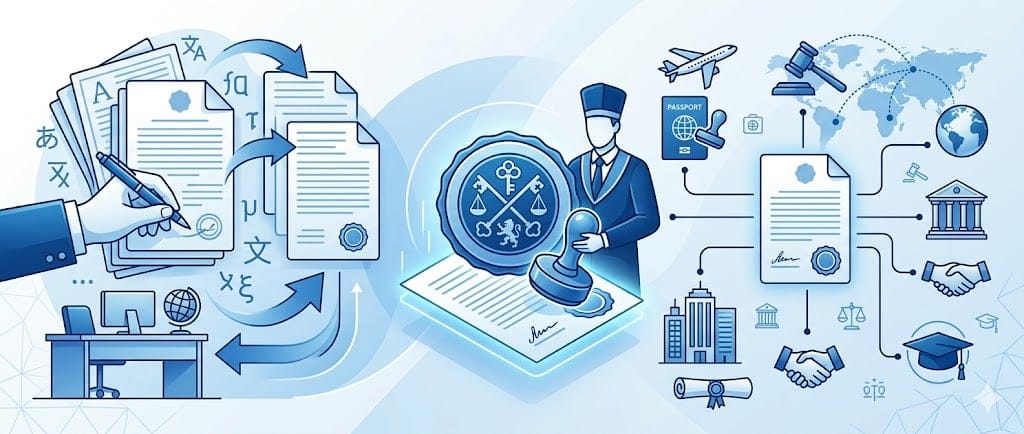
CATEGORY / Translation services
Notarized Translation Services: What They Are, When You Need One, and How to Get It Right
Every year, people submit translated documents to government agencies, courts, and institutions — only to have them rejected. Not because the translation was inaccurate. Because the wrong type of translation was submitted. This guide explains the difference between certified and notarized translation, when each is required, and how to order the right one the first time.
Read More 11 min read·19/06/2026
CATEGORY / Translation news
Is AI Translation Accurate Enough for Business? The 2026 Guide
AI translation in 2026 reaches approximately 96% accuracy across 133 languages. That number sounds reassuring until you do the arithmetic: on a 10,000-word document, 96% accuracy means roughly 400 words are potentially wrong. You cannot tell which 400 words without reading the whole document, and if you are reading the whole document anyway, you are already doing human review. The accuracy question is not whether AI translation is good. It is whether it is good enough for your specific document, your specific language pair, and the specific consequences of the errors it does produce. This guide answers that question by document type, with real data from peer-reviewed research and industry benchmarks.
Read More 19 min read·04/06/2026
CATEGORY / Translation services
AIPE vs. MTPE: What's the Difference and Which One Does Your Translation Project Need?
AIPE is showing up on purchase orders. Translators are listing it in their service coverage alongside MTPE, and clients are ordering it for Hebrew, Punjabi, and Tagalog projects without being entirely sure what they have bought. The confusion is understandable — AIPE (AI Post-Editing) and MTPE (Machine Translation Post-Editing) describe essentially the same workflow, but they arrive from different directions: MTPE is the industry's technical term, while AIPE is the buyer-facing label that has emerged as AI translation tools proliferated. Understanding what they share, where they differ, and how both compare to full human translation is the most practically useful thing a translation buyer can know in 2026. This guide answers every question buyers ask before, during, and after placing an order.
Read More 17 min read·04/06/2026
CATEGORY / Translation services
Why we pivoted from being just a "translation company" to being an "AI-enabled language solutions provider"
For almost 20 years, Tomedes built its reputation as a professional translation company. Then the market shifted — not away from professional translation, but away from the vocabulary buyers used to look for it. CEO Ofer Tirosh explains what the data showed, what the team decided, and what "AI-enabled" actually means when it is more than a marketing phrase.
Read More 7 min read·04/06/2026