Translator Hub

The Translator Hub

Practical insights for freelance translators and the businesses that work with them. Browse by category or start with what is most relevant to your work.

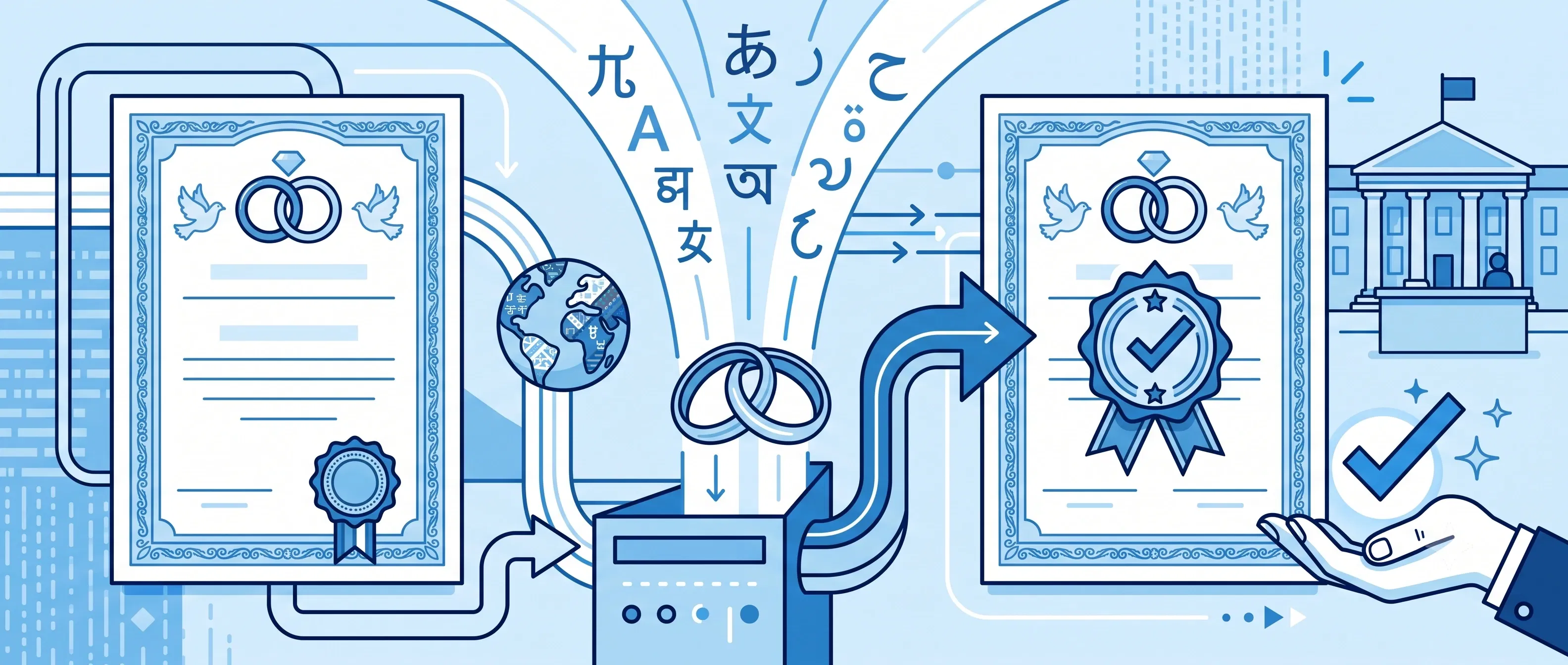
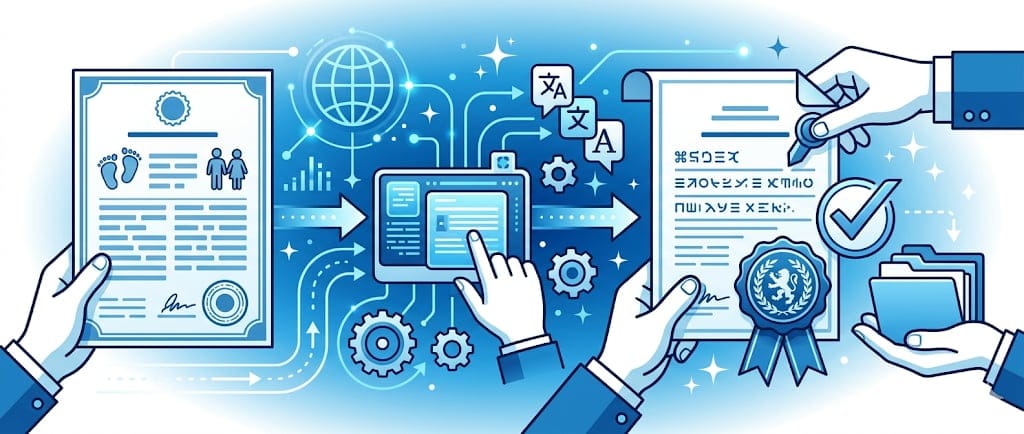
  • A notarized translation document with an official notary seal and signed certification statement on a desk alongside a foreign-language original

    CATEGORY / Translation services

    Notarized translation services: What they are and when you need one

    Every year, people submit translated documents to government agencies, courts, and institutions — only to have them rejected. Not because the translation was inaccurate. Because the wrong type of translation was submitted. This guide explains the difference between certified and notarized translation, when each is required, and how to order the right one the first time.

    Read More 11 min read·19/06/2026
  • Split comparison showing AI translation output with highlighted error segments alongside professionally reviewed translation with quality checkmark

    CATEGORY / Translation news

    Is AI translation accurate enough for business? The 2026 guide

    AI translation in 2026 reaches approximately 96% accuracy across 133 languages. That number sounds reassuring until you do the arithmetic: on a 10,000-word document, 96% accuracy means roughly 400 words are potentially wrong. You cannot tell which 400 words without reading the whole document, and if you are reading the whole document anyway, you are already doing human review. The accuracy question is not whether AI translation is good. It is whether it is good enough for your specific document, your specific language pair, and the specific consequences of the errors it does produce. This guide answers that question by document type, with real data from peer-reviewed research and industry benchmarks.

    Read More 19 min read·04/06/2026
  • Side-by-side comparison diagram showing AIPE and MTPE translation workflow stages with human review checkpoint

    CATEGORY / Translation services

    AIPE vs. MTPE: What's the difference and which one does your project need?

    AIPE is showing up on purchase orders. Translators are listing it in their service coverage alongside MTPE, and clients are ordering it for Hebrew, Punjabi, and Tagalog projects without being entirely sure what they have bought. The confusion is understandable — AIPE (AI Post-Editing) and MTPE (Machine Translation Post-Editing) describe essentially the same workflow, but they arrive from different directions: MTPE is the industry's technical term, while AIPE is the buyer-facing label that has emerged as AI translation tools proliferated. Understanding what they share, where they differ, and how both compare to full human translation is the most practically useful thing a translation buyer can know in 2026. This guide answers every question buyers ask before, during, and after placing an order.

    Read More 17 min read·04/06/2026
  • Ofer Tirosh, CEO of Tomedes, at his desk reviewing AI translation strategy documents — representing the company's 2026 pivot to AI-enabled language services provider

    CATEGORY / Translation services

    Why we pivoted from being just a "translation company" to being an "AI-enabled language solutions provider"

    For almost 20 years, Tomedes built its reputation as a professional translation company. Then the market shifted — not away from professional translation, but away from the vocabulary buyers used to look for it. CEO Ofer Tirosh explains what the data showed, what the team decided, and what "AI-enabled" actually means when it is more than a marketing phrase.

    Read More 7 min read·04/06/2026
  • Marketing ops lead reviewing AI translation output on screen with red correction marks and brand guidelines open beside it

    CATEGORY / Translation services

    Is Your AI Translation Workflow Costing You More Than It Saves?

    You did not set out to build a broken translation workflow. You adopted AI because it was fast, scalable, and significantly cheaper than sending everything to a human translator. For a while, it probably worked well enough. Then the complaints started. A regional team flagged that the brand voice sounded wrong. A client noticed a terminology inconsistency between two documents. Your content ops lead started spending three hours reviewing every batch before it could go live. The AI did not get worse. The gap between what AI produces and what your audience actually needs got more visible as you scaled. This article is for marketing and content ops leads who are already using AI translation, already running into these problems, and trying to decide what to do next.

    Read More 17 min read·28/05/2026
  • Map of Arabic dialect regions showing Maghrebi, Egyptian, Levantine, Gulf, and Mesopotamian zones with corresponding countries

    CATEGORY / Translation services

    Arabic Dialect Translation: Which Arabic Do You Actually Need?

    When a client orders "Arabic (Libyan) to English transcription and translation," they are not being pedantic. They have been burned before — they received a translation in Egyptian Arabic or Modern Standard Arabic, and the Libyan speaker on the receiving end could not fully understand it, or the content sounded foreign and unnatural. Arabic is not one language with regional accents. It is a family of varieties that differ in vocabulary, grammar, pronunciation, and cultural register to an extent that makes choosing the wrong one a genuine translation failure. This guide covers the five major Arabic dialect groups, when MSA is and is not the appropriate choice, and exactly how to brief a translation agency so you get the Arabic your audience actually speaks.

    Read More 16 min read·25/05/2026
  • Professional Spanish interpreter facilitating a community meeting between English-speaking NGO staff and Spanish-speaking clients

    CATEGORY / Translation services

    English to Spanish Interpretation for NGOs: Real Questions, Real Answers

    English to Spanish interpretation is the most requested language service in the US nonprofit sector, and one of the most misunderstood. Program managers who need an interpreter for a community meeting, a case intake, a legal consultation, or a multilingual conference are rarely language professionals. They have practical questions: What mode do I need? Can I use a volunteer? How much should I budget? How do I find someone qualified? This guide answers those questions directly, drawn from the real inquiries Tomedes receives from NGOs every week.

    Read More 17 min read·22/05/2026
  • Professional translator working on rare indigenous language documents at a desk with reference materials

    CATEGORY / Translation services

    Rare and Indigenous Language Translation: What to Expect on Timelines, Costs, and Quality

    Rare and indigenous language translation is among the most specialized work in the language services industry. The translator pool is small, machine translation tools offer little to no reliable support, and the linguistic structures of many indigenous languages have no equivalent in the major world languages buyers typically work with. When an ISO-certified agency sends a procurement inquiry for four North American indigenous languages on the same day, it is not a hypothetical scenario. It is a signal that demand for this work is real, growing, and consistently underserved by mainstream language service providers. This guide covers what makes rare and indigenous language translation genuinely different, what buyers should expect on timelines and rates, and what to verify when selecting a provider.

    Read More 17 min read·21/05/2026
  • A montage of symbolic translation artifacts (a manuscript page, a printing press, a multilingual dictionary, and a modern laptop) representing the history of translation from antiquity to the present day

    CATEGORY / Languages

    18 famous translators throughout history — and what made them great

    Throughout history, translators have done more than convert words from one language to another. They have shaped religions, sparked revolutions, built literatures, and transmitted knowledge across civilizations. The transmission of Greek philosophy to the Islamic world, the spread of Buddhism across East Asia, the Reformation, the European Renaissance, and the emergence of national literatures in dozens of languages — all of these transformative movements depended on translators whose names are far less well known than the ideas they carried.

    Read More 13 min read·21/05/2026
  • A comparison of open Bible translations (ESV, NASB, KJV, NIV, and LSB) arranged on a wooden table, representing the range of formal and dynamic equivalence approaches to biblical accuracy

    CATEGORY / Translation services

    The most accurate Bible translations: A complete comparison guide

    With over 900 English translations of the Bible, choosing the most accurate one is a question that scholars, pastors, students, and new readers wrestle with regularly. The challenge is that accuracy in Bible translation is not a single fixed target, it depends on what you believe a translation should preserve. A translation that faithfully reproduces the syntax of the Greek original may sacrifice readability for modern audiences. A translation optimized for clarity may make interpretive choices the original text leaves ambiguous. This guide covers the major English translations, their translation philosophy, textual basis, reading level, and the contexts for which each is best suited.

    Read More 13 min read·21/05/2026