 Add text to get the translation that 22 AI models agree on


The Translator Hub
Practical insights for freelance translators and the businesses that work with them. Browse by category or start with what is most relevant to your work.

CATEGORY / Translation services
What are the different types of interpretation?
A breakdown of the 7 main types of interpretation, what each one is actually used for, and how to choose the right one for your business.
Read More 7 min read·18/09/2026
CATEGORY / Translation services
AI translation accuracy: The content types that need multiple rounds of review
Some AI-drafted translations are approved in a single pass. Others go through several rounds of vendor work spread across days before they ship. We looked at a year of Tomedes' own AI-assisted (MTPE) projects, and the difference isn't random: it lines up closely with content type.
Read More 6 min read·14/09/2026
CATEGORY / Translation services
How much does on-site interpretation cost?
A practical guide to what on-site interpretation costs, when it's worth paying more for over a remote option, and how booking actually works.
Read More 5 min read·08/09/2026
CATEGORY / Translation services
Translation used to be One-to-Many. AI made it One-to-One.
Over the years we've gotten requests to translate the same document for different customers. Legal documents, mostly. Both parties to the same dispute, each sending us the same contract. This has probably happened to every language service provider at some point.
Read More 5 min read·07/09/2026
CATEGORY / Translation services
Top interpretation companies in the USA: 2026 guide
The U.S. interpretation market is consolidating fast. See the leading interpretation companies in the USA for 2026, updated with current ownership and service details.
Read More 13 min read·04/09/2026
CATEGORY / Translation services
How nonprofits cut costs with interpretation solutions
Learn how nonprofits can reduce interpretation costs without sacrificing quality for OPI, Zoom interpretation, and flexible NGO rates from Tomedes.
Read More 6 min read·04/09/2026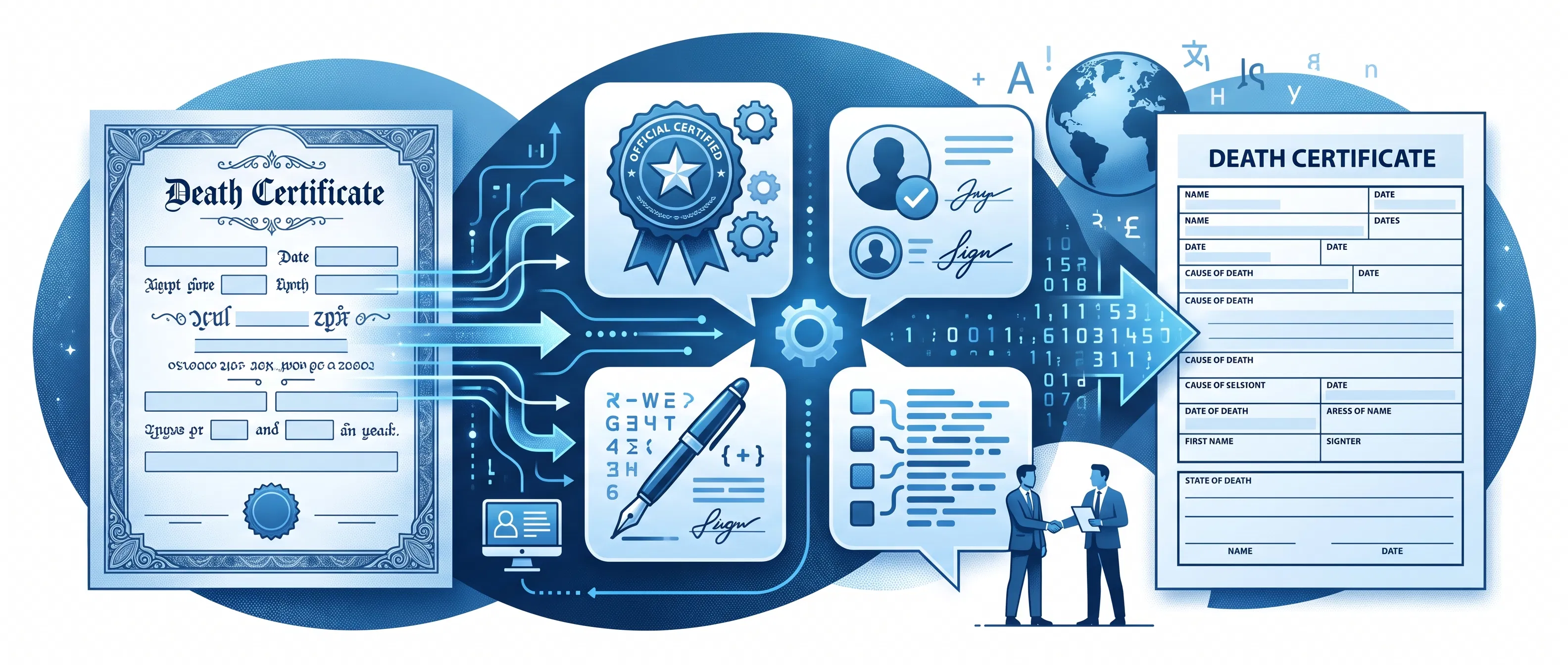
CATEGORY / Translation services
What you actually need to translate a death certificate
A death certificate is one page. What depends on it rarely is. An estate can't be settled, a life insurance claim can't be paid, and a probate case can't move forward until the document is not only translated, but translated in a way the receiving institution will actually accept.
Read More 6 min read·02/09/2026
CATEGORY / Translation services
Who's responsible when your AI translation gets it wrong?
I read a piece on X this week arguing there are only four ways to make money. Labor: you trade time for money. Capital: your money earns while you sleep. Arbitrage: you spot something priced wrong and close the gap. Insurance: you get paid to absorb risk other people can't sleep with. Everything else is a story on top.
Read More 5 min read·26/08/2026
CATEGORY / Translation services
1 in 4 translation projects hit a bottleneck you wouldn't expect
I wrote recently that DTP, desktop publishing, is becoming a bottleneck in translation work. Not always, but often enough to notice. I used decks and packaging as my example: the kind of client-facing document where layout is the first thing anyone sees, and where AI handles the resize reasonably well but not well enough for anything that goes out the door.
Read More 3 min read·18/08/2026
CATEGORY / Translation services
The translation option most small businesses don't know about
We pulled a year of orders and split them two ways: our biggest repeat clients, the law firms and agencies placing ten or more orders a year, against everyone smaller than that.
Read More 3 min read·13/08/2026