 Add text to get the translation that 22 AI models agree on


We rewrote our quote page, because "professional translation" needed to mean something again
I made a call this week to rewrite the Tomedes quote page. Not a copy refresh, a structural change to how we describe what we sell and to whom.
The trigger was a specific problem I noticed in a review of our quote flow. The page listed "330+ languages" as a primary value claim for our AI translation service. That number is accurate. It is also, in the current market, nearly meaningless as a differentiator. Every AI translation platform running large language models can assert global language coverage. Language count stopped being a signal of quality or capability the moment raw AI output became widely accessible. We were leading with a number that told buyers nothing useful about what they were actually purchasing.
So I asked the team to make two changes. First: call the professional translation option exactly what it is (professional human translation) not a speed tier, not a delivery option, not a product feature. Second: replace the language count claim with what actually differentiates it, which is the involvement of a native-speaking professional translator who is accountable for the output.
The AI translation option stays on the page. It is also real and useful — for the right content, at the right risk level. The change is not about removing AI translation. It is about being honest that these are two different products serving two different buyer needs, and that conflating them does not serve anyone.
What actually changed on the Tomedes quote page?
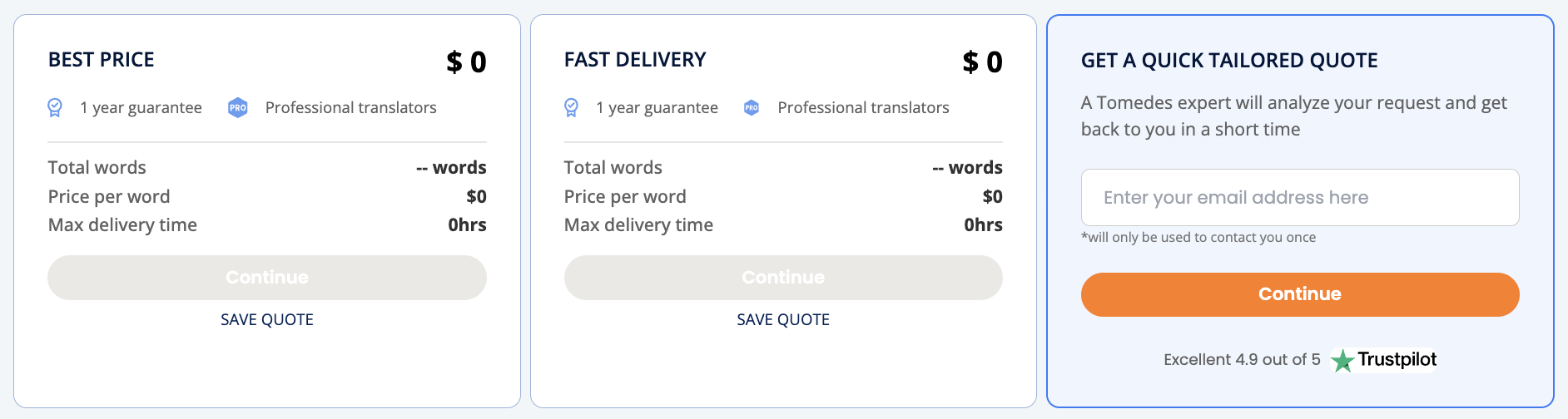
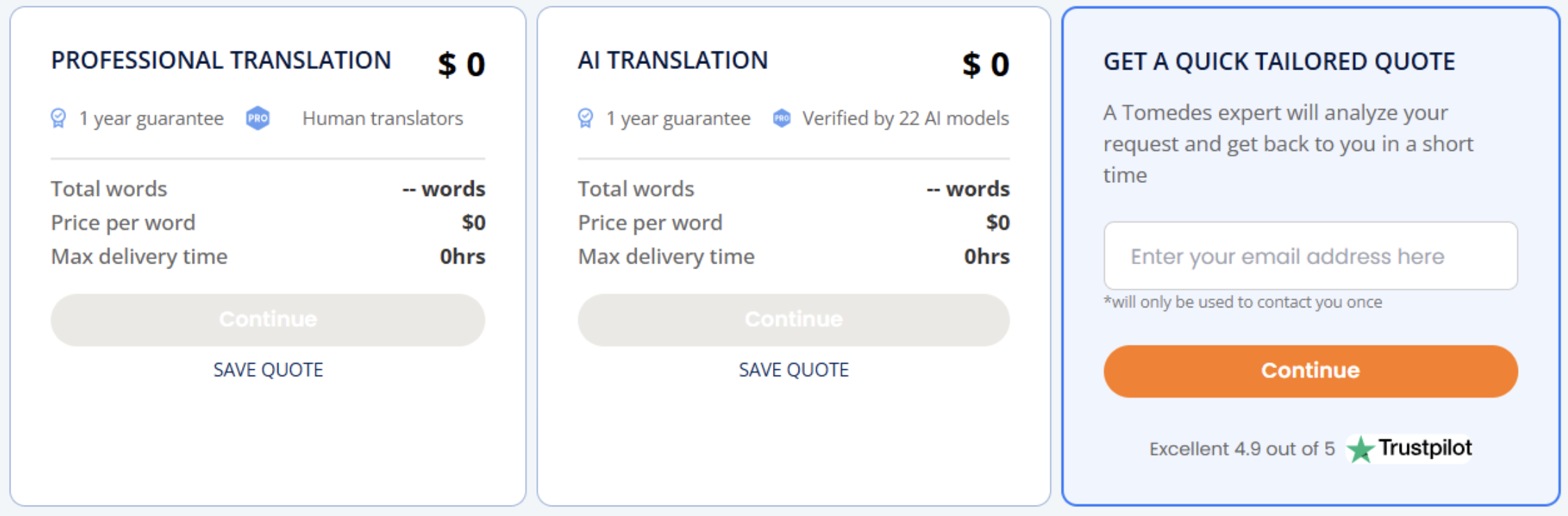
The quote page previously featured a "fast delivery" card as one of the service options alongside standard professional translation. That card is being replaced with a clearly labeled "AI translation" option, priced at $0.10 per word. The professional translation option is being relabeled to "professional human translation" (explicitly, not by implication).
BEFORE
AFTER
The page is being tested on a staging URL now. The team is tracking performance against previous data once it goes live, which is planned for next week.
This is a small change in terms of lines of code. It is a significant change in terms of what the page says about how Tomedes thinks about the work.
Why did the "supported languages" stop being a useful claim?
Until a few years ago, the number of languages a professional translation company supported was a genuine proxy for the depth of its translator network. Building coverage in 100 or 200 language pairs required years of recruitment, native-speaker vetting, and active quality management across a large professional network. It was hard to replicate quickly, which meant it carried real signal.
AI translation tools changed that. A platform running multiple large language models can assert coverage across hundreds of languages from the day it launches. The infrastructure cost of adding a language pair has dropped close to zero. As a result, language count shifted from being a differentiator to being a floor specification — something buyers assume before they start comparing providers on the things that actually matter.
The things that actually matter are: subject-matter expertise in the target domain, accountability when the translation is wrong, consistency across large volumes, and the ability to handle content types where raw AI output creates unacceptable risk. None of those can be communicated with a number. They require explanation. The quote page rewrite is the beginning of that explanation.
What is the real difference between professional human translation and AI translation?
Professional human translation is the work of a native-speaking translator with subject-matter expertise, who reads the source text, makes interpretive decisions about meaning and register, and produces a target text that communicates the same intent to a reader who does not share the source language. Tomedes translators are vetted for native-language competency and matched to projects by domain — a legal translator for legal content, a medical translator for clinical documentation, a marketing specialist for brand copy.
AI translation is the statistical prediction of the most probable target-language equivalent of a source text, based on patterns in training data. It is fast, increasingly accurate for high-resource language pairs and common subject matter, and genuinely useful for content where speed and cost outweigh the risk of subtle errors.
The meaningful difference is interpretive judgment and accountability. When a contract is mistranslated, a professional translator can be named, credentialed, and held responsible. When an AI model predicts incorrectly, there is no equivalent accountability structure. Tomedes' 1-Year Quality Guarantee exists precisely because a named human professional produced the work and can be held to it.
Who should use professional human translation versus AI translation?
This is the question the old quote page did not answer clearly, and the new one is designed to address directly.
Professional human translation is the appropriate choice when the content carries real consequences if the translation is wrong. Legal contracts, medical documentation, regulatory filings, certified documents, financial disclosures, and brand copy in new markets all fall into this category. Nimdzi research consistently shows that 9 in 10 international users will ignore a product that is not available in their native language — which means translation errors in customer-facing content are not minor inconveniences, they are conversion and trust problems.
AI translation is appropriate for internal communications, high-volume content with lower error risk, first-pass drafts that will be reviewed by a human, and situations where speed and cost are the primary constraints. Tomedes offers AI translation with human post-editing (which brings AI output up to a standard equivalent to professional translation for appropriate content types) as well as raw AI translation for content where that level of review is not required.
The honest version of this decision framework is: it depends on what happens if the translation contains an error. The higher the consequence, the stronger the case for professional human translation. The quote page now makes that decision framework visible at the point where buyers are making the choice.
What does the 1-year quality guarantee actually mean for buyers?
The 1-Year Quality Guarantee means that if an error is identified in a Tomedes professional translation within 12 months of delivery, Tomedes will correct it at no additional cost. Full stop.
That guarantee is only possible because a named professional translator is accountable for every delivery. It is not a marketing statement, it is a structural commitment that requires a human in the loop. No AI translation platform offers an equivalent, because no AI translation platform has a named professional whose work can be revisited and corrected under a guarantee period.
For buyers evaluating professional translation companies, the quality guarantee is one of the fastest ways to assess whether a provider's quality claims are real commitments or positioning language. A guarantee that is backed by nothing (no named translator, no ISO-certified process, no accountability structure) is not worth the page it is written on.
Tomedes holds certification under ISO 17100:2015 for professional translation, ISO 18587:2017 for machine translation post-editing, and ISO 9001:2015 for quality management. Those certifications mean an external auditor has verified that our quality processes are documented, repeatable, and applied. They are the operational foundation the guarantee sits on.
How does Tomedes decide who translates your document?
Assignment is based on three criteria: native-language competency in the target language, verified subject-matter expertise in the relevant field, and performance history within the Tomedes network of over 20,000 professional translators.
A legal translation project is assigned to a translator with legal training and documented experience in legal translation for the relevant jurisdiction, not simply a fluent speaker of the target language. A medical device manual goes to a translator with clinical or biomedical expertise. A brand localization project goes to someone with demonstrated marketing translation experience in the target culture.
This matching process is part of the ISO 17100:2015 requirements and is documented in our quality management system. It is also the reason the "270+ languages" claim, on its own, never told the full story. Coverage is the floor. Expertise is the ceiling. The new quote page is designed to communicate both.
Why are we now explicitly labeling services as "professional human translation" and "AI translation"?
Because buyers deserve to know what they are purchasing. Professional human translation and AI translation are different products with different quality profiles, different accountability structures, and different appropriate use cases. The previous quote page did not make that distinction clearly enough. The new page does — with separate service options, separate pricing, and separate descriptions that reflect what each service actually involves.
How does the quote page change affect our current clients?
Existing clients are not affected operationally. The change is to how services are labeled and described during the quoting process — it does not alter delivery workflows, pricing structures for existing contracts, or quality standards. The intent is to give new buyers a clearer picture of what they are choosing between, and to give returning buyers language that more accurately reflects what they have already been receiving.
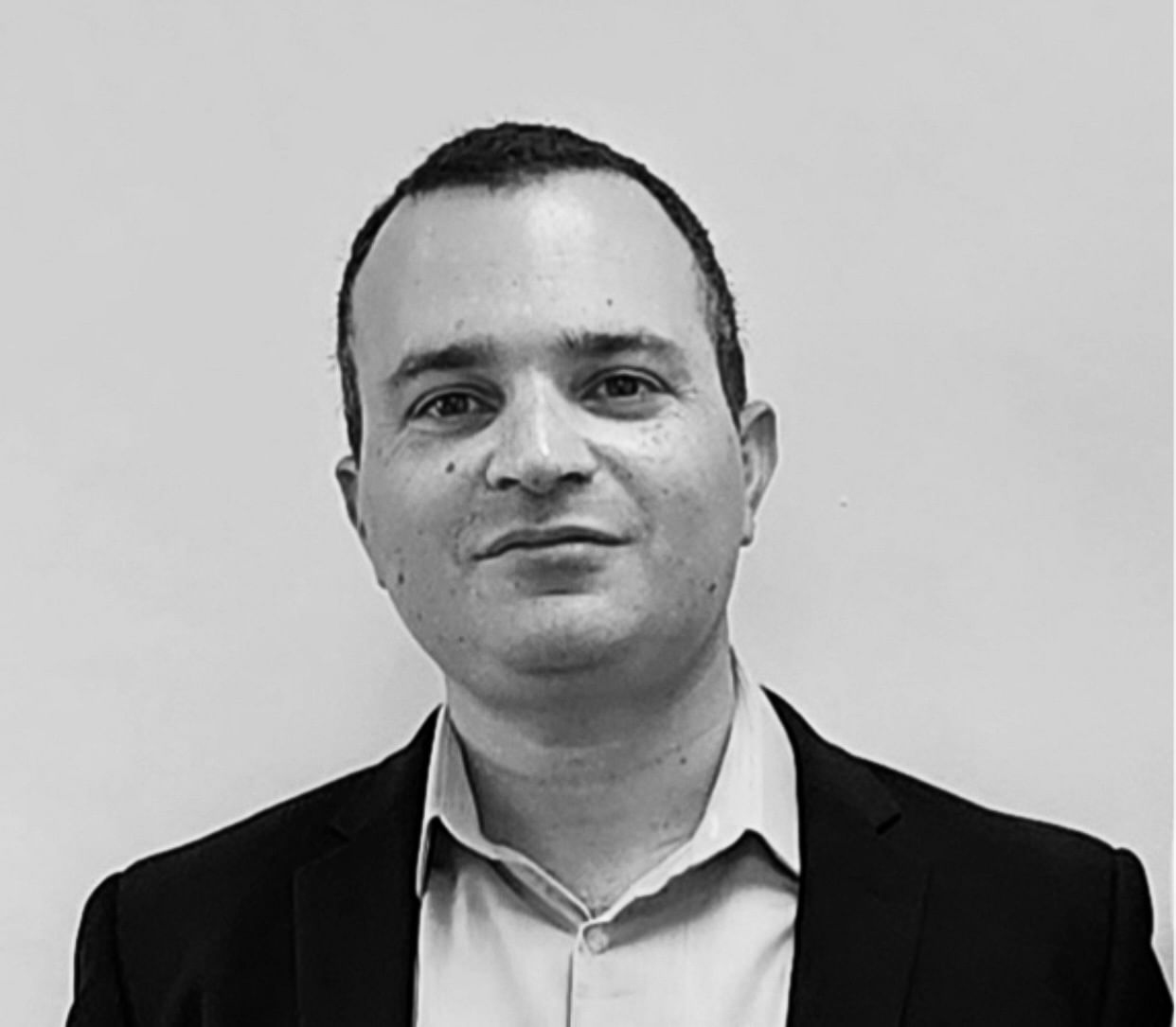
Written by Ofer Tirosh
Connect on LinkedInOfer founded Tomedes in 2007 and now leads the company's push to combine two decades of human translation expertise with AI. He writes about where the language industry is actually heading and the shifts nobody's ready for, the bets that paid off, and the ones that didn't.
Share:

Post your Comment