 Add text to get the translation that 22 AI models agree on


AIPE vs. MTPE: What's the difference and which one does your project need?
AIPE is showing up on purchase orders. Translators are listing it in their service coverage alongside MTPE, and clients are ordering it for Hebrew, Punjabi, and Tagalog projects without being entirely sure what they have bought.
The confusion is understandable. AIPE (AI Post-Editing) and MTPE (Machine Translation Post-Editing) describe essentially the same workflow, but they arrive from different directions. MTPE is the industry's technical term, governed by an international ISO standard and used in agency quotes for the past decade. AIPE is the buyer-facing label that emerged as AI translation tools proliferated — showing up on invoices, POs, and service menus as the technology became more visible to people who are not translation professionals.
According to Nimdzi's 2025 survey, MTPE adoption among language service providers jumped from 26% in 2022 to 46% in 2024 — a 75% leap in just two years. Most of the buyers driving that growth are not linguists. They are procurement leads, localization managers, and content ops teams who encounter "AIPE" and "MTPE" on the same invoice and reasonably want to know whether they are buying the same thing, something different, and whether human translation is still the better option for their content.
This guide answers every question those buyers ask — directly, with real cost data, real use cases, and a clear framework for choosing the right tier every time.
What is AIPE and why is it appearing on translation purchase orders?
AIPE stands for AI Post-Editing. It describes a workflow in which an AI system (typically a large language model or a neural machine translation engine) produces a first-draft translation, and a qualified human linguist then reviews, corrects, and refines that output before it is delivered.
The term itself is relatively new in buyer-facing contexts. AIPE focuses on post-editing machine translations by enhancing human review processes through error correction, sentence restructuring, and overall flow and linguistic style improvement. The core mechanism (AI draft plus human review) is not new at all. What is new is the label appearing on the client side of the transaction.
Why is it appearing on POs now? Two reasons.
First, as AI translation tools became mainstream consumer products (DeepL, ChatGPT, Google Translate), buyers began encountering AI-generated draft translations and recognizing that those drafts needed human improvement before they could be published. The label "AI Post-Editing" emerged organically to describe what that improvement looked like as a billable service.
Second, enterprise buyers began specifying AI-assisted workflows on their purchase orders to distinguish them from full human translation and to signal their expectation of a lower price point. When a client writes "AIPE" on a PO for a Hebrew or Punjabi project, they are typically indicating that they expect a hybrid workflow (AI for volume, human for quality) rather than a translator working from scratch.
The practical consequence: translators and agencies receive orders labelled AIPE that they have been executing as MTPE for years. The workflow is the same. The invoice label has changed to match the buyer's vocabulary.
What is MTPE and where does the term come from?
MTPE stands for Machine Translation Post-Editing. It has been the professional translation industry's standard term for the hybrid AI-plus-human workflow since neural machine translation became commercially viable in the mid-2010s.
The workflow is exactly as the name describes: a machine translation engine produces a raw output, and a human post-editor reviews that output and corrects it to meet the required quality standard. The post-editor may make minor corrections (light post-editing) or comprehensive revisions (full post-editing), depending on the content type, the quality of the MT output, and the quality standard the project requires.
MTPE is not a new concept introduced by generative AI. It predates GPT and large language models entirely. The first formal quality standard governing MTPE (ISO 18587:2017, Translation Services: Post-editing of Machine Translation Output) was published in 2017 and defines both full post-editing (output equivalent in quality to human translation) and light post-editing (output fit for purpose but not publication-polished).
Tomedes holds ISO 18587:2017 certification, the only international standard that specifically governs MTPE quality. This is not a general quality management credential. It is the standard written specifically for this workflow, and holding it means Tomedes' MTPE processes have been independently audited against its requirements.
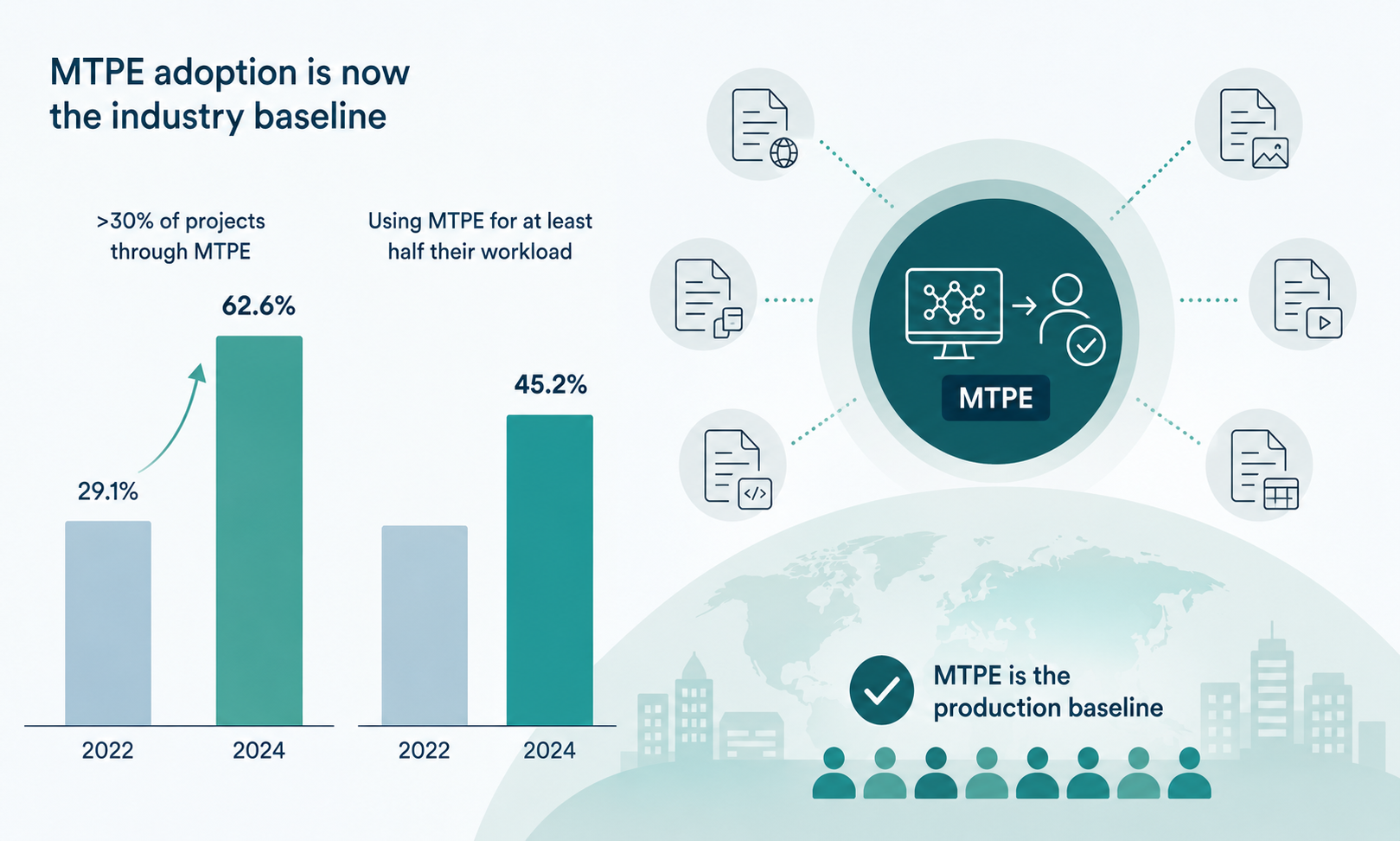
By 2024, 62.6% of LSPs were running more than 30% of their projects through MTPE, up from 29.1% in 2022, and 45.2% were using MTPE for at least half their workload. MTPE has moved from an experimental workflow option to the production baseline across most of the language services industry. Most buyers ordering translation today are receiving MTPE whether or not that label appears on their invoice.
Are AIPE and MTPE the same thing?
In practice, yes. AIPE and MTPE describe the same workflow from two different vantage points.
MTPE is the industry's technical descriptor: machine translation output reviewed and corrected by a human post-editor. AIPE is the buyer-facing descriptor that emphasizes the AI component of that same process. When a client writes "AIPE" on a purchase order, and an agency delivers "MTPE" on an invoice, they are typically describing identical production steps.
The one nuance worth understanding: AIPE as a term has sometimes been used to describe workflows where the post-editing function itself is performed by an AI model rather than a human, what the research literature calls Automatic Post-Editing (APE). APE systems learn from human post-edit data and apply it to machine translation output to improve quality automatically. This is a distinct and more automated process than human-reviewed MTPE, and it is where the label "AIPE" can occasionally create ambiguity.
The key question to ask any provider using the AIPE label: is the post-editing performed by a human linguist, or by an automated system? If the answer is a human (which it should be for any content going to a customer, a partner, or a regulated context), then AIPE and MTPE are functionally interchangeable. If the answer is automated, you are looking at a fully automated workflow with no human quality gate, which carries materially different quality implications and is not appropriate for most commercial content.
When Tomedes receives an AIPE order, the post-editing is performed by a qualified human linguist. The AI produces the draft. The human owns the output.
How does AIPE or MTPE compare to full human translation?
The three tiers of professional translation (full human translation, MTPE or AIPE, and raw AI output) each serve different purposes. They are not interchangeable, and selecting the wrong tier for a content type is the most common and most costly mistake buyers make.
| Full Human Translation | MTPE or AIPE | Raw AI Output | |
|---|---|---|---|
| Starting point | Translator works from source | AI draft, human corrects | AI output only |
| ISO standard | ISO 17100:2015 | ISO 18587:2017 | None |
| Quality ceiling | Highest | High (full PE) or functional (light PE) | Unpredictable |
| Speed | Standard | 30–50% faster | Immediate |
| Cost | $0.15–$0.30 per word | $0.05–$0.15 per word | Near zero |
| Right for | Legal, medical, marketing, certified translation | Technical docs, UI strings, high-volume content | Internal gisting, research, real-time monitoring |
| Human accountability | Full | Full (with certified provider) | None |
The cost and speed advantages of MTPE are real and significant for appropriate content. A typical SaaS application with 50,000 words localized into 8 languages costs approximately $36,000 for human translation or $23,400 for MTPE or AIPE — a saving of $12,600 on a single project. Across a year of ongoing localization, that delta is substantial.
The critical caveat: productivity typically rises 30–50% and costs drop 25–75% versus pure human translation, but only for content types where MT performs reliably. For content where MT performs poorly (complex legal language, culturally specific marketing copy, medical patient instructions, low-resource language pairs), the post-editing effort required narrows or eliminates the cost advantage, and the quality ceiling of even excellent post-editing may not match what a domain-specialist human translator produces from scratch.
The tier is not a budget decision. It is a content decision. The budget follows from choosing the right tier for the content, not the other way around.
What does the workflow actually look like at each tier?
Understanding the production steps at each tier clarifies what you are buying and what quality standard applies.
Full human translation (ISO 17100:2015)
A qualified translator with domain expertise in the content type translates the source text from scratch. A second qualified translator reviews the output. The project manager delivers the reviewed translation. Every segment has been read, rendered, and checked by two independent professionals. This is the workflow required for certified translation, legal documents, medical patient-facing content, and any content where accuracy and professional accountability are non-negotiable.
Full MTPE or AIPE (ISO 18587:2017, full post-editing)
An MT engine or AI model generates a first-draft translation of the full document. A qualified human post-editor reviews every segment, correcting errors in accuracy, terminology, fluency, and style. The output meets the same quality standard as human translation for appropriate content types. This workflow is appropriate for technical documentation, software UI, e-commerce catalogs, knowledge base articles, and high-volume structured content. Tomedes uses SMART (its 22-model consensus technology) to generate a stronger starting draft before human post-editors begin, which means less correction effort and more consistent terminology from document to document.
Light MTPE or AIPE (ISO 18587:2017, light post-editing)
An MT engine generates a draft. A human post-editor corrects critical errors (mistranslations, factual inaccuracies, missing content) but does not revise for stylistic polish or complete brand voice alignment. The output is fit for purpose but not publication-polished. This tier is appropriate for internal communications, operational documents used by staff rather than customers, and any content where comprehension accuracy matters but aesthetic quality is secondary.
Raw AI output (no human review)
The MT engine or AI model output is used as delivered, without human review. This tier is appropriate only for internal gisting, preliminary research on foreign-language documents, and real-time communication monitoring at scale — contexts where the output is never published, shared with customers, or used in any regulated process.
The tier decision is made at intake, not after the AI runs. A project manager who understands the content type and intended use makes the routing decision, loads the appropriate glossary and style guide, and assigns the post-editor with matching domain expertise. Changing the tier after the AI has run is possible but inefficient, like deciding which level of renovation a house needs after the contractor has already started.
How much does each tier cost, and what does the math look like at scale?
Translation pricing is confusing partly because different providers present rates in different ways (per word, per hour, per project) and partly because MTPE and AIPE rates vary more than human translation rates depending on the quality of the AI draft and the content type.
Current market rate ranges (2026):
According to Tomedes' translation rates guide:
- Full human translation: $0.15–$0.30 per word
- Full MTPE or AIPE: $0.05–$0.15 per word
- Light MTPE or AIPE: $0.03–$0.08 per word
- Raw AI output: Near zero (tool cost only, no human labor)
These ranges are wide because the actual cost depends on language pair, content domain, volume, and the quality of the MT output. A high-resource language pair like English to Spanish with clean, structured source text will come in toward the lower end of the MTPE range. A lower-resource pair like English to Tagalog with complex or ambiguous source content will come in toward the higher end, because the post-editor has more to correct.
For a SaaS application with 50,000 words in 8 languages, the cost difference between full human translation ($36,000) and MTPE/AIPE ($23,400) is approximately $12,600. Across a year of quarterly product updates in 8 languages, that differential compounds significantly.
The calculation buyers often miss: MTPE rates reflect the post-editor's labor. When the AI draft quality is low (because the language pair is challenging, the content is highly technical with proprietary terminology, or the source text is ambiguous), the post-editor spends more time correcting, and the effective cost rises toward the human translation range. A provider who quotes a flat MTPE rate without assessing the likely MT quality on your specific content is quoting a number that may not reflect what the project actually costs to execute well.
The right question at intake is not "what is your MTPE rate?" It is "what quality of MT output can you produce for this content and language pair, and how does that affect the post-editing effort and the final price?"
Which content types are right for AIPE or MTPE, and which require human translation?
Content type is the primary determinant of which tier is appropriate. The following framework is drawn from real project experience across industries.
Full human translation is required for:
Legal documents including contracts, court filings, patents, terms and conditions, and certified translations required by USCIS, courts, or academic institutions. Medical patient-facing content including informed consent forms, discharge instructions, pharmaceutical labeling, and clinical trial documentation where errors carry patient safety implications. Marketing and brand content including campaign copy, taglines, and any content where cultural resonance and brand voice are strategically significant. Certified translation of any kind, the certification attesting to accuracy requires a human professional's signature and cannot be attached to AI-generated output.
MTPE or AIPE is appropriate for:
Technical documentation including user manuals, product specifications, API documentation, and knowledge base articles. Software localization including UI strings, error messages, and system notifications with structured, repetitive content. E-commerce product descriptions for standard product specifications, dimensions, materials, and features. E-learning modules with instructional, structured content and moderate terminology density. Internal operational documents, compliance updates, and staff-facing communications where the audience is internal and the publication standard is functional rather than polished.
The language pair matters. MTPE rates generally run $0.05 to $0.15 per word, roughly half the cost of full human translation — but the tradeoff is quality ceiling: machine output reviewed by a human works well for high-volume, lower-stakes content, but is not appropriate for legal, medical, or creative work where accuracy and nuance are critical. For lower-resource language pairs including many indigenous languages, some African languages, and some Central Asian pairs, the MT quality baseline is low enough that full post-editing effort approaches the cost of human translation, and the quality ceiling may still be lower.
The hybrid approach most professional localization teams use: human translation for customer-facing marketing and legal content, MTPE for internal documentation and help content, and a final LQA (linguistic quality assurance) pass as a quality gate before each release. This distributes budget toward the content where quality failure carries the highest cost.
What is ISO 18587:2017 and why does it matter when choosing a provider?
ISO 18587:2017 is the international standard for the translation service of post-editing of machine translation output. Published by the International Organization for Standardization, it defines the requirements for the full MTPE process — including the competencies required of post-editors, the quality standard that full post-editing must achieve, and the process requirements for light post-editing.
Holding ISO 18587:2017 certification means a translation provider's MTPE workflow has been independently audited against those requirements. It is not a general quality credential. It is the specific standard written for this specific workflow.
This matters for buyers for two reasons.
First, it provides a verifiable quality benchmark. When a provider says their MTPE output meets "professional quality standards," that phrase is meaningless without a standard to anchor it. ISO 18587:2017 defines what full post-editing quality actually means (output equivalent in accuracy and reliability to human translation) and a certified provider is accountable to that definition.
Second, it provides documentation for regulated industries. Healthcare organizations, legal service providers, and government agencies that need to demonstrate the quality basis of their translated communications can cite a provider's ISO 18587:2017 certification in their compliance documentation. A provider without the certification cannot supply that documentation.
Tomedes holds both ISO 18587:2017 (MTPE quality) and ISO 17100:2015 (human translation quality), meaning the same quality governance framework applies to both tiers. A project routed to MTPE is not held to a lower standard of process oversight than a project routed to human translation. The workflow differs. The accountability framework does not.
What should you ask a provider before ordering AIPE or MTPE?
The most common source of disappointment with MTPE or AIPE is a mismatch between what the buyer expected and what the workflow actually delivers. These questions, asked at intake, close that gap.
Is the post-editing performed by a human or by an automated system? If the answer is automated, you are ordering raw AI with a correction layer — not human-reviewed MTPE. For any published content, customer-facing content, or regulated content, human post-editing is required.
What MT engine or system generates the starting draft? A provider using a single general-purpose MT engine produces a different starting baseline than a provider using a consensus approach across multiple models. The starting draft quality directly affects how much the post-editor can improve in a given amount of time, and therefore the quality ceiling of the final output.
Do you hold ISO 18587:2017 certification? If yes, ask to see the certificate. If no, ask what quality standard governs their MTPE workflow and how compliance with that standard is audited. A provider without a verifiable quality standard for MTPE is operating on internal guidelines that you cannot independently assess.
How is terminology managed? For any content with brand-specific terms, technical vocabulary, or legally required phrasing, the provider should be able to tell you how an approved termbase is loaded into the workflow before translation begins, and how adherence is audited across the full content set.
What is the quality guarantee? A provider confident in their MTPE output should back it with a measurable guarantee. Tomedes backs every project (including MTPE and AIPE orders) with a 1-Year Quality Guarantee. If an error attributable to the workflow is found within a year of delivery, Tomedes corrects it at no additional cost.
Can you match the post-editor to my content domain? A post-editor with legal expertise performs differently on a contract than a generalist with strong language skills but no legal background. For any domain-specific content, the post-editor's domain knowledge is as important as their language proficiency.
Request a quote for Tomedes MTPE or AIPE services and describe your content type, language pair, and volume. A project manager will confirm which tier is appropriate for your specific project and explain how the workflow handles your quality requirements.
FAQs
Q: Is AIPE the same as MTPE?
A: In most commercial contexts, yes. AIPE (AI Post-Editing) and MTPE (Machine Translation Post-Editing) describe the same workflow: an AI or machine translation system produces a first draft, and a qualified human linguist reviews, corrects, and refines it. MTPE is the industry's established technical term, governed by ISO 18587:2017. AIPE is the buyer-facing label that has emerged as AI translation tools became more widely visible to non-specialist purchasers. When a client writes AIPE on a purchase order and an agency delivers MTPE on an invoice, they are typically describing identical production steps. The one exception: AIPE is sometimes used to describe workflows where a second AI model (rather than a human) performs the post-editing. Always confirm with your provider whether the post-editing is human or automated.
Q: When should I choose MTPE over human translation?
A: Choose MTPE when the content is high-volume, structurally repetitive, and does not require original creative judgment or legally defensible human accountability. Technical documentation, software UI strings, e-commerce product catalogs, knowledge base articles, and internal operational communications are all good candidates. Choose full human translation when the content is legal, medical patient-facing, brand-sensitive, or requires certified translation for official use. Productivity typically rises 30–50% and costs drop 25–75% versus pure human translation when MTPE is applied to appropriate content. Applied to inappropriate content, the efficiency gains disappear and the quality ceiling drops.
Q: What is ISO 18587:2017 and does my translation provider need it?
A: ISO 18587:2017 is the international standard for machine translation post-editing. It defines the competency requirements for post-editors, the quality standard that full post-editing must achieve, and the process requirements for light post-editing. Not every provider needs to hold this certification for every project — but for regulated industries, enterprise procurement, or any context where you need to document the quality basis of your translated content, a provider holding ISO 18587:2017 can provide that documentation. Tomedes holds ISO 18587:2017 alongside ISO 17100:2015, applying the same process governance to MTPE projects that it applies to full human translation projects.
Q: How much cheaper is MTPE than human translation?
A: According to Tomedes' translation rates guide, full human translation typically runs $0.15–$0.30 per word, while full MTPE or AIPE runs $0.05–$0.15 per word. Light MTPE or AIPE runs $0.03–$0.08 per word. For a SaaS application with 50,000 words localized into 8 languages, that translates to approximately $36,000 for human translation versus $23,400 for MTPE or AIPE. The actual saving depends on language pair, content type, and the quality of the MT draft. For lower-resource language pairs or complex technical domains, post-editing effort increases and the cost advantage narrows.
Q: Can I order AIPE for Hebrew, Punjabi, or Tagalog?
A: Yes — Tomedes provides MTPE and AIPE services for Hebrew, Punjabi, Tagalog, and hundreds of other language pairs. The practical consideration is that MT quality varies by language pair. Hebrew and Tagalog are well-supported by modern MT engines. Punjabi (Gurmukhi script) has lower MT coverage than many European languages, which means post-editing effort may be higher and the cost advantage over human translation may be narrower. When ordering AIPE for any less common language pair, confirm with your project manager that the MT engine being used has been evaluated for that specific pair and content type before the workflow is selected.
Q: What does Tomedes use to generate the AI draft in MTPE projects?
A: Tomedes uses SMART (its proprietary technology that runs content through 22 AI models simultaneously and selects the consensus translation sentence by sentence) as the basis for the AI draft in MTPE projects. The consensus approach produces a more consistent and reliable starting draft than a single MT engine, which means post-editors spend more time on cultural and domain judgment and less time correcting fundamental translation errors. Every MTPE project is managed by a dedicated project manager who loads the client's style guide and approved termbase before translation begins, and every deliverable is backed by Tomedes' 1-Year Quality Guarantee.
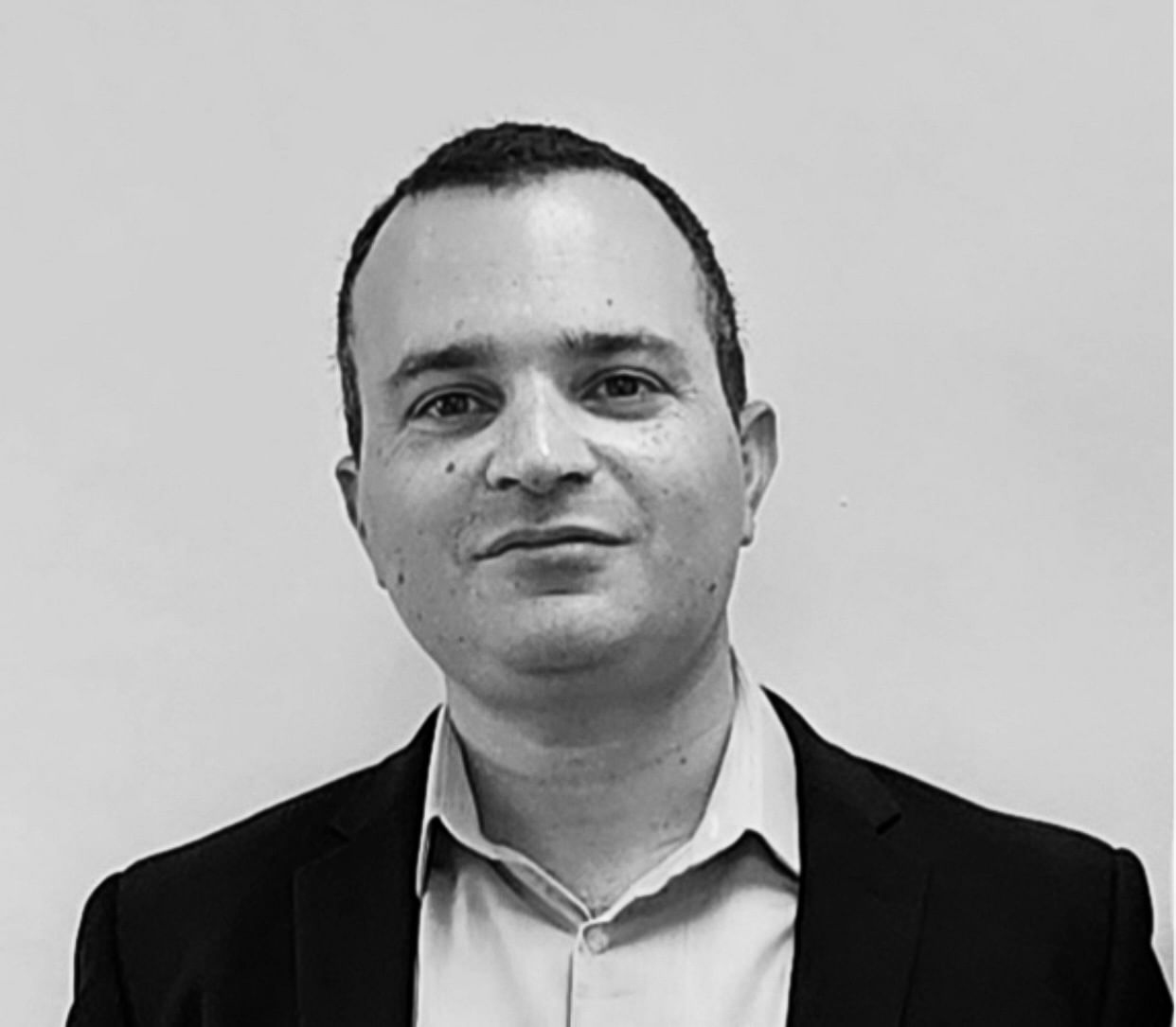
Written by Ofer Tirosh
Connect on LinkedInOfer founded Tomedes in 2007 and now leads the company's push to combine two decades of human translation expertise with AI. He writes about where the language industry is actually heading and the shifts nobody's ready for, the bets that paid off, and the ones that didn't.
Share:

Post your Comment