 Add text to get the translation that 22 AI models agree on


What AI translation costs: The decision behind Tomedes' $0.01/word rate
The translation industry has a transparency problem. Companies have been quietly adding "AI options" to their service menus without saying clearly what buyers are actually getting (whether there is a human in the loop, what the quality floor is, or why the price is what it is). Most of the time, the AI offering looks like a discounted version of the human offering, with the discount doing all the communicating about quality rather than any honest description of the product.
We decided to do it differently. Just recently, Tomedes restructured how we present and price our two translation tracks. We named them explicitly: Human Translation and AI Translation. We set AI translation at a flat $0.01 per word, regardless of language pair. And we launched without a human proofreading layer in the default workflow (deliberately) to see what the market actually does before we build assumptions into the product.
This post is about the reasoning behind those decisions. Not a press release about what we built. The actual reasoning, including the part where I will tell you what we have not fully settled yet.
What we actually decided
The starting point was the quote page. For a long time, our service options were labeled in ways that were vague enough to mean almost anything. The distinction between what we call human translation and what we were increasingly offering as AI-assisted translation was not clear from the outside. It was not always clear on the inside either.
William Mamane, our CMO, and I made a decision that felt simple but had a lot underneath it: name the two tracks explicitly. "Human Translation" and "AI Translation" — not "Standard" and "Premium," not "Professional" and "Express," not anything that obscures what is actually happening to the document.
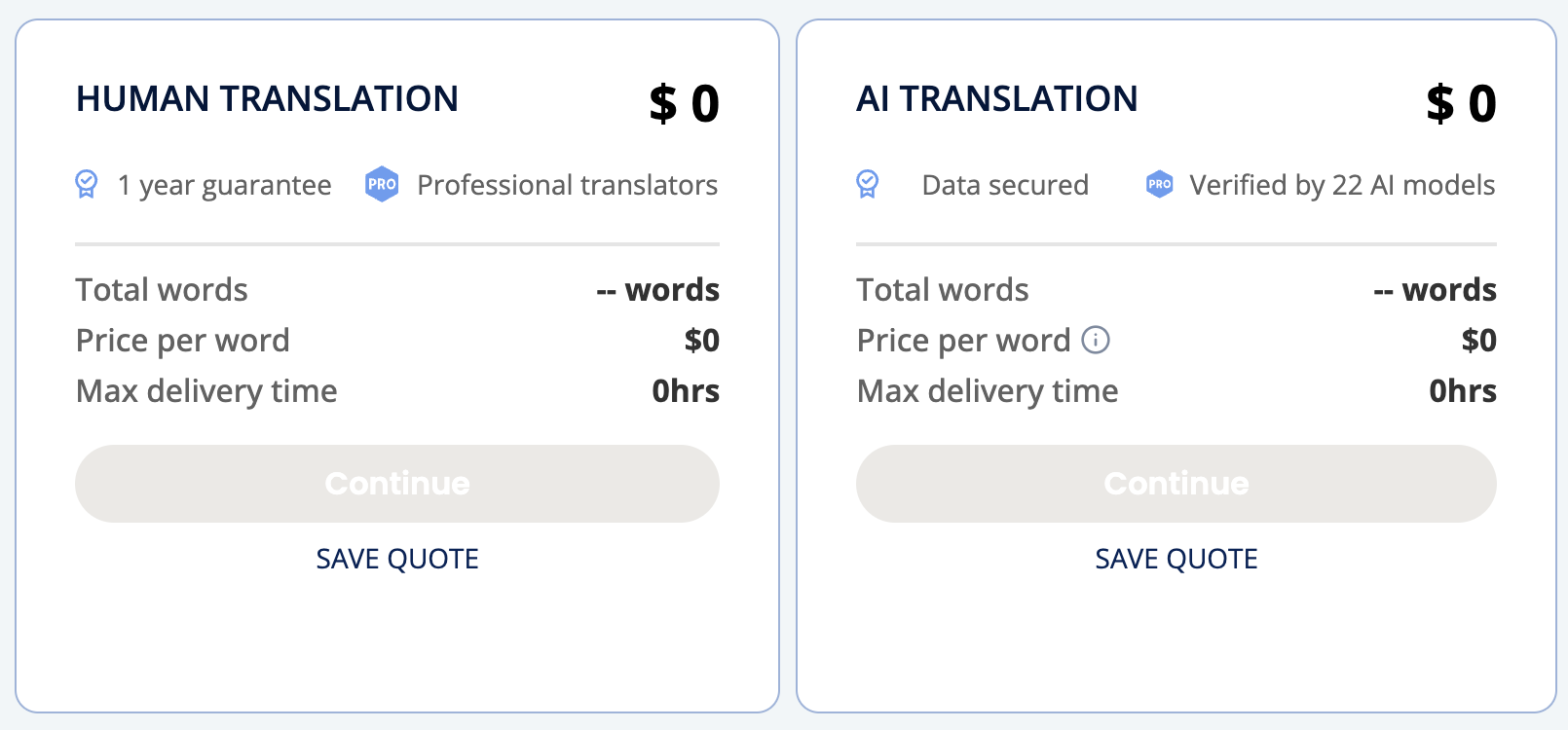
That naming decision forced every other question. If we are going to call it AI Translation, what exactly is it? What does it include? What does it not include? What do we guarantee? What does it cost? We also added "Verified professional translators" as a stated value proposition for the human track — because if you are going to draw a line, you need to say what is on the other side of it. The line is the product.
Why flat pricing makes sense for AI translation
The translation industry typically prices by language pair. English to Spanish costs less than English to Japanese, which costs less than English to Arabic. The logic is real: some pairs have larger translator pools, faster workflow throughput, and lower per-word production costs.
AI translation does not work that way — or at least, it does not have to. The underlying model cost does not vary meaningfully between language pairs at the volume levels most clients work at. So we asked: why price it differently?
We set AI translation at a flat $0.01 per word, regardless of language pair. That is an AI translation pricing philosophy choice, not just a rate card entry. It says: the price you see is the price. What you paid to translate your English-to-Spanish brochure is the same rate you would pay to translate the same content into Mandarin, Arabic, or Polish. No surprises, no tiers, no language-pair-based ambiguity in the quote.
I want to be clear about what that simplicity costs us. Flat pricing means we are not fully optimizing margin on every language pair. That is a trade we made deliberately. The bet is that clarity and predictability are worth more to buyers (especially buyers translating into multiple languages) than per-pair pricing optimization is worth to us. Translation pricing is one of the most common sources of friction before a project even starts. Removing that friction has value.
For buyers researching professional human translation rates, Tomedes' guide to translation rates in 2026 covers the full range of per-word pricing by language pair, content type, and quality level. The AI track is a different product (and a deliberately different price point) by design.
Why we launched without human proofreading first
This is the decision that requires the most explanation, because it is the easiest to misread.
When we launched the AI translation track, we launched it without post-editing machine translation in the default workflow. No human reviewer checking the output before delivery. That was not an accident or a cost-cutting shortcut. It was a deliberate product decision, and the reasoning is this: we wanted to know what buyers actually want from an AI translation before we assumed we knew and built that assumption into the default.
Post-editing (specifically MTPE, machine translation post-editing) is a real, valuable step. It is governed by its own ISO standard (ISO 18587:2017) and meaningfully improves output quality for high-stakes content. Tomedes offers it, and we are good at it. But adding MTPE to the AI track by default would have blurred the line we just drew. It would have made AI Translation look like a slightly faster, slightly cheaper version of Human Translation — which is exactly the kind of obscuring move we were trying to stop doing.
So we launched the AI track clean. The buyer gets AI translation. If the content requires human review on top (for anything published, legally significant, or regulated), the buyer knows they are in Human Translation territory, or they are explicitly requesting MTPE as an add-on. The tracks stay distinct, and we get real data on what buyers actually choose before we make the default decision for them.
That is a deliberate bet. If engagement data shows that buyers on the AI track consistently want a human review layer, we will add it as a default. But we will add it because the data showed us something, not because we assumed it before we had any signal.
Where the line sits between Human Translation and AI Translation
To be specific about what this means for buyers:
| Human Translation | AI Translation | |
|---|---|---|
| Who does it | Certified human linguist + native-speaker reviewer | AI model |
| Standard | ISO 17100:2015 | — |
| Human review | Yes, included | Not in default workflow |
| Quality Guarantee | 1-Year Quality Guarantee | Not applicable in same form |
| Best for | Certified documents, legal filings, regulated content, publishing | Internal documents, draft content, high-volume low-stakes translation |
| Pricing | Language-pair based | Flat $0.01 per word, all language pairs |
The 1-Year Quality Guarantee applies to Human Translation. It does not extend to the AI track in the same form — because the AI track is priced and positioned as a different product with a different quality expectation, and applying the same guarantee to both would make the distinction meaningless.
That is the line. It is not a judgment about which track is better for every use case. It is an honest statement about what each one is.
What is still unresolved, and why I am saying that publicly
Here is the part most companies skip in posts like this.
We are watching the engagement data from the AI track with genuine curiosity. We do not yet know exactly what the typical buyer on that track looks like, what they are translating, or what they come back and ask for. That data will shape real decisions, including whether to add MTPE as a default layer and at what content threshold.
I am saying this publicly because building in public is only useful if it is actually public. A post that describes only the decisions you are already confident about is not transparency, it is a press release with a first-person byline. The translation industry is in the middle of a genuine transition. Human translation, AI translation, and hybrid post-edited workflows are three real options with three real cost and quality profiles. Most buyers do not have a clear framework for choosing between them, and most providers are not helping them build one.
Our bet is that being explicit (about the tracks, the prices, the guarantees, and the open questions) is the right posture. Not because it is tidier than ambiguity. Because buyers spending real money on language-critical work deserve to know what they are buying.
Two tracks. One honest answer about what each one costs.
Tomedes' AI translation service is live at $0.01 per word, regardless of language pair. The Human Translation track is the right choice for certified, legal, and regulated content where professional accountability and the 1-Year Quality Guarantee matter.
If you have worked with both (or have a view on where the human and AI line should sit), I would genuinely like to hear it.
Written by Ofer Tirosh
Connect on LinkedInOfer founded Tomedes in 2007 and now leads the company's push to combine two decades of human translation expertise with AI. He writes about where the language industry is actually heading and the shifts nobody's ready for, the bets that paid off, and the ones that didn't.
Share:

Post your Comment