 Add text to get the translation that 22 AI models agree on


French translation varieties: A practical guide by region
French translation requests rarely name a country. Most simply say "translate this into French," as though French translation varieties did not exist, and one target would serve every francophone reader equally. In Tomedes' own request data from the past year, the overwhelming majority, over 90 percent, arrived exactly this way: unspecified.
That gap surfaced clearly in a recent project brief Tomedes received from a software company preparing to launch in Canada. The brief requested "French localization" for the product's user interface, with no further detail. A standard European French translation would have satisfied the literal request, but it would not have satisfied Quebec users, or Quebec law. Only after Tomedes' project team asked a clarifying question, whether the target audience was Quebec specifically, did it become clear the client needed Canadian French, not Standard French, along with the terminology conventions Quebec's regulatory environment expects. The distinction changed which linguists were assigned and how several interface strings were rendered.
That kind of gap matters because nine in ten international consumers ignore products that are not offered in their own language, and that expectation does not stop at the choice of French as a language; it extends to which French. A user interface localized in Standard French can read as stiff or foreign to a Quebec audience, where language use is shaped by provincial law rather than convention alone (Source: Charter of the French Language, Quebec Official Publisher).
This guide draws on Tomedes' own project data to explain what actually changes between the varieties of French the company translates most often, why the gap between specified and unspecified French requests is worth closing before a project begins, and what a properly scoped French translation brief should include.
Why isn't "French" specific enough for a translation project?
Requesting "French" without a target region is roughly equivalent to requesting "English" without specifying American, British, or Australian audiences. The written standard is largely shared, but pronunciation, vocabulary, formality, and even legal requirements differ enough to affect how a translation is received. French translation varieties are not dialectal trivia; they determine whether content reads as natural or as visibly foreign to its intended audience.
The word présentement means "at the moment" in France but "as a matter of fact" in many African francophone countries, a small example of how a single word can carry different meanings depending on region. Formality conventions also shift: Canadian French uses the informal tu far more widely than Standard French, even in business contexts where Standard French would default to the more formal vous.
Tomedes' own data reflects how common this ambiguity is in practice. In the past year, the vast majority, more than 90 percent, of French translation requests received by Tomedes did not specify a target variety at all, the software localization example above being one instance drawn from that larger pattern.
Which varieties of French does Tomedes translate most often?
Among the minority of requests that did specify a variety, Canadian or Quebec French made up close to two-thirds, Metropolitan French accounted for roughly a third, and African French represented less than one percent of specified requests. Belgian and Swiss French showed no explicit tagging at all in the past year, which most likely reflects a data visibility gap rather than an absence of demand; these requests are almost certainly present within the unspecified majority rather than genuinely absent from the request pool.
| Variety | Share of specified requests | Typical use case |
|---|---|---|
| Canadian / Quebec French | Majority (roughly two-thirds) | Software UI and strings, technical documentation, financial and legal content |
| Metropolitan (France) French | Significant minority (roughly a third) | Nonprofit communications, corporate and legal documents |
| African French | Small fraction (under 1%) | Medical and healthcare content, though sample size is too small to generalize from |
| Belgian / Swiss French | Not separately tagged | Likely present within the unspecified majority |
Canadian French requests skew heavily toward software localization, specifically user interface strings and technical documentation, a pattern consistent with Quebec's regulatory requirements around French-language business operations. Metropolitan French requests trend toward nonprofit and corporate or legal work, suggesting a more institutional buyer profile for that variety specifically.
How is Canadian French different from Standard French?
Canadian French, and Quebec French in particular, differs from Standard French in pronunciation, grammar, and vocabulary. The letters D and T are frequently affricated, sounding closer to "dz" and "ts," and certain vowel sounds diverge noticeably from European French. Grammatically, Quebec French uses tu far more broadly and favors on over nous in everyday speech.
Vocabulary differences carry real business risk if overlooked. In Quebec, being plein means having eaten one's fill; in France, the same word applied to a person can mean pregnant. A product manual, marketing document, or customer-facing interface translated for Paris will not automatically read naturally, or even correctly, for a Quebec audience, as the software localization case above illustrates.
For business and legal translation purposes, Quebec French functions as a distinct target language rather than a regional accent of Standard French. A business translation project intended for the Canadian market should specify Quebec French explicitly rather than defaulting to the more commonly assumed European standard.
Why does Quebec's language law affect translation decisions?
Quebec's Charter of the French Language, commonly known as Bill 101, establishes French as the official language of government, the courts, and the workplace in Quebec, and directs that French be the normal and everyday language of work, instruction, communication, commerce, and business within the province. This is not simply a cultural preference; it is a compliance framework that shapes how software, packaging, and business documents must be presented to reach Quebec markets.
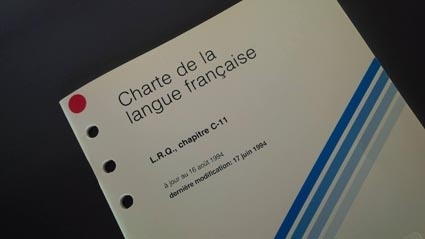
This regulatory pressure likely explains why software UI and strings localization make up such a large share of Tomedes' Canadian French requests. Businesses entering the Quebec market are not only translating for readability; they are translating to meet a jurisdiction-specific standard. Buyers evaluating localization services for the Canadian market should treat this distinction as a compliance question, not only a linguistic one.
What changes in Belgian, Swiss, and African French?
Belgian French, spoken primarily in Wallonia and Brussels, preserves some vocabulary that Standard French replaced with more complex forms. The number 70 is septante rather than soixante-dix, and déjeuner refers to breakfast rather than lunch. Swiss French follows a similar pattern, using septante and huitante for 70 and 80, alongside vocabulary borrowed from German reflecting Switzerland's multilingual context.
African French is not a single variety but an umbrella term covering distinct regional forms across dozens of countries, including West and Central African French, Maghreb French, and East African French, each shaped by contact with different local languages. Tomedes' own African French request volume remains too small to draw firm conclusions from at this stage, though the broader pattern suggests genuine demand exists in this space that current intake processes may not be capturing accurately.
What should a French translation brief specify?
A complete French translation brief should name the target country or region, not simply the language. It should also flag any relevant regulatory context, such as Quebec's Charter of the French Language, that may affect how content must be presented. Finally, it should note the content type and audience, since industry patterns show that certain varieties correlate with certain use cases, such as Canadian French with software localization or Metropolitan French with institutional communication. The software company mentioned earlier avoided a costly rework simply by answering one additional question before translation began.
Buyers working across multiple francophone markets should expect to need more than one French translation, not one translation reused across all of them. Tomedes' French translation services are staffed with human linguists across major regional varieties, matched to the target market and subject matter of each project, backed by ISO 17100:2015 certification and a 1-Year Quality Guarantee.
FAQs
Q: Is Canadian French the same language as Standard French?
A: Canadian French, particularly Quebec French, is close enough to Standard French that speakers of each can generally understand one another, but for professional translation purposes, it is treated as a distinct target rather than a regional accent. Differences in pronunciation, grammar, and vocabulary are significant enough that a Standard French translation will often read as foreign to a Quebec audience.
Q: Do I need a separate French translation for Belgium and Switzerland?
A: Belgian and Swiss French are close to Standard French and often more mutually intelligible with it than Canadian French is. That said, both contain regional vocabulary, such as septante for 70, that a specialist translator will use to avoid content reading as subtly foreign to a local audience.
Q: Why do so many businesses request "French" without specifying a region?
A: Most buyers are not aware that French translation varieties exist in any meaningful way, particularly if their prior translation experience has been limited to Standard French content. Tomedes' own data shows this is the norm rather than the exception, with the large majority of French requests received in the past year carrying no variety specification at all.
Q: How does Tomedes match translators to French varieties?
A: Tomedes maintains linguists across major French-speaking regions and matches each project to a translator familiar with the target variety and subject matter. Buyers who specify their target market at the outset, such as Quebec, France, or a specific African market, receive a more precise match than those who default to a generic French request.
Q: What happens if the wrong French variety is used for a target market?
A: Content translated in the wrong variety typically remains understandable but reads as formal, distant, or subtly foreign to the intended audience, which can undercut marketing effectiveness or, in regulated contexts such as Quebec, create compliance exposure. Specifying the target variety at the brief stage is the most reliable way to avoid this outcome.
Ready to reach the francophone market that matters to your business? Get a quote for professional French translation matched to your target region, or contact Tomedes to discuss which French variety fits your project.

Written by William Mamane
Connect on LinkedInWilliam leads marketing and growth at Tomedes, where he turns SEO experiments and real campaign data into the strategy behind MachineTranslation.com's reach. He writes about how AI products actually get found and trusted plus the tactics that work, the ones that don't, and what search is rewarding right now.
Share:

Post your Comment