 Add text to get the translation that 22 AI models agree on


Localization vs. translation: The line most businesses don't see until launch
A client asks for a translation. The brief is straightforward: take this marketing copy, this app interface, this website, and render it in another language. The project ships on schedule. Then, weeks later, a request comes in for a quality review, because something about the finished product does not feel quite right to the local market it was meant to reach.
This pattern shows up often enough in Tomedes' own project data that it is no longer a one-off surprise. A large majority of what actually functions as localization work arrives at intake labeled as translation, most visibly in marketing content, where the localization label is barely used at all despite the work itself clearly requiring it. Localization vs translation is not a technicality; it is the difference between content that reads correctly and content that reads as though it belongs.
The gap tends to surface after delivery rather than before it. Every instance of a post-launch quality audit in Tomedes' recent project history exists because a client noticed something was off only once the content was live, not because the concern was flagged at the brief stage. According to CSA Research's "Can't Read, Won't Buy" study, 76% of online shoppers prefer to buy products with information available in their native language, and the businesses in this data set were not skipping translation. They were simply scoping less than the market required.
This piece uses Tomedes' own request data to explain what is localization beyond a textbook definition, why so much of it gets requested as plain translation, and what a properly scoped brief should include before a project starts, not after it ships.
What is localization, and how is it different from translation?
Translation converts words from one language to another. Localization adapts content, including formatting, currency, imagery, tone, and cultural references, so it feels native to a specific market rather than merely readable in its language. A translated app might use the correct German words; a localized app also uses German date formats, appropriate currency display, and interface conventions German users expect.
The distinction matters most in exactly the content types Tomedes sees most often: marketing copy and software interfaces. Both categories carry cultural and functional expectations that a word-for-word translation will not automatically meet. Tomedes' localization services exist specifically to close that gap, treating adaptation as part of the deliverable rather than an optional add-on.
Why do so many localization projects get requested as translation?
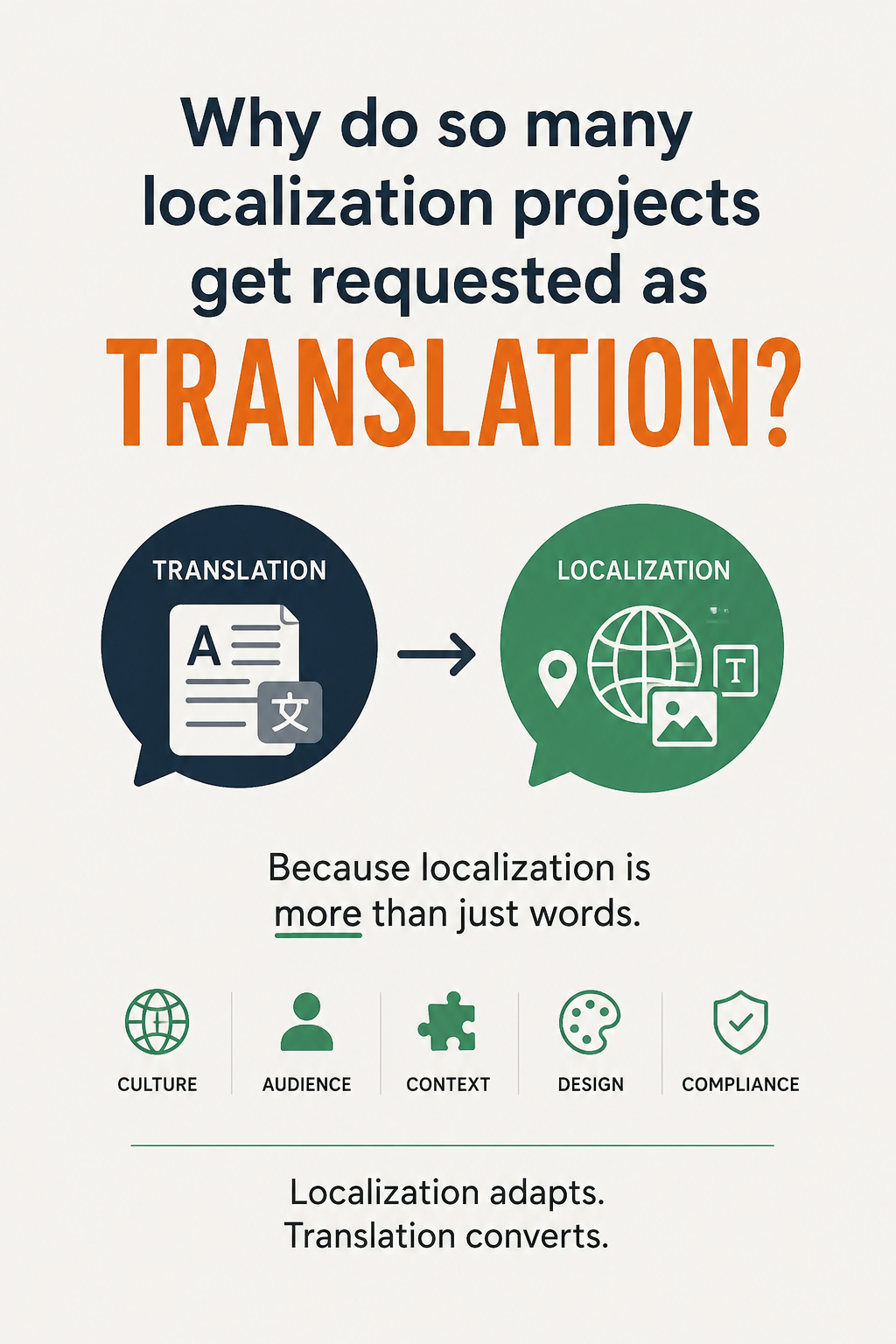
Marketing content makes up the largest single share of localization-shaped work Tomedes handles, and it is also the category least likely to be labeled as localization at intake. Software and app interface work makes up nearly as large a share and shows the same pattern, though somewhat less pronounced.
The likely explanation is straightforward: clients requesting marketing translation are often thinking about language, not market fit, at the moment they submit a brief. The cultural and formatting adaptation localization requires is not always visible until the content is reviewed against its actual target audience, which is precisely why so much of this work surfaces as a quality concern after delivery rather than a scoping decision before it.
What does the scope gap actually look like in practice?
The clearest evidence of this gap in Tomedes' own data is where localization quality audits appear: after delivery, not before it. Every documented instance follows the same shape, a project delivered as a standard translation, followed later by a dedicated quality review once a market-fit concern surfaced.
| Signal | What it indicates |
|---|---|
| Post-delivery quality audits | Original intake was translation-only; adaptation gaps surfaced after launch |
| Projects flagged for re-estimation mid-project | Scope was not fully defined at intake |
| Translation briefs that became transcreation deliverables | Adaptation need was discovered during the project, not scoped upfront |
| Same-language editing and adaptation requests | Even single-language content can require localization-level adaptation for tone or audience fit |
None of these patterns are unusual on their own. Together, they describe a market where localization is frequently delivered without ever being named, which means it is also frequently priced, resourced, and reviewed as though it were simpler than it is.
Which industries and markets are driving localization demand right now?
Marketing and software/app interface work together account for the overwhelming majority of Tomedes' localization-shaped project volume, with website localization representing a much smaller share by comparison, lower than its likely real-world demand would suggest.
| Category | Share of localization demand | Notable pattern |
|---|---|---|
| Marketing content | Largest share, over half | Concentrated among a small number of long-term enterprise clients |
| Software / app interfaces | Second-largest share, roughly two-fifths | Includes both standard translation and machine-translation-with-human-review workflows |
| Video | Small share | Multi-language batch delivery is the typical format |
| Website | Smallest share | Likely underrepresented relative to actual market need |
A concentrated group of long-term enterprise clients accounts for close to half of all localization volume, while a meaningful minority of clients expand from one localization type into another over time, for example, moving from software strings into marketing content. That expansion pattern is a genuine signal that once a client experiences localization done properly, they tend to bring more of their content into that same process rather than treating it as a one-off service.
Gaming app localization has declined notably over the past six months, while software and UI localization has grown over the same period, a shift worth watching rather than a conclusion the data can fully explain on its own.
Are there new markets worth watching?
A small number of newer localization patterns have appeared only in the past six months, worth flagging even though the volume behind them is still modest. Southeast Asian languages, including Malay and Filipino, have started appearing in software and app localization requests where they had no prior presence. Nordic languages, including Swedish, Finnish, and Norwegian, have also emerged through a continuous-localization platform integration, a different buyer profile from the batch-project clients that make up most of Tomedes' localization work.
Neither pattern is large enough yet to represent a defined market shift, but both are consistent with the broader theme in this data: localization needs often show up gradually, through a new market or a new content type, well before a client formally names it as a localization requirement.
What should a localization brief include from the start?
A complete localization brief should name the target market specifically, not only the target language, since formatting, cultural references, and tone expectations vary by market even within a single language. It should also identify the content type early, since Tomedes' own data shows marketing content and software interfaces carry adaptation needs that plain translation briefs routinely miss.
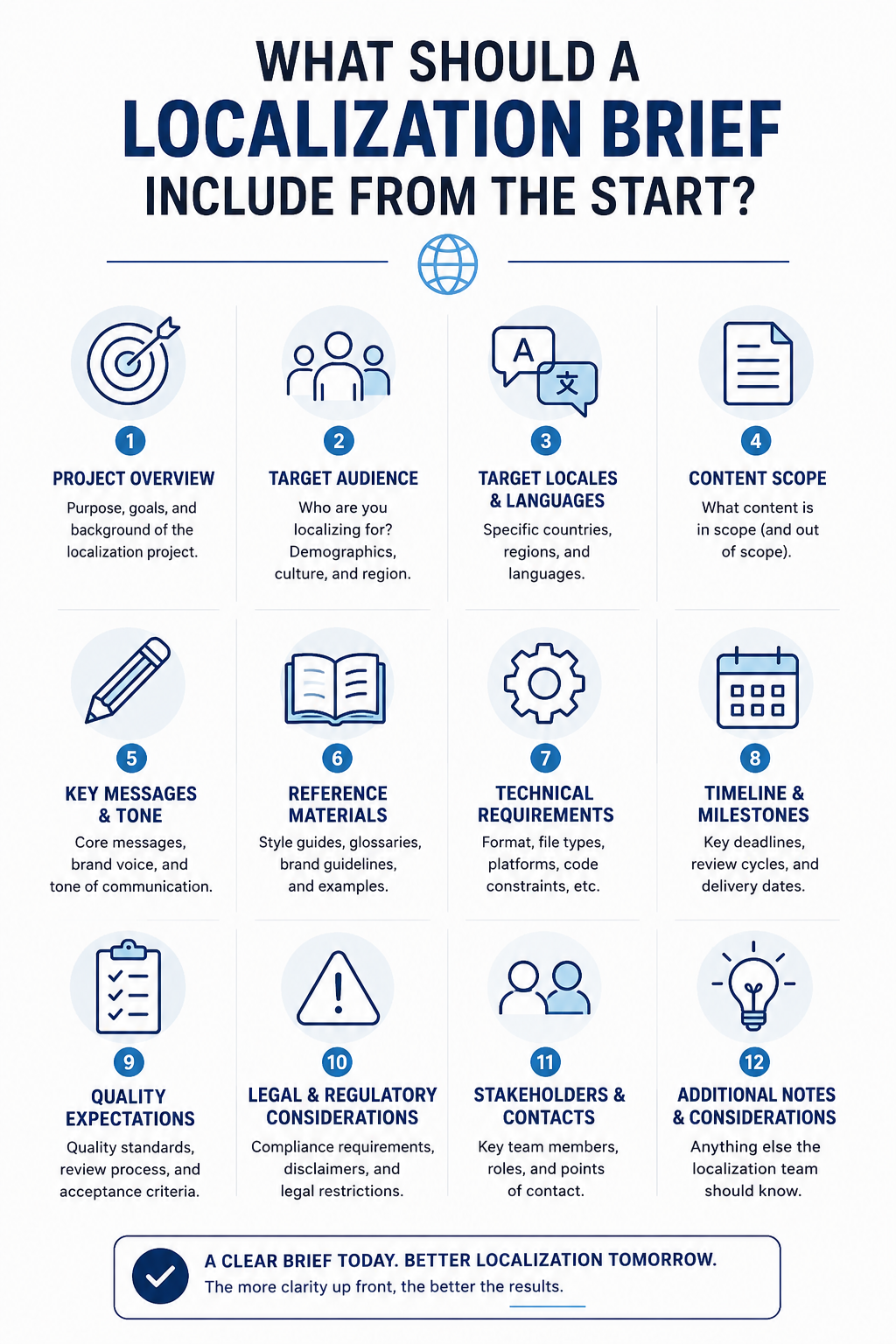
Finally, a strong brief should build in a review step focused on market fit, not only linguistic accuracy, before a project is considered complete rather than after launch. For a related look at how this same "what did we actually mean by the request" gap shows up in French translation specifically, see Tomedes' guide to French translation varieties, which documents a similar pattern in a single-language context.
Tomedes' localization services, including dedicated game localization support, are built around this distinction from the outset, backed by ISO 17100:2015 and ISO 9001:2015 certification. For a closer look at how localization relates to internationalization and globalization more broadly, see Tomedes' guide to localization, internationalization, and globalization, and for a practical walkthrough of scoping a project correctly from the start, see the localization process guide.
FAQs
Q: What is localization, in simple terms?
A: Localization is the adaptation of content, including language, formatting, currency, imagery, and tone, so that it feels native to a specific target market rather than simply translated into its language. It goes beyond word-for-word conversion to address how a market actually expects to receive information.
Q: How do I know if I need translation or localization?
A: If the content is customer-facing, such as marketing materials, a website, or a software interface, localization is almost always the more appropriate scope, since these content types carry cultural and functional expectations translation alone will not meet. Internal or purely informational documents are more often translation-only projects.
Q: Why does localization cost more than translation?
A: Localization includes work beyond language conversion, such as formatting adaptation, cultural review, and sometimes visual or UX adjustments, which is why it typically carries a broader scope and cost than translation alone. Scoping a project as localization from the outset, rather than discovering the need mid-project, is generally more cost-effective than adding it in after a quality concern arises.
Q: Can a project start as translation and become localization later?
A: Yes, and Tomedes' own project data shows this is common, particularly in marketing content and software interfaces. It usually happens when a post-delivery quality review surfaces a market-fit issue that a translation-only scope did not anticipate, at which point the work is often revisited as a localization or transcreation task.
Q: Does localization matter for a single-language market?
A: Yes. Even within one language, regional and cultural adaptation can matter significantly, as seen in cases where same-language content still required editing and adaptation for a specific audience's tone and expectations.
Considering whether your next project needs translation or localization? Get a quote and Tomedes will help you scope it correctly from the start, or contact Tomedes to talk through your target market's specific requirements.

Written by Emilyn Sinamban
Connect on LinkedInEmilyn leads Tomedes' global Client Solutions department, built around one idea: every client relationship should have a single owner from first contact to final delivery. She writes about what clients actually tell her they worry about such as data security, deadlines, and the guesswork she's spent a career trying to remove.
Share:

Post your Comment