 Add text to get the translation that 22 AI models agree on


USCIS certified translation: The requirements most guides leave out
A birth certificate goes out for USCIS certified translation. Weeks later, a Request for Evidence arrives, not because a word was mistranslated, but because the certification statement was missing a translator's signature. The applicant assumed the translation itself was the deliverable. USCIS was looking for something narrower: proof that a qualified, independent person stood behind that translation in writing.
This distinction, between a translation being linguistically accurate and a translation being procedurally complete, is where most USCIS submissions run into trouble. Rejections tend to trace back to formatting and certification gaps rather than to the language itself, a pattern visible across the documents USCIS most commonly requires for immigration filings.
What actually makes a translation "USCIS certified"?
Under federal regulation 8 CFR 103.2(b)(3), any document containing a foreign language submitted to USCIS must include a full English translation, accompanied by the translator's signed certification that the translation is complete and accurate, and that the translator is competent to perform it. The USCIS Policy Manual confirms the same standard applies across benefit types, from naturalization to family petitions.
Notably, USCIS does not require a government-licensed or court-certified translator. There is no federal translator licensing system in the United States. That absence of an official credential is exactly why the certification statement itself carries so much weight: it is the only formal accountability the file contains.

USCIS accepts certified translations as clear digital scans or PDFs, provided the certification statement and signature are legible, so a physical mailed copy is not required unless the applicant wants one for their own records. A quote for the work is typically available within minutes of uploading the source document, since pricing depends mainly on word count, language pair, and how quickly the translation is needed rather than on any variable specific to the certification itself.
Which documents require certified translation?
Any document supporting a USCIS filing that is not already in English needs a certified translation, regardless of the visa category, petition type, or how minor the document may seem.
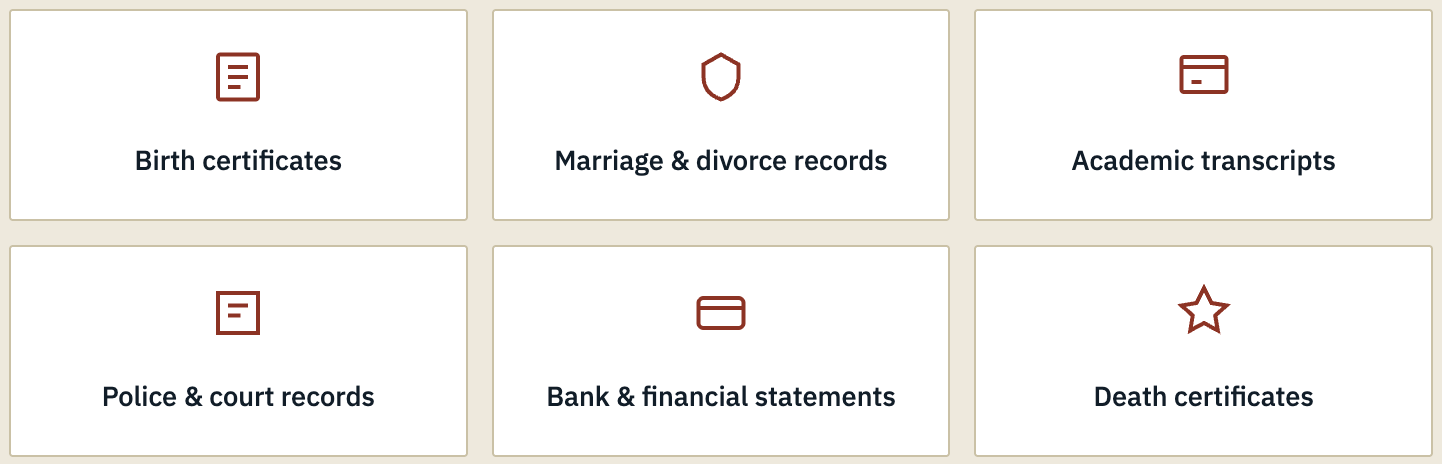
Every part of the source document needs an English counterpart, including stamps, seals, and handwritten annotations. A translation that summarizes or omits a section, even a section the applicant considers irrelevant, is treated as incomplete on its face.
Why USCIS translations really get rejected
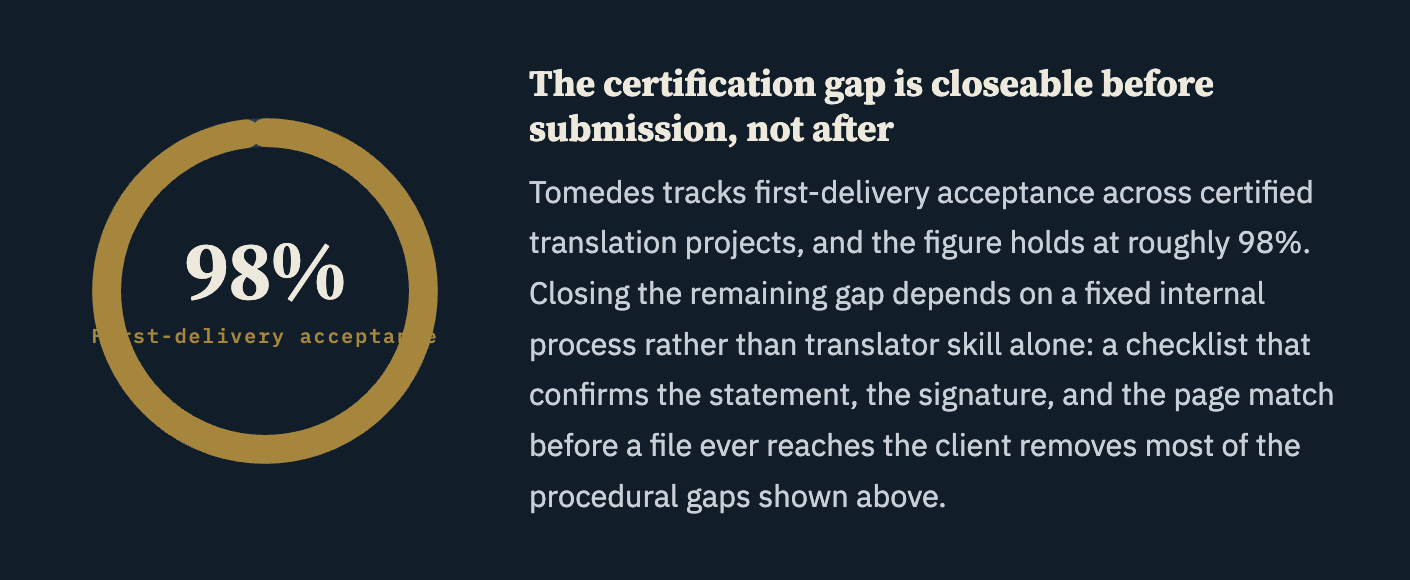
Translation quality is rarely the actual failure point. The pattern that shows up most often is procedural: a missing signature line, a certification statement that does not name the translator, or a translated document that does not mirror the original page for page.
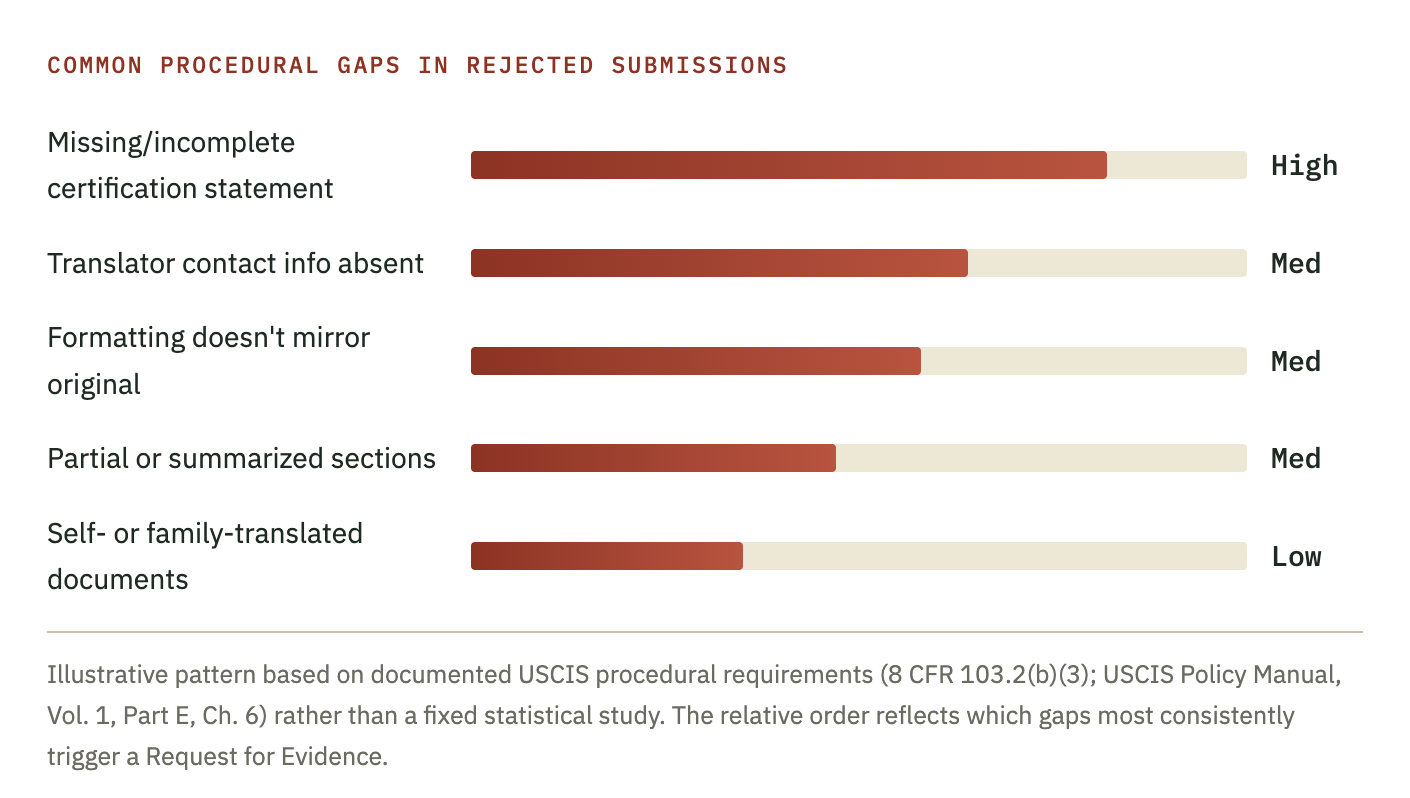
A Request for Evidence over a translation issue is rarely fatal to a case, but it is expensive in the way that matters most during an immigration filing: time. RFE response windows typically run 30 to 87 days depending on the request, and a translation-related RFE competes for that same window against every other document the applicant still needs to gather. Getting the certification statement right at the outset removes an entire category of delay that has nothing to do with the strength of the underlying application.
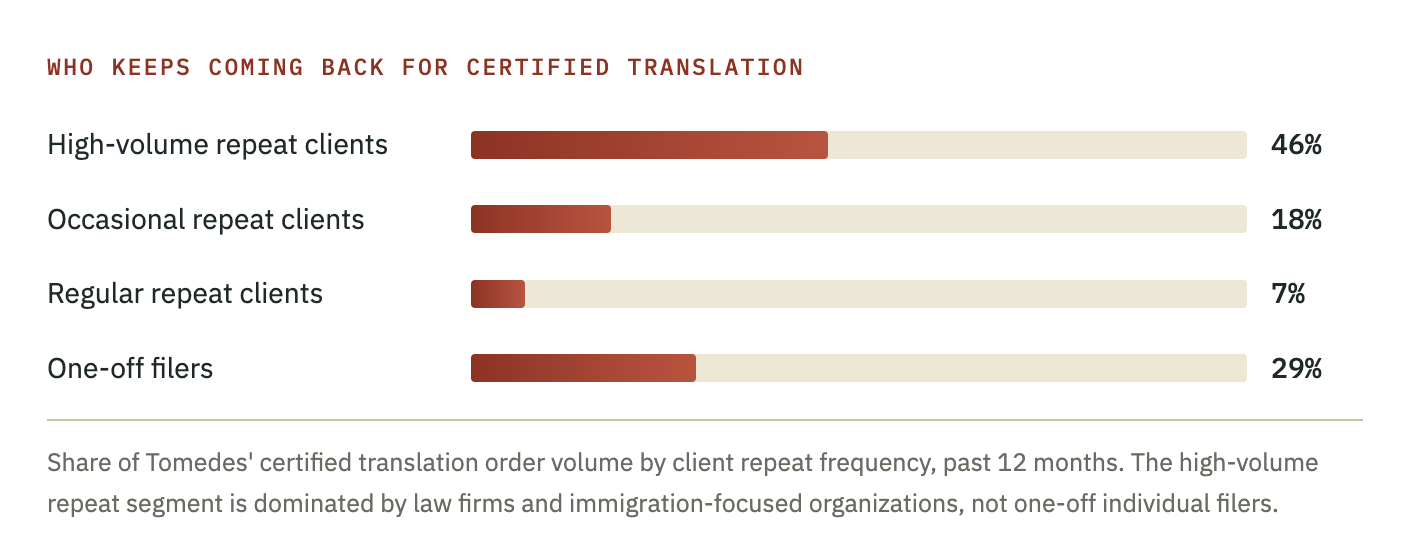
That concentration matters for a simple reason: law firms and immigration organizations handle certified translation as a routine, recurring part of their casework, not a one-time task. A vendor that satisfies that segment repeatedly, order after order, is being judged on exactly the procedural reliability this guide is about, since a firm managing dozens of client cases has no tolerance for a translation that comes back with a missing signature line.
What the certification statement must include
A certified translation is only as strong as the statement attached to it. USCIS looks for four specific elements, and a translation with a perfect statement wins over one with a technically flawless translation and an incomplete statement.
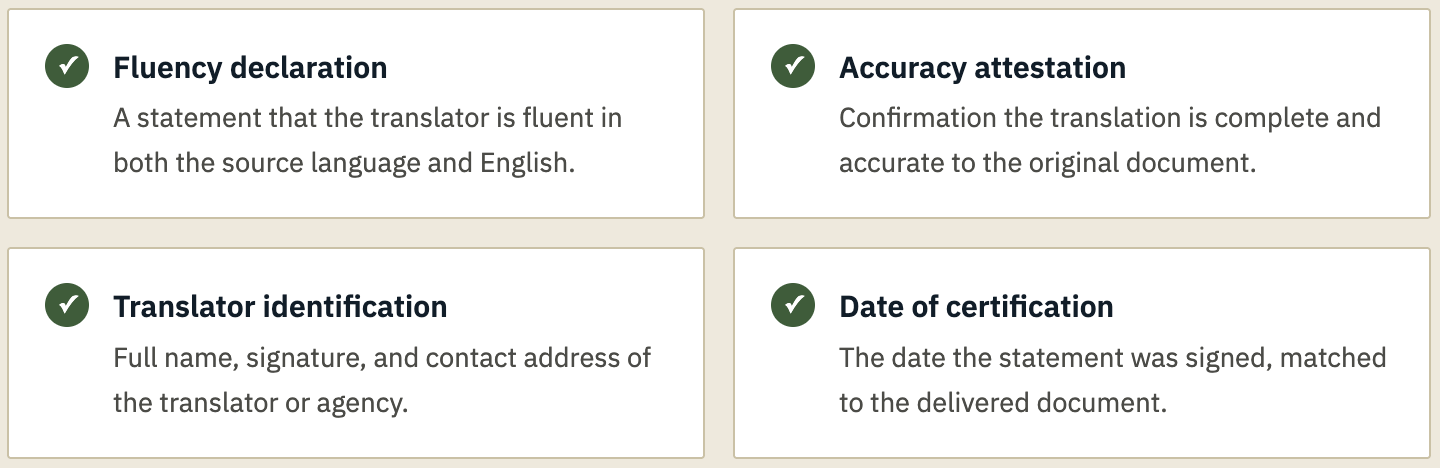
Formatting matters as much as wording. A translation should mirror the layout of the source document, page for page, so a reviewing officer can move between the original and the English version without confusion. Where part of a document is illegible in the original, the correct practice is to mark that section "illegible" rather than guess, and to flag it for the applicant to resolve directly with USCIS.
Why machine translation alone does not qualify
Machine translation, especially when paired with human post-editing (MTPE), has become fast and consistent for many document types. USCIS submissions are the exception. Two structural issues rule it out on their own: a certification statement requires a person to take professional responsibility for the translation's accuracy, which a machine cannot do, and USCIS expects formatting that mirrors the original document's layout, including stamps and seals, which raw machine output typically does not preserve without manual formatting work.
This is why certified translation for immigration purposes stays a human-certified deliverable even as machine-assisted tools improve elsewhere in the industry. The same human-accountability standard runs through Tomedes' broader certified translation work, which has supported document translation for organizations including Google, Microsoft, and Amazon, and follows ISO 17100:2015 quality requirements on every project.
Getting it right the first time
Confirm the document list before starting. Check USCIS form instructions for the specific filing, since required evidence varies by petition type.
Use an independent translator. USCIS does not accept a translation certified by the applicant or a relative, regardless of fluency.
Ask for the certification statement in writing before delivery. Confirm it names the translator and includes contact details alongside the signature line.
Check page-for-page formatting. A translation that reorganizes or condenses the layout invites additional scrutiny even when the wording is accurate.
Keep notarization separate from certification. USCIS itself does not require notarization, though other receiving institutions sometimes do; confirm requirements per document rather than assuming one standard applies everywhere.
Get a certified translation built to pass the first time
Tomedes prepares USCIS certification statements to match the format officers expect, backed by ISO 17100:2015 certification and a 1-Year Quality Guarantee.
Frequently asked questions
Q: Do USCIS translations need to be certified?
A: Yes. Under 8 CFR 103.2(b)(3), any document containing a foreign language submitted to USCIS must include a full English translation accompanied by the translator's signed certification of completeness and accuracy.
Q. Can I certify my own translation for USCIS?
A: No. USCIS does not accept a translation certified by the applicant or by a family member, even if that person is fluent in both languages. The certification must come from an independent translator or translation provider with no personal stake in the application.
Q: Who can translate a document for USCIS?
A: USCIS does not require a government-licensed or court-certified translator. Any competent, independent translator or translation company can provide the certification, provided they attest in writing to their fluency and the accuracy of the translation.
Q: Does USCIS require a certified translator to hold a special license?
A: No. There is no federal licensing system for translators in the United States. USCIS relies on the translator's signed certification statement rather than a government-issued credential, which is why the reputation and process of the translation provider matters more than a license number.
Q: How much does a certified translation for immigration cost?
A: Pricing depends on word count, language pair, and turnaround time, since document length and language rarity affect the work involved. Tomedes provides a firm quote within minutes of a document upload, before any payment or commitment is required.

Written by Denis Carvalho
Connect on LinkedInDenis manages client solutions for Tomedes' global accounts, where his job is simple to describe and hard to do: tell clients the truth early, then make sure the truth holds. He writes about what actually happens on a real translation project such as the timelines, the surprises, and the work that keeps a promise on schedule.
Share:

Post your Comment