 Add text to get the translation that 22 AI models agree on


Why our AI translation platform now accepts XLIFF and MQXLIFF files
A translator who wants a second opinion from AI translation has faced the same chore for years. Export the project from the CAT tool, flatten the segments into plain text, run the text through an outside platform, and rebuild the project by hand afterward. Many translators decided the extra work was not worth it.
I believe AI translation should fit the way professionals already work. I also believe it should earn trust through agreement across many models, and the confidence of one model should count for little. MachineTranslation.com, the AI translation platform Tomedes developed, now accepts XLIFF and MQXLIFF files and returns the same format.
The XLIFF file format exists to carry localizable content from one tool to the next (OASIS, 2018), yet running that content through an outside AI translation platform used to mean converting it first. I run Tomedes, so read this as the view of someone with a stake in the answer.
This post covers what changed, why the file format matters, how the release fits the platform we have built since 2023, and what I would check before trusting any AI translation output.
Key takeaways
- MachineTranslation.com now accepts XLIFF and MQXLIFF files and returns the same format, so a translator can import the result back into the CAT tool project.
- An XLIFF file holds source text, target segments, metadata, and translation memory data together, and converting it to plain text strips out that structure.
- As far as I understand, the AI assistance built into most CAT tools relies on one model, which gives the translator no signal about which suggestions to trust.
- In MachineTranslation.com's testing across 10,000 segments in 10 language pairs, comparing 22 AI translation models reduced translation error risk by 90% against single-model output.
- I believe AI translation should fit the translator's existing workflow and keep a human reviewer in charge of the final file.
What changed when MachineTranslation.com started accepting XLIFF and MQXLIFF files?
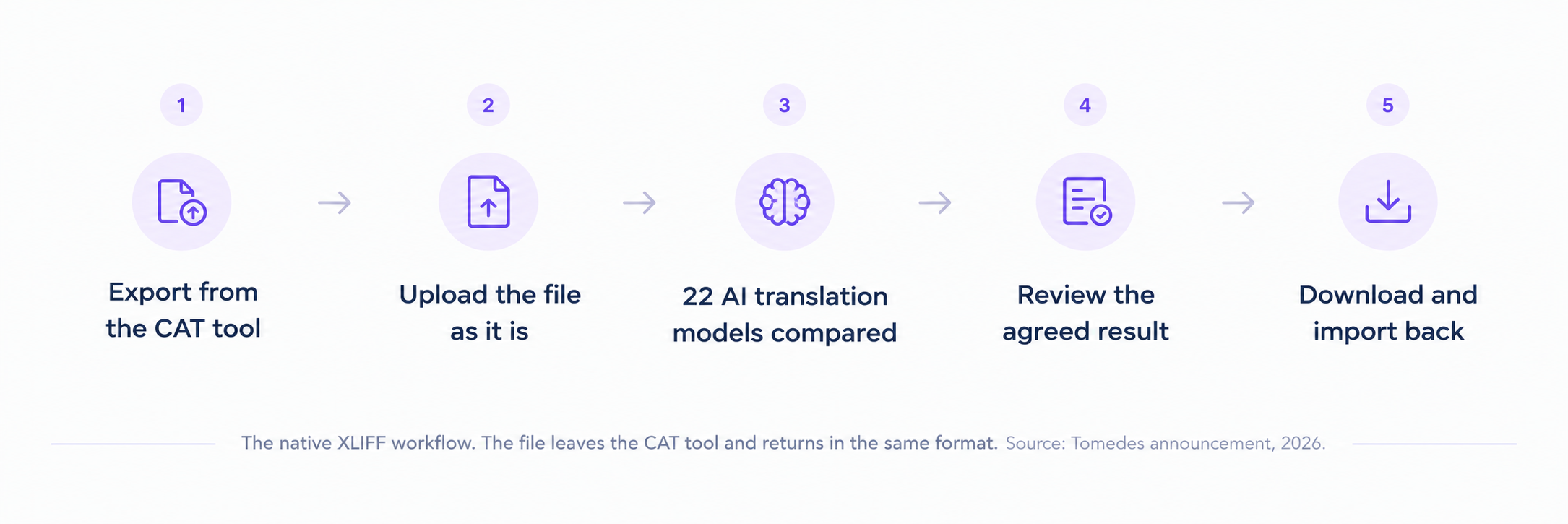
MachineTranslation.com now accepts XLIFF and MQXLIFF files directly. A translator exports a file from a CAT tool such as memoQ, Trados, Phrase, Wordfast, or OmegaT, uploads it, and reviews the translation that most of the AI translation models agree on. The translator then downloads the result in the same format and imports it back into the project.
As of October 2026, the file structure stays intact from upload to download, so nothing needs to be rebuilt by hand. The platform compares output from 22 AI translation models, and MachineTranslation.com has a separate post on translating XLIFF and MQXLIFF files with AI translation for readers who want the how-to.
Shashank Jain, our Tech Lead, said in the announcement that XLIFF support has been among the features professional users request most often. I think that makes sense, because a translator's working day happens inside a CAT tool.
What are XLIFF and MQXLIFF, and why do translators work in them?
XLIFF is the XML Localization Interchange File Format, a standard for carrying localizable content and its metadata from one step of the localization process to the next (OASIS, 2018). MQXLIFF is the memoQ-specific version of the format. Nearly every major CAT tool supports XLIFF, so it works as the standard exchange format for localization projects.
A single XLIFF file holds source text, target segments, metadata, and translation memory data together. That is why it travels well between tools. It is also why converting it to plain text strips out the structure a project relies on.
My view is that a file format is a promise to the translator that the work stays intact.
What breaks when a CAT tool file is flattened into plain text?
Flattening a CAT tool file separates the text from the information needed to put it back. A project exported from memoQ or Trados arrives with its segment boundaries and metadata attached, and plain text drops them. The translator is left to rebuild the project by hand.
Two ways to run a CAT tool project through an AI translation platform
| Step | Plain-text workflow | Native XLIFF workflow |
|---|---|---|
| Leaving the CAT tool | Export the project, then convert it to plain text | Export the XLIFF or MQXLIFF file |
| Running AI translation | Paste or upload the plain text | Upload the file as it is |
| Reviewing the output | Compare text that no longer has its segment structure | Review the translation most models agree on, in the original file structure |
| Returning to the project | Rebuild the project by hand | Download the same format and import it |
I would judge the platform by the last row of that table. If the file imports back into the project cleanly, the platform did its job, and if the translator has to rebuild anything, it did not.
Does a single AI suggestion tell a translator which segments to trust?
No, a single AI suggestion gives no signal about its own reliability, because a correct translation and an incorrect one arrive with the same apparent confidence. As far as I understand, the AI assistance built into most CAT tools relies on one model and returns one suggestion per segment. The translator has to find the weak segments alone.
Judgment is where translators already spend their time. In a Tomedes survey of translators, linguists reported spending 90% of their time on design, meaning tone, intent, and cultural nuance, up from 40% before AI handled grammar and syntax.
I believe many buyers compare AI translation tools on price and speed first. I think agreement across models is the better yardstick, because it tells a reviewer where to look.
How does comparing 22 AI translation models change what a translator reviews?
The platform runs the same text through 22 AI translation models and shows where they agree. Segments where the models converge are surfaced as the verified translation, and outlying results are set aside. The translator reviews a result that most of the models already support.
In MachineTranslation.com's testing across 10,000 segments in 10 language pairs, this method reduced translation error risk by 90% compared with single-model output. The test is our own, so I treat it as one data point. I would ask any vendor, including us, how error risk was measured.
Agreement across models still needs a human who owns the result, which is the idea behind human-in-the-loop AI translation. Tomedes is certified to ISO 18587:2017, the international standard for human post-editing of machine translation output.
Tomedes also introduced a Human Verification option on MachineTranslation.com in July 2024, where professional linguists review a translation after it is produced. I believe that human step is what makes agreement across models safe to rely on for important documents.
Why did we build around the CAT tool instead of replacing it?
We built around the CAT tool because translators have invested years in it, and I see no reason for them to give it up. What they want is a reliable way to check AI-assisted output without reorganizing how they work. Native XLIFF and MQXLIFF support is our answer to that.
Tomedes spent nearly two decades as a human translation agency before AI disrupted the industry. I chose to build MachineTranslation.com in 2023 instead of resisting AI, and Tomedes has served more than 120,000 business clients since 2007.
In my opinion, that history shapes how we design the platform. A team that has corrected machine output by hand for years makes different choices from a team that started with the models. I believe AI translation should fit the translator's existing workflow and keep a human reviewer in charge of the final file.
How has the platform advanced since 2023?
The platform has moved from comparing machine translation engines in 2023 to building one translation from 22 AI translation models, with human review added along the way. My read is that each release moved the platform closer to a decision a translator already makes.
Releases on MachineTranslation.com since 2023
| Date | Release | What it added |
|---|---|---|
| April 2023 | Machine translation comparison tool | Compared output from several machine translation engines, recommended an engine for each language pair, and added GPT-4 analysis of each engine's output |
| July 2024 | Human review | A human verification option after translation, where professional linguists review the result |
| October 2024 | AI Translation Agent | Three AI-generated questions after a translation, so the user can refine it; available on the free, starter, and advanced plans |
| December 2024 | Key Term Translations | Identification of up to 10 specialized terms in the source text |
| November 2025 | SMART consensus translation | One translation built from what 22 AI translation models agree on |
| October 2026 | XLIFF and MQXLIFF support | Native upload and download of XLIFF and MQXLIFF files in the same format (Tomedes, 2026) |
I think a dated record like this is the plainest evidence of how a platform is built, because anyone can check it.
What should translators and buyers check before trusting any AI translation output?
I would apply four checks to any AI translation output, including our own.
- Whether the file structure survives the round trip back into the CAT tool.
- Whether the result reflects agreement across several models or the confidence of one.
- Whether the vendor explains how it tested accuracy, including the sample size and language pairs.
- Whether a named human reviewer owns the final file.
Native XLIFF and MQXLIFF support makes the first check quick, because a translator can upload one file from a current project and see whether it comes back in the format it left in. If it does, the other three checks are worth the time.
Translators can try XLIFF and MQXLIFF support on their next project at MachineTranslation.com. For work where a named reviewer should sign off on the final file, talk to Tomedes about AI translation with human review.
FAQs
Q: What is the difference between XLIFF and MQXLIFF?
A: XLIFF is the standard XML Localization Interchange File Format, supported by nearly every major CAT tool, including Trados, Phrase, Wordfast, and OmegaT. MQXLIFF is the memoQ-specific version, widely used by freelance translators and language teams. MachineTranslation.com accepts both and returns the file in the format it received.
Q: Can I upload an XLIFF file to MachineTranslation.com?
A: Yes, MachineTranslation.com accepts XLIFF and MQXLIFF files and returns the translation in the same format, so it can be imported back into the CAT tool project. As of October 2026, the platform compares up to 22 AI models and returns the translation that most of them agree on.
Q: Does the file structure stay intact after AI translation?
A: Yes, according to MachineTranslation.com, the file structure stays intact from upload to download, because the platform reads the format directly instead of converting it to plain text. The translator imports the returned file into the original project. I would still run the usual checks inside the CAT tool before delivery.
Q: Is comparing several AI translation models more reliable than using one?
A: Yes, in MachineTranslation.com's testing across 10,000 segments in 10 language pairs, comparing 22 AI models reduced translation error risk by 90% against single-model output. The test is our own, so I treat it as one data point. A human reviewer should still approve the final translation.

Written by Ofer Tirosh
Connect on LinkedInOfer founded Tomedes in 2007 and now leads the company's push to combine two decades of human translation expertise with AI. He writes about where the language industry is actually heading and the shifts nobody's ready for, the bets that paid off, and the ones that didn't.
Share:

Post your Comment