 Add text to get the translation that 22 AI models agree on


Why your diploma translation for credential evaluation may get sent back
A diploma translation for credential evaluation can be accurate and still get sent back. The applicant pays, uploads the file, waits, and then learns that the evaluator wants a new translation. WES, a nonprofit credential evaluator in the U.S. and Canada, lists several kinds it cannot accept, including handwritten translations, translations of photocopies, translations completed by the applicant, and incomplete translations (Source: WES, 2025).
Tomedes treats a diploma translation as an exhibit in someone else's file. The evaluator owns the rulebook, so the rulebook comes first. I would rather an applicant spend an afternoon reading it than pay for a second translation.
Tomedes sees one version of this problem in the files it receives. About half of the leads who send Tomedes files send a scan or a phone photo. A photo is enough to get a quote, and sometimes not enough to get an accepted translation.
Key takeaways
- WES does not accept translations completed by the applicant, handwritten translations, translations of photocopies, or incomplete translations.
- A translation converts a document into another language, while a credential evaluation determines how a non-U.S. credential compares with a U.S. credential, so a translation cannot replace an evaluation.
- WES requires an exact, word-for-word translation in which an evaluator can read every course title and grade.
- About half of the leads who send Tomedes files send a scan or phone photo, while WES does not accept translations of photocopies, so ask the institution for official copies before the translation starts.
- Evaluators and state licensing boards each set their own requirements, so the receiving body's current list overrides any general checklist.
Do you need a translation for a credential evaluation?
It depends on the language of the document and on the evaluator, because the rules differ. WES says translation is unnecessary in most cases, but for evaluations processed in the United States it requires translations of documents issued in languages other than English. Your required-documents list gives the final answer.
WES does not translate documents itself, so the applicant arranges the translation. The U.S. Department of Education says credential evaluation services generally require English translations of any non-English documents (Source: U.S. Department of Education, 2025). For Canadian evaluations, WES accepts English or French translations, and an English-language version from the institution does not replace a translation.
Open the required-documents list in your evaluator account before ordering anything. If a document appears there with a translation requirement, the translation is part of the file. If it does not, a translation may add cost without adding value.
What is the difference between translating and evaluating a diploma?
A translation moves the words of a document into another language. A credential evaluation determines how a non-U.S. credential compares with a U.S. credential. The two usually happen in that order, because evaluation services generally require English translations of non-English documents.
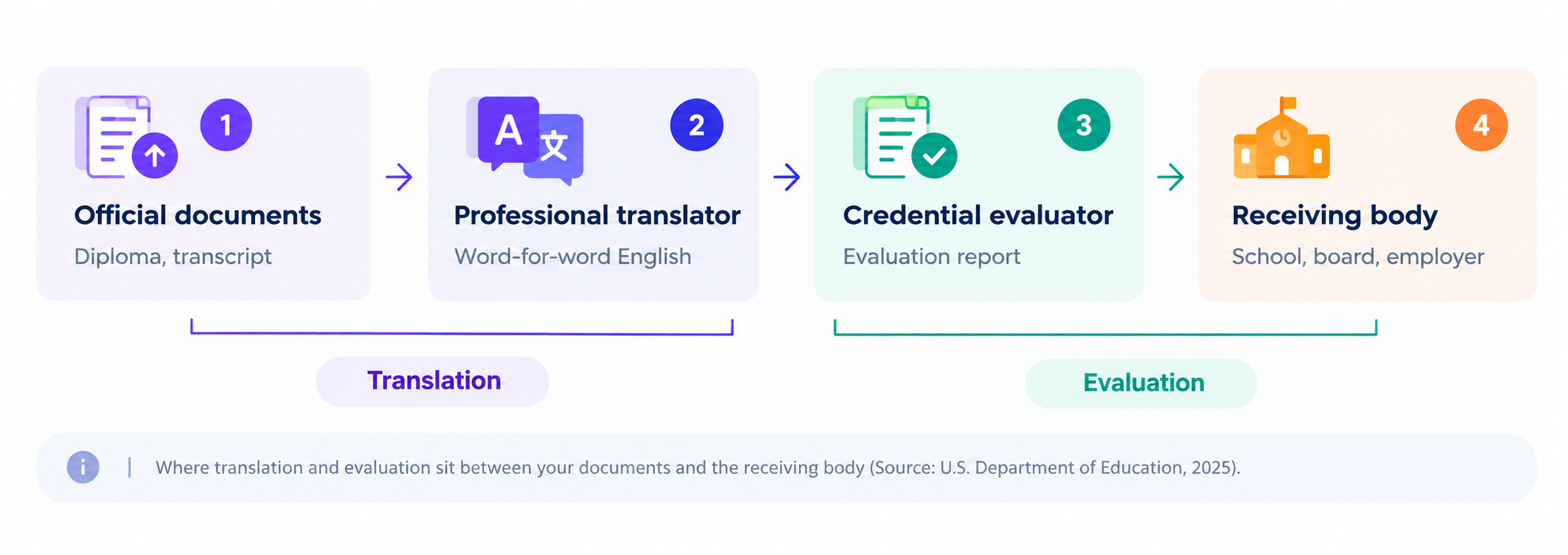
| Translation | Evaluation | |
|---|---|---|
| What it does | Converts the words of a document into another language | Determines how a non-U.S. credential compares with a U.S. credential |
| Who does it | A professional translator | A private credential evaluation service, usually for a fee |
| Typical output | A complete English version of the diploma or transcript | A case-by-case evaluation report |
Many people carry credentials earned abroad. WES reports that more than two million immigrants and refugees with college degrees are unemployed or underemployed in the U.S., and 60 percent of them hold credentials earned abroad (Source: WES, 2023).
A translation cannot prove a degree equivalent, so ordering one and stopping there leaves the file incomplete. Tomedes provides academic translation for the translation step.
Who is allowed to translate a diploma for an evaluator?
A professional translator who is independent of the applicant. WES requires every translation to be completed by a professional translator, who may work at a university, a certified translation agency, or another professional translation service. It rejects translations completed by applicants.
A raw machine translation does not meet that requirement as WES words it, and ISO 17100:2015 places raw machine translation with post-editing outside its scope (Source: ISO 17100:2015). AI translation can help an applicant read a transcript, and the version submitted still needs a professional translator behind it.
Tomedes works to ISO 17100:2015, which requires a second linguist to revise every translation against the source text. I would point any buyer to that revision step first, because every translation that leaves an ISO-certified provider has been checked by someone who did not write it. An applicant cannot revise their own translation that way.
Providers often label the result a certified translation, and evaluators word their expectations differently. Read what a certified translation is, then check the evaluator's own wording before the translation starts. One recent Tomedes order for a credential evaluation shows the timing problem, because the client asked for the certified-translation statement only after delivery.
What must a diploma and transcript translation contain?
All of the text, translated exactly and word for word, and legible enough for an evaluator to read every course title and grade. WES requires exact translations of everything written in the original language, with clear text for course titles, grades, institution details, and applicant information.
| WES requirement | What to check in your file |
|---|---|
| Exact and word for word | Every line of the original appears in the translation, including headers and footers |
| Clear and legible | Course titles and grades can be read without zooming or guessing |
| Completed by a professional translator | A named translator or agency produced it, and the applicant did not |
| PDF or JPEG, up to 10 MB, no password | The file opens without a password and stays under the size limit |
Compare the delivered file with the original line by line before you upload it, including the reverse side and any annex or grading-scale legend. Seals and stamps carry text, so ask the translator to render it and to describe each signature in brackets. Leave grades as issued, because comparing them with U.S. grades is the evaluator's job.
Use one spelling of your name and of the institution's name across every document, and match the passport. A mismatch between documents gives the evaluator a reason to query the file.
Can you send a phone photo of your diploma to the translator?
It depends on the evaluator, because WES does not accept translations of photocopies and asks that the translator work from official documents. A phone photo may be fine for getting a quote. Confirm the final source copy with the evaluator before the translation starts.
WES also warns that unofficial documents or student copies might not match the official versions exactly. It suggests asking the institution for two sets of documents, one for WES and one for the translation service.
Tomedes sees the same habit in practice. About half of the leads who send files send a scan or phone photo. The fix is cheapest at the start, when the institution can be asked for both sets in one request.
Do licensing boards and colleges follow the same translation rules as evaluators?
No, because each receiving body sets its own requirements and may add steps. The U.S. Department of Education lists schools, employers, state licensing boards, and immigration authorities as recognizing bodies and advises consulting the entity that will evaluate your credentials. WES publishes its own list.
For regulated professions, the Department says the state licensing board is the authoritative source. The evaluation may be done by the board, a general service, or a service specific to the profession. WES adds that regulated professions often require or prefer reports from services specific to their field.
Tomedes receives diploma and transcript requests bound for licensing boards and credentialing programs. Some bodies also require notarization, and the page on notarized translation services covers that step. Readers who need to check other paperwork in the same file can use Tomedes' list of documents that require certified translation.
How do you prepare a diploma for translation step by step?
Pick the evaluator and read its rules first. Then request official copies, give the translator every page, match names across documents, check the delivered file, and upload it in the accepted format. The order matters because the first two steps decide what the translator is asked to produce.
- Confirm the evaluation service. Ask the school, employer, or licensing board which evaluation service it accepts, then open that service's translation requirements. For WES, the required-documents list sits in the applicant account.
- Request official copies. Ask the institution for official documents, and ask for two sets if possible, one for the evaluator and one for the translator.
- Give the translator every page. Send both sides of every document, plus any annex or grading-scale legend.
- Share the correct spellings. Send the spelling of your name from your passport and the institution's English name, if it has one, so every document matches.
- Order a professional translation. Ask for an exact, word-for-word translation completed by a professional translator. Add a signed statement of accuracy if the receiving body asks for one.
- Check the delivered file. Read the translation against the original line by line, and fix any mismatch in names, dates, or grades before uploading.
- Upload in the accepted format. WES accepts PDF or JPEG files up to 10 MB, and the PDF cannot be password-protected. Preview each file before submitting, because WES does not allow deletion after submission.
If a diploma or transcript is headed to an evaluator or licensing board, request a certified translation from Tomedes. Name the body that will receive the file, and send that body's translation requirements with your documents.
FAQs
Q: How do I translate my diploma?
A: Start with the receiving body's translation rules, then give a professional translator the official diploma, including the reverse side and any annex. WES does not accept translations completed by applicants, so a self-made version will not work for its evaluations. Check the finished file against the original.
Q: How to get an official translation of a diploma?
A: Official has no single meaning, because each receiving body defines it. WES asks for an exact, word-for-word translation completed by a professional translator, and other bodies may add a signed statement or notarization. Confirm the wording on the body's requirement list before you order.
Q: Where can I get certified translations of official documents?
A: A professional translator or a translation agency can provide them. Tomedes provides certified translation for official documents and works to ISO 17100:2015, which requires a second linguist to revise every translation. Ask any provider to confirm that its output meets your evaluator's written requirements.

Written by Ofer Tirosh
Connect on LinkedInOfer founded Tomedes in 2007 and now leads the company's push to combine two decades of human translation expertise with AI. He writes about where the language industry is actually heading and the shifts nobody's ready for, the bets that paid off, and the ones that didn't.
Share:

Post your Comment