 Add text to get the translation that 22 AI models agree on


What 50 translators learned working alongside AI
Internal data from the Tomedes team reveals that AI didn't just change the speed of translation, it upgraded the entire profession.
Is the era of "manual typing" officially over?
For centuries, the act of translation was physically demanding. To move an idea from English to French, a professional had to physically type every single word. The "brain power" was often bottlenecked by the "finger power." A linguist could only think as fast as they could type.
In 2026, that bottleneck is gone.
The goal of a recent deep-dive study conducted at Tomedes was to understand exactly how this technological leap affects the people on the front lines. Rather than relying on generic industry statistics, the analysis focused on 50 senior in-house linguists – experts who have transitioned from "Manual Translation" to "AI-Assisted Workflows."
The results were surprising. While the prevailing media narrative often focuses on the fear of replacement, the internal data tells a story of empowerment.
The findings reveal that AI hasn't replaced the translator. It has promoted them.
Has the role shifted from "writer" to "architect"?
The survey posed a fundamental question to the cohort: "How has the daily role changed since integrating advanced LLMs?"
The data was decisive. 82% of respondents stated they no longer view themselves primarily as "writers" – they now identify as "architects."
In traditional workflows, a translator spent approximately 60% of their energy on construction (grammar, spelling, sentence structure) and only 40% on design (tone, intent, cultural nuance).
With AI handling the "construction" (laying the bricks of the sentence instantly) the human energy budget has flipped. Linguists now spend 90% of their time on design.
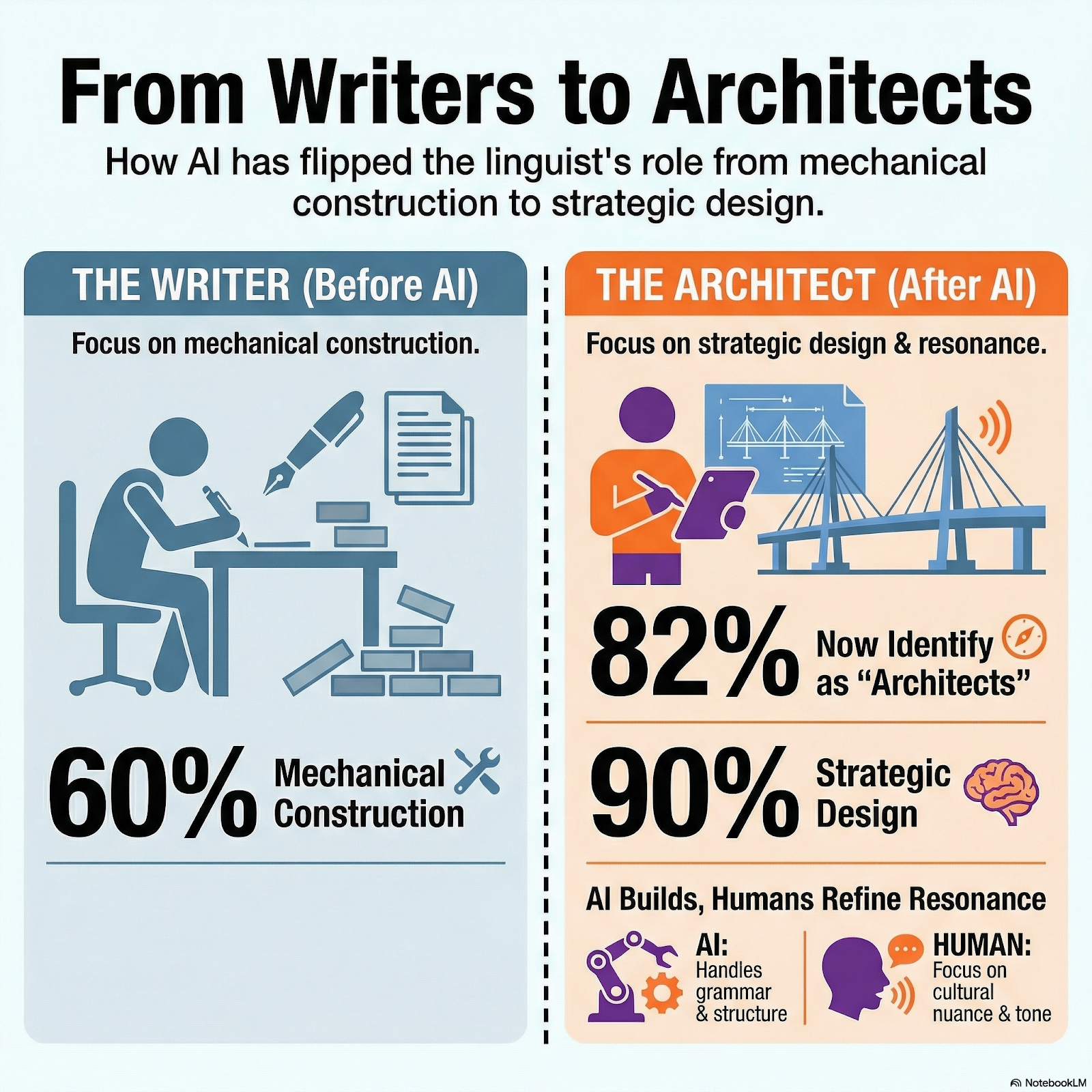
Qualitative feedback from the study highlighted this shift, with Senior French Linguists noting that the focus has moved from conjugating verbs (which the AI handles perfectly) to ensuring the voice resonates with the specific demographic, be it a Parisian teenager or a corporate banker. This represents a return to the strategic core of the profession.
Does AI make the job easier or more mentally demanding?
One of the most significant findings from the analysis concerned "Cognitive Load."
When asked, "Is the job easier or harder with AI?", the responses broke down as follows:
- 30% reported it as "easier" (due to less physical typing).
- 70% reported it as "more mentally engaging."
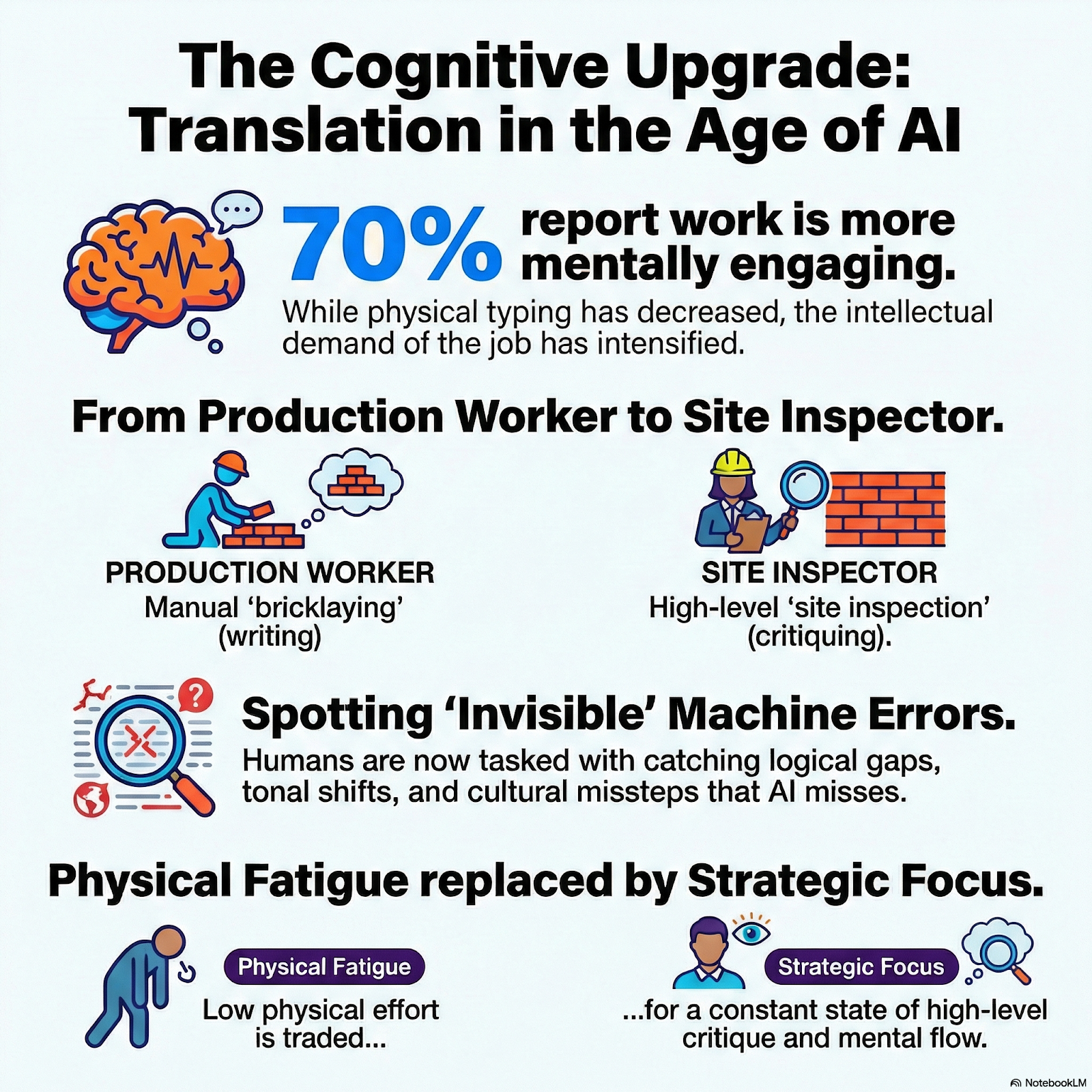
This distinction is crucial. The work hasn't become "mindless." In fact, it has become more intellectual.
Typing a translation from scratch often involves entering a "flow state" that relies heavily on muscle memory. Working alongside AI, however, requires a constant state of high-level critique.
The data shows that while physical fatigue has dropped to near-zero, "Strategic Focus" has increased. The human is no longer the bricklayer; they are the site inspector. They are tasked with spotting the "invisible" errors (logical gaps, tonal shifts, and cultural missteps) that a machine might miss.
This is a "cognitive upgrade." Effectively, the entire translation department has moved from a production role to a strategy role.
Why do linguists prefer the "co-pilot" model over manual work?
Perhaps the most encouraging statistic from the survey regarded job satisfaction.
Participants were asked: "If you could return to a 100% manual workflow tomorrow, would you?"
92% said No.
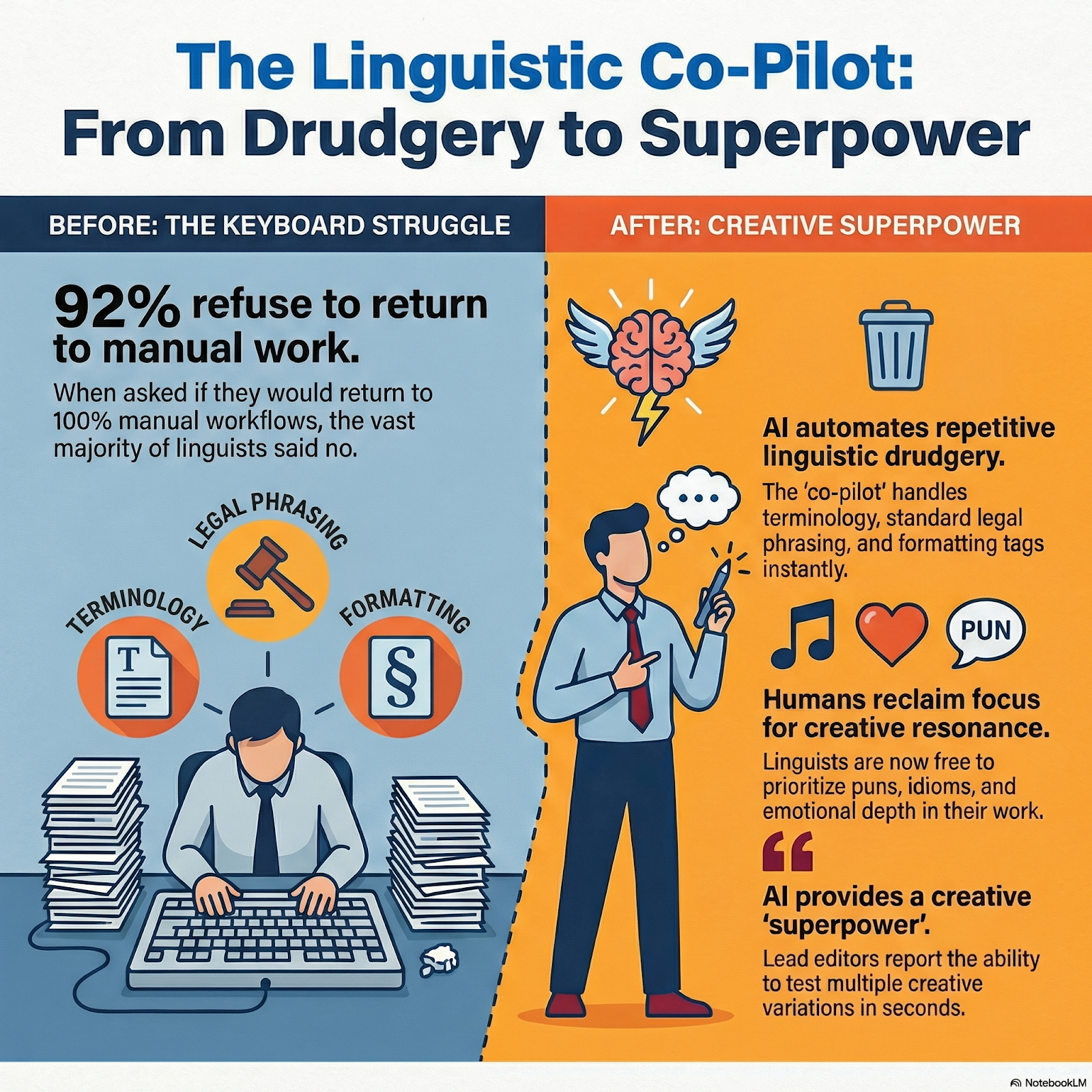
The preference for the "co-pilot" model stems from the removal of drudgery.
The AI acts as an efficient junior assistant, handling repetitive terminology, standard legal phrasing, and formatting tags instantly. This frees the human expert to focus on the creative aspects of language: puns, idioms, and emotional resonance.
Feedback from Spanish lead editors indicated that the new workflow feels like having a "superpower," allowing for the testing of multiple creative variations in seconds. The struggle against the keyboard has been replaced by the exploration of ideas.
How does the new workflow balance speed and soul?
Based on this data, the industry is seeing the formalization of a philosophy known as "The Human-AI Symbiosis."
In this model, AI is not viewed merely as a cost-cutting tool, but as a Quality Multiplier.
The machine provides the velocity: It ensures millions of words can be processed rapidly.
The human provides the veracity: They ensure those words are factually true, empathetic, and culturally safe.
The survey proves that when both sides of this equation are respected, the result is not a reduction in quality, but a renaissance of creativity. The machine builds the frame; the human paints the picture.
Summary of key findings
Category | Key Metric | Operational Insight |
Role Identity | 82% of linguists now identify as "Architects" rather than "Writers." | The human role has shifted from creating the structure to designing the intent and strategy. |
Energy Allocation | 90% of time is now spent on Design (Tone/Nuance). (Previously only 40%) | AI handles the "construction" (grammar/syntax), allowing humans to focus almost exclusively on high-value cultural work. |
Cognitive Load | 70% report the job is "More Mentally Engaging." (Only 30% called it "Easier") | While physical fatigue (typing) is gone, strategic focus is higher. The work is now about high-level critique rather than rote production. |
Workflow Preference | 92% would refuse to go back to a manual workflow. | The "co-pilot" model successfully removes the drudgery of translation, leading to higher job satisfaction. |
Core Philosophy | Velocity + Veracity | The new "Human-AI Symbiosis" uses the machine for speed (volume) and the human for truth (safety). |
FAQs
Q: Does using AI make the translator lazy?
A: No. The study shows the opposite. Editors report being more focused because they are relieved of repetitive typing duties, allowing them to devote 100% of their attention to nuance and accuracy.
Q: Can AI handle creative content like marketing slogans?
A: Not alone. AI provides excellent "options," but it takes a human "architect" to choose the one that lands emotionally. The partnership is what delivers the final polish.
Q: Is "post-editing" just correcting mistakes?
A: That is an outdated view. Modern "semantic review" is less about fixing errors and more about elevating style. The AI gets it "right"; the human makes it "great."
Q: How does this benefit the client?
A: Clients receive the best of both worlds: the speed and consistency of a machine, combined with the safety and flair of a human expert – without the costs associated with manual "typing" hours.
Post your Comment