 Add text to get the translation that 22 AI models agree on


What our data says about AI translation and official documents
You can get a translation in seconds now. Getting an immigration office, a court, or a university admissions desk to accept it takes longer, and that is the situation most people who contact Tomedes are in.
I believe better AI translation quality will not change that for most official documents, because the receiving body asks for a named translator's signature and a quality score cannot supply one. In the leads that reached Tomedes between September 10 and October 7, 2026, almost half the requests were official or institutional submissions, and about 3% were for reading, study, or personal messages.
The industry conversation is about quality. Marco Trombetti, CEO of Translated, told SlatorCon San Francisco on September 3, 2026 that AI translation cannot match human translation quality today and that nothing suggests it will stay out of reach. Translated's study of 11 years of translator edits projects that the time spent correcting AI translation output will reach human parity by 2031.
I take that forecast seriously. This article uses our own data to show who requests translation, what the USCIS rule asks of a translation, and what to do when an AI translation is good and still not accepted.
Key takeaways
- Almost half of the translation requests that reached Tomedes between September 10 and October 7, 2026 were official or institutional submissions (48%), and 41% asked for a certified, sworn, or notarized translation.
- 8 CFR 103.2(b)(3) asks USCIS filers for a full English translation, the translator's certification that it is complete and accurate, and a statement that the translator is competent, so a signature is part of the requirement.
- In our four-week sample, the orders that used the AI translation option were mostly certificate-type, legal, and medical documents, usually with no stated purpose.
- Translated's study projects that correction time for AI translation output will reach human parity by 2031, and I expect the signature requirement for official documents to outlast it.
- When an AI translation is good but not accepted, I would ask the receiving institution what it requires in writing, read with AI translation first, and order a certified translation for the filing.
Can AI translation be used for official documents?
It depends on the receiving institution, because some ask a named translator to certify the result. For USCIS, 8 CFR 103.2(b)(3) asks for a full English translation, the translator's certification that it is complete and accurate, and a statement that the translator is competent (U.S. federal regulation, 2026).
The rule says nothing about how the translation is produced. It attaches the requirement to a person, who signs that the work is complete and accurate and that they are competent in both languages.
That is why I draw a line between an AI translation and a certified translation. An AI translation with no signature is a draft you can read, and a signed certification is a promise a named person makes about the result.
I am not a lawyer, and each agency decides its own filings, so treat this as general information that is no substitute for legal advice. The longer version for immigration filings is in our USCIS certified translation guide, and the service itself is Tomedes' certified translation.
What do official-document requests look like in our data?
Almost half of them are official. Of the translation requests that reached Tomedes between September 10 and October 7, 2026, 48% were official or institutional submissions, such as immigration files, credential evaluations, and licensing boards, and 41% asked for a certified, sworn, or notarized translation.
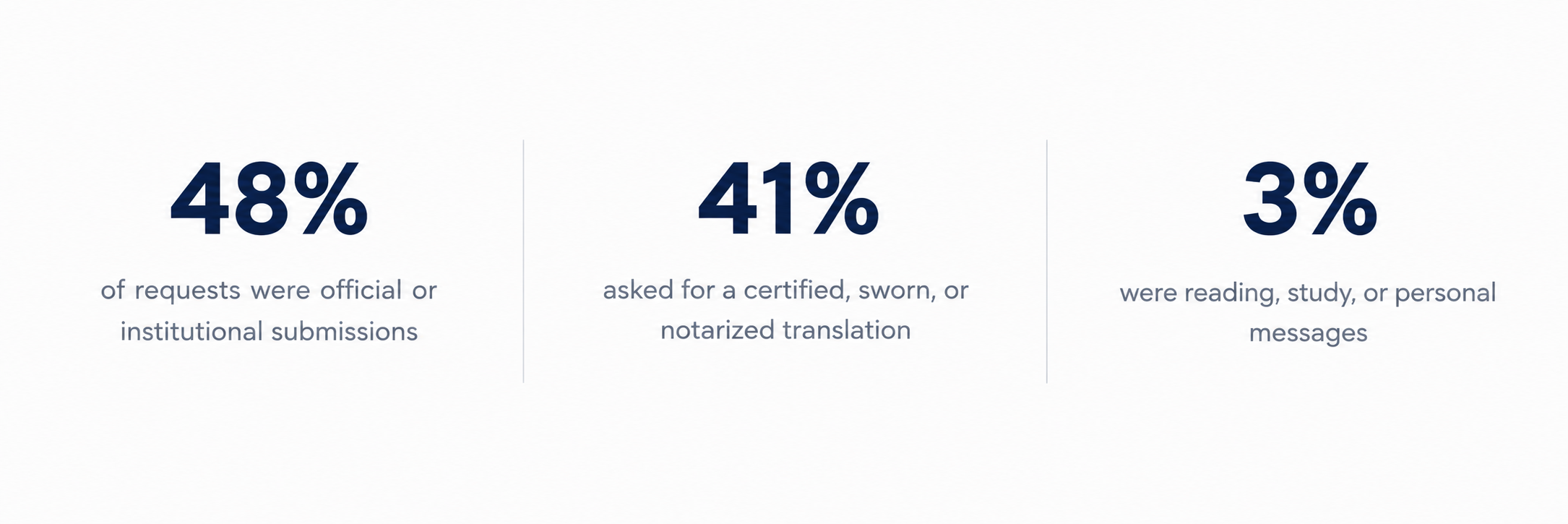
We read each request and coded it by where the translation goes. Official submissions and court or legal work together made up 52% of requests, other work and publishing 30%, reading, study, and personal messages about 3%, and requests with an unclear purpose 15%.
Mostly short, official-looking documents, usually with no stated purpose. In our four-week sample, the orders that used the AI translation option were mostly certificate-type, legal, and medical documents. The sample is a handful of orders, so I treat it as a pattern to watch and not as a measurement. One order used the AI translation option for legal documents the client wanted to read for their own reference. Another client asked for a certified review of an AI draft of a court judgment for a visa application. My read is that some buyers use the AI translation option to learn what a document says before they decide whether it needs a signature, though I cannot be certain. Most of these orders gave no purpose, so I cannot prove it. Tomedes' AI translation service is built for that first read, with human review available when the document is going to be filed. No, not by itself, because acceptance of an official document rests on a named person who certifies the result, and a quality gain does not create that person. Translated's study projects correction time for AI translation output reaching human parity by 2031, and I expect the signature requirement to outlast it. I think parity in quality will settle the question for reading and for most business content. For official documents, the person receiving the document has to decide whose accountability they are accepting, and a signed certification answers that question where a quality score cannot. Nimdzi's 2026 report describes buyers who sent content once marked not for machine translation straight through raw AI translation output, ran into quality failures and hallucinations, and came back to providers for expert-in-the-loop validation. The same report names financial and legal, life sciences, and government among the strongest verticals, where regulated work still requires human oversight. Trombetti made a similar point about today. Enterprises considering fully automated translation, he said, cannot keep their current quality with the best models available. I could be wrong on the timing. Rules change, and an agency may one day accept machine-produced translations with disclosure, so I would plan around the signature today and check the rule again each year. Decide who will accept the document before you choose how to translate it. Use AI translation to read and to draft, and use a certified human translator for anything an institution will file or rule on. Asking first costs one email and can save a rejected filing. I would not order the certified translation until step one is answered, because institutions differ on what they accept. Tomedes' certified translations carry a 98% first-delivery acceptance rate, and Tomedes holds ISO 17100:2015 for its translation process. Legal documents that go to a court or an agency belong with a human translator, and Tomedes' legal translation service is built for that work. If acceptance rules change, the share of requests asking for certified translation will move first, and I will be watching that number in our data. Q: Does USCIS need a certified translation? Q: Can I certify my own translation for USCIS? Q: Can ChatGPT do translation?Who sends official documents to AI translation?
Does better AI translation quality change who accepts a document?
What should businesses do when AI translation is good but not accepted?
FAQs
A: Yes, because 8 CFR 103.2(b)(3) requires a full English translation that the translator has certified as complete and accurate, together with the translator's statement that they are competent. The regulation does not mention notarization. A signed certification is the part an AI translation tool cannot provide on its own .
A: Yes, in principle, because the regulation asks for a translator who is competent in both languages and does not require a professional. As far as I understand, the risk rises if an officer doubts your competence. A person must sign the statement, so an AI translation tool cannot certify it for you.
A: Yes, ChatGPT translates well in major languages and works as a reading aid. It can omit or add content without flagging it, and it cannot sign a certification, so a qualified human translator should check anything an institution will receive. Use it to understand a document, then decide whether the filing needs a signature.
Written by Ofer Tirosh
Connect on LinkedInOfer founded Tomedes in 2007 and now leads the company's push to combine two decades of human translation expertise with AI. He writes about where the language industry is actually heading and the shifts nobody's ready for, the bets that paid off, and the ones that didn't.
Share:

Post your Comment