 Add text to get the translation that 22 AI models agree on


OSHA language requirements and the documents employees are told to read
A hotel group recently asked us to translate its HR policies and training materials into Haitian Creole and French, with a review of AI translations included. A healthcare employer asked for workers' compensation guidelines, an injury report, witness and declination forms, and a triage flyer in four languages. Neither request was for a handbook, and both come down to the question behind OSHA language requirements, which is whether the people holding the documents can use them.
I lead client solutions at Tomedes, and my position is that forms and training come before the handbook, because those are the documents an employee has to act on. OSHA frames the duty around comprehension, since an employer must instruct employees using both a language and a vocabulary they can understand. Telling employees who are not literate to read training materials does not satisfy that duty.
The workforce makes this a mainstream question. In 2025 the foreign born accounted for 19.1 percent of the U.S. civilian labor force. They were also more likely than native-born workers to hold service jobs and jobs in natural resources, construction, and maintenance.
Key takeaways
- OSHA requires employers to instruct employees in a language and vocabulary they can understand, and compliance officers check that training reached employees in a format they could follow.
- The 2010 policy statement covers training that OSHA standards require, not every workplace document, but employers who already give work instructions in another language are expected to train the same way.
- The foreign born were 19.1% of the U.S. civilian labor force in 2025 and more likely than native-born workers to work in service, construction, and maintenance jobs.
- In four weeks of Tomedes requests, employers asked for training materials, injury and witness forms, and policies for employees in languages including Haitian Creole, Vietnamese, Korean, and Chinese, not only handbooks.
- For policies tied to safety, discipline, wages, or legal rights, Tomedes recommends full human translation with editing and a final bilingual check.
What do OSHA language requirements actually require?
OSHA requires employers to present required training in a way employees can understand, which means a language and a vocabulary they can follow. If an employee does not speak or comprehend English, the instruction must be in a language that employee understands, and a limited vocabulary has to be accounted for.
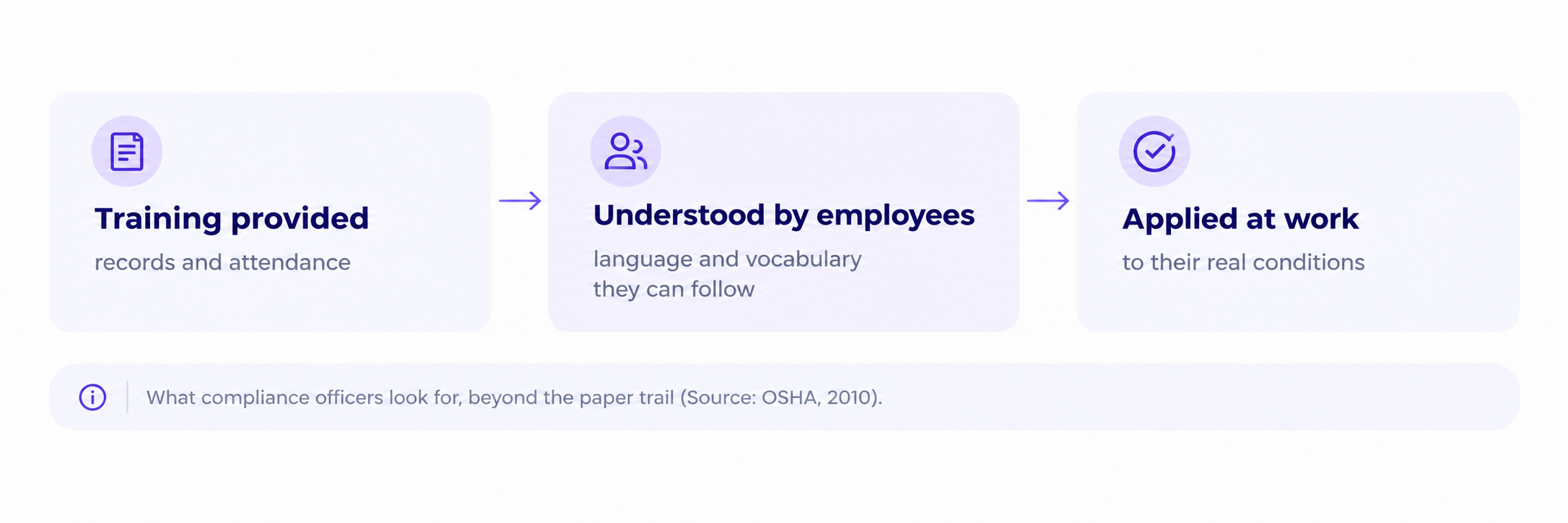
Compliance officers test this directly. They check that training was provided in a format employees could understand, and they look beyond paper records, because an employer can hold training records for employees who could not follow the training. A violation may be cited as serious when a reasonable person would conclude the employer did not convey the training in a way employees could understand.
The policy covers training requirements in agriculture, construction, general industry, and maritime work. This is general information and not legal advice, so check the standard that applies to your work.
Does OSHA require every workplace document in the employee's language?
No, not as a blanket rule, because OSHA's 2010 policy statement addresses training that OSHA standards require, and it asks whether employees understood what they were taught. Specific standards add their own comprehension requirements, so check the ones that apply to your work.
One line in the statement reaches further. Employers that customarily give work instructions or other workplace information in a language other than English are expected to provide safety and health training in the same way.
In practice, that makes the documents you already issue a signal. If schedules, job instructions, or HR notices already go to employees in Spanish or Haitian Creole, the training should follow the same pattern. That is my reading of the statement, and employment counsel can confirm how it applies to your workplace.
Which documents should employers translate first?
Start with the documents an employee has to act on, which are safety training, injury and incident forms, and the policies that set rights and duties. General company material can follow. This is our view, and it matches the requests we receive.
In those four weeks, employers asked us for HR policies and training materials for hotel employees. A healthcare team asked for workers' compensation guidelines with injury, witness, and declination forms, and a company asked for HR and compliance policies for its employees in Brazil. The languages were Haitian Creole, French, Chinese, Korean, Spanish, Vietnamese, and Brazilian Portuguese, and once those documents are in place, our employee handbook translation service covers the full handbook.
Where to start, and what to check before each document goes out
| Document | Why it comes first | Check before it goes out |
|---|---|---|
| Safety training slides, videos, and quizzes | OSHA asks whether employees understood the training | Language, vocabulary level, and a format that works for employees who read less comfortably |
| Injury, incident, and witness forms | Employees complete them after something has gone wrong | Plain wording, and field names that match the policy that cites them |
| Declination and acknowledgment forms | They record what an employee was told or chose | The employee signs the version in the language they read |
| Workers' compensation and benefits guidelines | Employees have to claim these rights themselves | Terms match the official forms employees will see |
| HR and compliance policies | They set rights and duties | Defined terms stay consistent across every document |
| Flyers and signage | They are read quickly, at the moment of need | Test the wording on a few employees before printing |
Declination and acknowledgment forms deserve extra care because they record a decision. A signature on a form the employee could not read is a weak record of anything.
Can AI translation handle safety training and HR documents?
It depends on the document, because OSHA asks whether employees understood the result, and a machine draft that no one has reviewed cannot show that. For policies tied to safety, discipline, wages, or legal rights, we recommend full human translation with editing and a final bilingual check.
AI post-editing fits material that is high in volume and not tied to legal rights, such as internal reports or e-learning modules. A professional translator corrects the AI output and stays accountable for it. We offer that route as our AI post-editing service.
Employers also arrive with AI translations already in hand, and one asked us to review them as part of an employee-document project. We work to ISO 17100:2015, which requires a second linguist to revise every translation against the source.
Relying on a bilingual employee carries the same risk, because a colleague who speaks the language has not necessarily been trained to translate it.
How do you check that employees understood the translation?
Ask a native reader to review the translation, then ask a few employees to explain the instruction back in their own words. The review catches wording errors, and the teach-back shows whether the meaning landed. OSHA looks at comprehension, and compliance officers look past training records.
Some standards build the check in. Bloodborne pathogens training requires an opportunity for interactive questions and answers with the trainer, and lockout/tagout requires employers to verify that employees acquired the knowledge they were taught.
Match vocabulary to the people reading it. OSHA says a limited vocabulary must be accounted for, so a policy written in a lawyer's register may need a plainer version for the floor.
How are HR and injury documents kept confidential during translation?
Injury reports and witness statements carry names and health details, so settle confidentiality before the files move. Our HR translation services use secure file transfer, role-based access, and NDAs on request. Ask for an NDA before you send forms that name employees.
Clients in healthcare and finance tell us that data security comes first, and an employee document with names in it raises the same concern.
How do you keep translated policies current when they change?
Treat each language edition as a versioned document, with the version and effective date recorded, and update every language when the English source changes. Translation memory and terminology management keep terminology consistent and reduce turnaround and cost when policies change.
Update the forms and training whenever the policy changes, because they cite it. The post on common HR issues in translation covers related problems.
OSHA's test will keep asking whether employees understood, so build the check into the project from the start.
Employees can only act on what they can read, and a translation earns trust when the person holding it can say what it asks them to do. If your team needs employee documents translated, start from the Tomedes quote page and tell us which documents employees act on first.
FAQs
Q: What are the OSHA requirements for non-English speaking workers?
A: Employers must provide required training in a language and vocabulary the employee understands, and for employees who are not literate, handing them written materials does not satisfy the obligation. The standard that applies to your work sets any further details.
Q: Is it legal to tell employees to only speak English at work?
A: It depends on how broad the rule is, because an English-at-all-times rule is treated as a burdensome condition of employment, while a rule limited to certain times is allowed only with business necessity (Source: EEOC, 29 CFR 1606.7). It does not change the duty to train employees in a language they understand.
Q: Can I use AI translation for HR and safety documents?
A: It depends on the document, because OSHA looks at whether employees understood the result. Tomedes recommends full human translation with editing and a final bilingual check for policies tied to safety, discipline, wages, or legal rights.
Q: Which workplace documents should be translated first?
A: Rank documents by risk and by how often employees act on them. Safety training and injury forms rank high in the requests we receive. A supervisor can tell you which documents prompt the most questions on the floor.

Written by Emilyn Sinamban
Connect on LinkedInEmilyn leads Tomedes' global Client Solutions department, built around one idea: every client relationship should have a single owner from first contact to final delivery. She writes about what clients actually tell her they worry about such as data security, deadlines, and the guesswork she's spent a career trying to remove.
Share:

Post your Comment