 Add text to get the translation that 22 AI models agree on


A client’s experience with our translation team
Most buyers choose a translation vendor on a quote, a turnaround estimate, and a sample page. All three describe the first delivery. None of them shows what happens when the schedule moves, a reviewer wants a phrase changed, or the audience turns out to speak a specific regional variety of the language.
I have worked at Tomedes for ten years, first as a Project Manager and now as Head of Client Solutions. My view is that the way a vendor handles those moments tells you more than the way it handles the first file. A client recently sent Tomedes a letter about exactly that, so I am using it here as evidence.
Below, I put the client’s own words next to the project record, so you can see which parts are documented and which are the client’s impression. I also list what I would ask any vendor before signing. ISO 17100:2015, the standard behind our certification, requires a second linguist to revise the translator’s work before delivery, which is a separate matter from the changes a client asks for afterward.
Key takeaways
- The client’s letter credits Tomedes with meeting deadlines, accommodating urgent requests, handling revisions and regional dialect adaptation, and communicating clearly.
- The project record documents the language pair as English to Mexican Spanish, with the client’s own Spanish glossaries applied as mandatory reference.
- Supplementary and missing files arrived mid-engagement and went into the existing workflow without disrupting grades already in production.
- A dedicated account contact kept standing instructions on every order, so each new batch started without a fresh brief.
- I believe a vendor’s response to changes tells a buyer more than its first delivery does, and I list six questions to ask before signing.
What did the client say about working with Tomedes?
Kristina Scott, Senior Product Manager at Paradigm Math, LLC, wrote that Tomedes met deadlines, accommodated urgent requests under tight timelines, handled revisions and regional dialect adaptation with care, and communicated clearly. She also named Denis, the project manager, as an exceptional point of contact.
The letter follows a multi-batch project to translate Paradigm’s TK–8 mathematics curriculum into Spanish, which the Paradigm Math customer success story describes in full. As of October 2026, that record lists the language pair, the workflow, and the batches delivered.
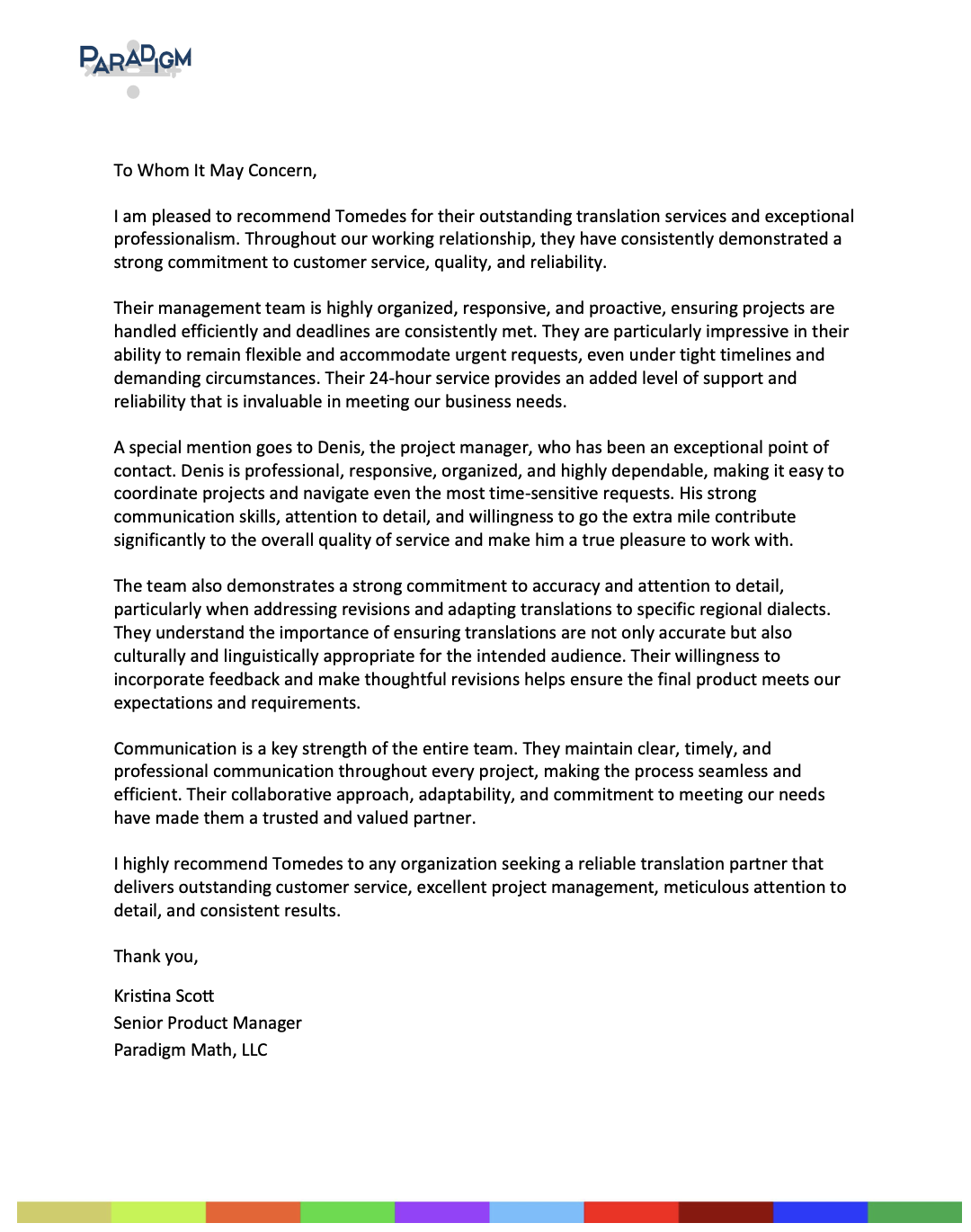
What the letter says and what the project record shows
| Topic | The client’s words | The project record |
|---|---|---|
| Urgent requests | “accommodate urgent requests, even under tight timelines and demanding circumstances” | Supplementary and missing files were added mid-engagement and folded into the existing workflow. |
| Revisions | “willingness to incorporate feedback and make thoughtful revisions” | Terminology was held in one shared reference across all grades, built in the Key Terms Glossary tool. |
| Regional dialects | “adapting translations to specific regional dialects” | Language pair recorded as English to Spanish (Mexican); the client’s Spanish glossaries were applied as mandatory reference. |
| Point of contact | “Denis, the project manager, who has been an exceptional point of contact” | A dedicated account contact managed the engagement across all batches and kept standing instructions on every order. |
| Communication | “clear, timely, and professional communication throughout every project” | Not documented in the project record. This is the client’s own assessment. |
Where the record has detail, a reader can check the claim. Where it is silent, as it is on communication, the letter is the client’s assessment and nothing more.
Can a translation vendor handle urgent requests without lowering quality?
It depends on whether urgent work enters the same glossary, review, and delivery steps as planned work, because quality drops when a vendor skips steps to save time. A vendor whose process is built to absorb additions can move fast without cutting those steps.
Kristina wrote that the team was “particularly impressive in their ability to remain flexible and accommodate urgent requests, even under tight timelines and demanding circumstances.” In the project record, supplementary files and missing-file additions emerged mid-engagement and were folded into the existing workflow without disrupting the production schedule for grades already in progress.
My take is that the question to ask a vendor is whether the rush file goes through the same steps as the planned ones. If the answer is a separate, faster route, I would expect the quality to differ as well.
The letter also mentions a 24-hour service. Tomedes publishes its human support as available 24/7, but I do not want to assume that is what Kristina meant.
What does a good translation revision process look like?
A good revision process records the client’s requested change, applies it through the same glossary the rest of the project uses, and updates every place the term appears. It also tells the client what changed, so one correction does not create a new inconsistency somewhere else.
The word revision covers two different things. Inside the translation process, ISO 17100:2015 requires a second linguist to compare the translation with the source before delivery. After delivery, a client revision is a request to change wording, terminology, or fit for the audience.
Kristina’s letter is about the second kind. She credited the team’s “willingness to incorporate feedback and make thoughtful revisions,” and she linked it to accuracy and attention to detail.
On this project, terminology sat in one shared reference. Paradigm supplied grade-level Spanish glossaries and Spanish equivalents for the Standards for Mathematical Practice, and Tomedes built a unified terminology reference across all grades in the Key Terms Glossary tool.
I believe a revision process is working when the tenth change costs the client no more effort than the first.
Does a translation need to be adapted to a regional dialect?
Yes, because vocabulary and register that are standard in one region can read as foreign in another, and readers notice the mismatch. Adaptation works best when the brief names the target region from the start and the vendor checks the result against it.
In Paradigm’s case, the project record names the language pair as English to Spanish (Mexican), for classrooms in California. The letter uses a broader phrase and says the team adapted translations to “specific regional dialects.” I will not read more into it than the record supports.
The record also shows who held the terminology decisions. Paradigm had already developed grade-level Spanish glossaries, and translators applied them as mandatory reference instead of making independent terminology choices. I think that is a useful model for any buyer with an established house vocabulary, since the client sets the standard and the vendor enforces it.
Nimdzi reports that 9 in 10 international users ignore products that are not in their native language. Native language is the floor, and for English to Spanish work I think regional fit is the next thing a buyer should specify, because a translation can be in the right language and still read as written for someone else.
How does a translation team keep a long project consistent when new files arrive?
On this project, a dedicated account contact kept the client’s standing instructions on every order, so each new batch began with the same workflow, glossary references, and layout requirements. Supplementary files joined that same workflow instead of getting a separate process.
The engagement ran in batches for the TK books and Grades 1, 2, 4, 5, 6, and 8, plus additional files and missing-file supplements. Each batch had its own deadline tied to Paradigm’s publishing and adoption schedule.
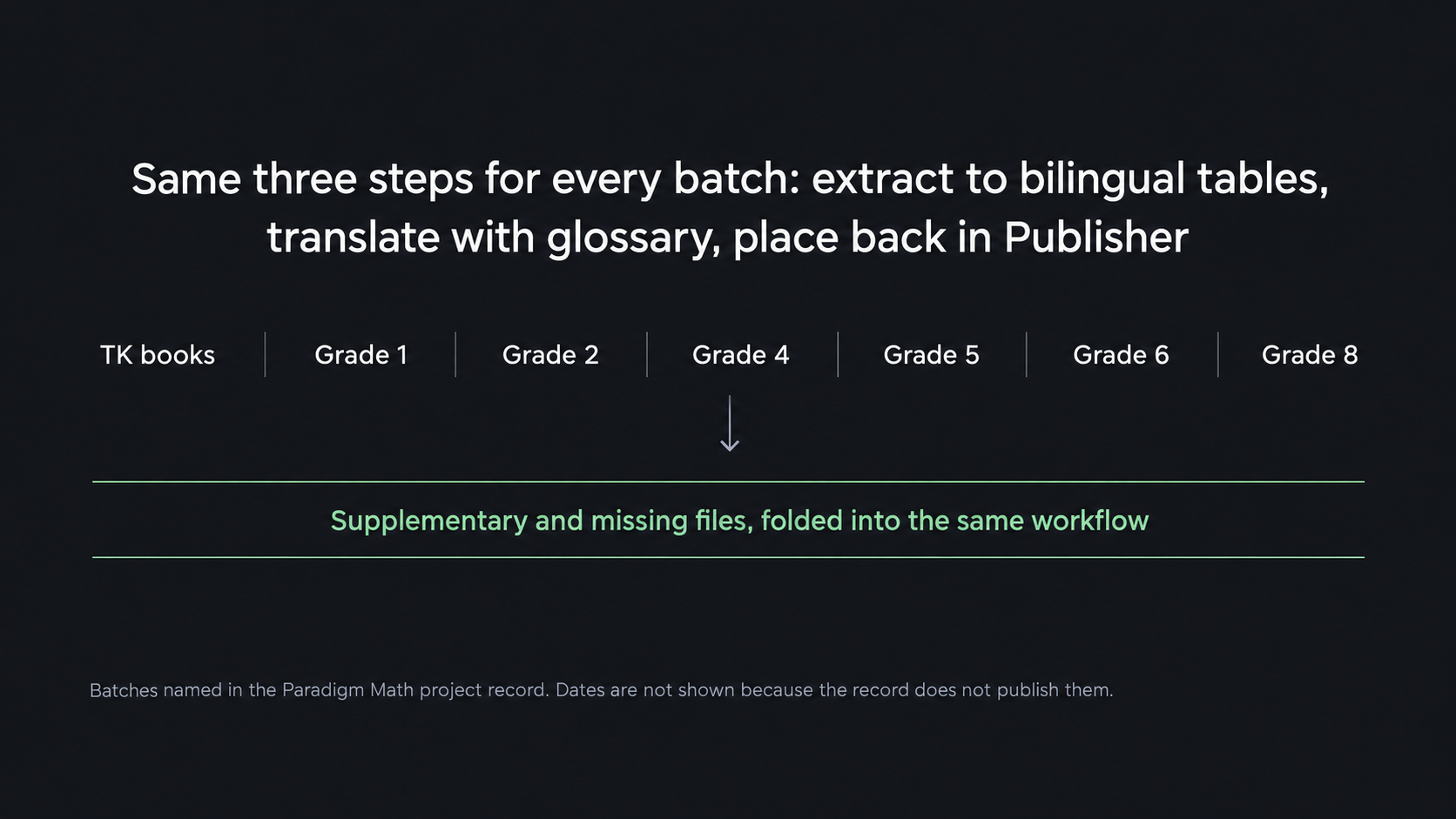
Each batch followed the same three steps. Content was extracted from Microsoft Publisher into bilingual tables, translated and reviewed with the glossary applied, and placed back into the original Publisher files with fonts, colors, layout, and math symbols intact.
The client singled out Denis, Tomedes' Client Solutions Expert and the Project Manager here, in the letter as “professional, responsive, organized, and highly dependable.”
In my opinion, the standing instruction is one of the more useful tools in a long project, because it removes the re-briefing that lets small differences creep in.
What does one client letter not tell you?
It does not give you turnaround times, error rates, or costs, and it comes from one client who chose to write it. It tells you how that client experienced the work and which of its claims the project record can back up.
I would not rest a vendor decision on one letter, including this one. A buyer should read it next to independent reviews, which Tomedes links from its site on Trustpilot, G2, Clutch, and GoodFirms, and should ask any vendor for the project record behind a testimonial.
The letter also does not say how many revision rounds the project needed or how fast the urgent files came back.
What should you ask a translation vendor before signing?
Ask who owns your project from first contact to final delivery, how late files are handled, how your glossary is enforced, how a regional variety is specified, and how a change is applied across the whole project. The answers show how the vendor behaves after the first delivery.
These are the six questions you should ask, drawn from what the letter and the project record describe.
- Who is my single point of contact from first contact to final delivery, and who covers when that person is away?
- What happens when files arrive after the project starts?
- Will my glossaries be mandatory reference for every translator, and how is that enforced?
- How will the target region be specified and checked?
- When I request a change, how is it applied across files already delivered?
- Can I speak with a client who sent changes mid-project?
On my team, every client-facing person owns the client relationship from first contact through final delivery. I think that structure is what Kristina’s letter describes from the outside, though I cannot speak for what she had in mind.
If you are planning a multi-batch project, send the files and glossaries you already have through the quote form and tell us the target region.
FAQs
Q: Can Tomedes accept urgent additions to a project already in progress?
A: Yes, because on the Paradigm Math engagement supplementary files and missing-file additions arrived mid-project and were folded into the existing workflow without disrupting grades already in production. Availability and timing depend on language pair, volume, and deadline, so confirm specifics with a project manager before committing.
Q: How do I request a specific regional variety of Spanish?
A: Name the target region in the brief, for example Mexican Spanish for California classrooms, and share any glossaries or style references you already have. On the Paradigm Math project, the client’s Spanish glossaries were applied as mandatory reference, so translators followed established terms instead of choosing their own.
Q: What is the difference between ISO revision and a client revision?
A: ISO 17100:2015 requires a second linguist to compare the translation with the source before delivery. A client revision happens after delivery, when the client asks for changes to wording, terminology, or regional fit. Both matter, but only the first is a built-in quality step in the translation process.

Written by Emilyn Sinamban
Connect on LinkedInEmilyn leads Tomedes' global Client Solutions department, built around one idea: every client relationship should have a single owner from first contact to final delivery. She writes about what clients actually tell her they worry about such as data security, deadlines, and the guesswork she's spent a career trying to remove.
Share:

Post your Comment