 Add text to get the translation that 22 AI models agree on


We asked our translators how they use AI translation on client documents
Our clients, especially those in legal, healthcare, and finance, tell us that data security is their number one concern when using AI translation. A business that orders a human translation usually assumes no AI translation touched the file, and the buyer rarely sees how the work was done.
In my opinion, the label on a translation now tells a buyer less than the policy behind it. In a pilot survey of 20 translators from the Tomedes network, 18 said they use AI translation tools on client work at least rarely, and only 8 described what they deliver as human translation only.
That fits the wider industry. Slator's 2025 market report found that among respondents using machine translation or large language models, 90 to 98 percent perform some level of post-editing on the output.
This article shares what the 20 translators told us about how often they use AI translation tools, what they say they deliver, where they never use it, whether they disclose it, and how they protect confidential files. It is a small pilot, so I report counts and not percentages.
Key takeaways
- Eighteen of 20 translators in our pilot use AI translation tools on client work at least rarely, and 8 use them often or almost always.
- Nine of 20 describe what they deliver as AI plus human translation, 8 say human translation only, and 3 say it depends on the document; 6 of the 8 who say human translation only still use AI translation tools at least rarely.
- Nine of 20 never use AI translation tools on certified or sworn translations, and 7 never use them on legal contracts.
- Of the 18 translators who use AI translation tools, 9 always tell the client or agency, and 3 use free public tools or do not know the data terms of the tools they use.
- From where I sit, agencies should publish their AI translation policy and name the review step, and the translators who left comments ask for the same thing.
How many translators use AI translation tools on client work?
Almost all of them, mostly in a supporting role. Of the 20 translators in our pilot, 18 use AI translation tools on client work at least rarely, 13 use it sometimes or more, and 8 use it often or almost always.
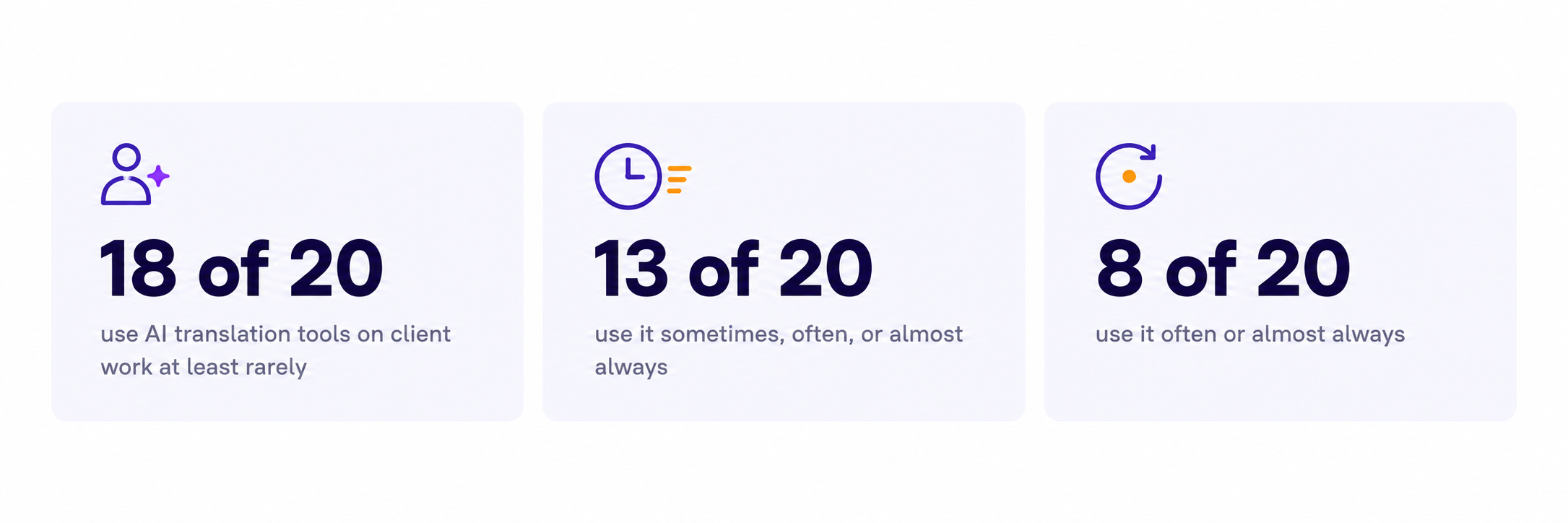
We ran the pilot as an anonymous questionnaire of 10 questions, answered by 20 translators from the Tomedes network. With 20 responses, the figures are counts and not percentages; select-all questions add up to more than 20, answers are self-reported, and the group may not represent all translators. Written comments appear with the translator's permission and are unedited.
Terminology lookup is the most common use, named by 13 of the 18 who use AI translation tools. Nine use it for first drafts, 7 for quality checks, 6 for rephrasing, 5 for checking their own translation, and 4 for understanding the source.
On tools, 9 use general AI assistants, 7 use AI built into their CAT tool, 6 use general machine translation, and 4 use a platform provided by an agency or client. Respondents could pick more than one.
These numbers show me AI translation becoming a working tool for translators, used most for lookup and checking, with drafting a smaller share. Slator's finding that most respondents using these tools post-edit the output points the same way.
What do translators say they deliver when a client asks for a translation?
The answers split almost evenly. Nine of 20 describe their work as AI plus human translation (5 human translation with AI assistance and 4 AI draft with human post-editing), 8 say human translation only, and 3 say it depends on the document.
For a buyer, that means the phrase human translation can cover very different workflows. My advice to a buyer is to ask for a description of the workflow. On certified and legal work first. Nine of 20 never use AI translation tools on certified or sworn translations, 7 never on legal contracts, 5 never on immigration documents, 5 never on medical records, and 4 never on financial documents; 7 exclude no document type.Where do translators never use AI translation tools?
To me, the pattern shows translators protecting the work where a named person has to stand behind it. That is the logic of certified translation, where the receiving institution asks for a signature. It depends on the translator, because 9 of the 18 who use AI translation tools always tell the client or agency, 6 do so when asked, 1 does so only when required, 1 never does, and 1 preferred not to say. That leaves 8 of the 18 whose clients learn that AI translation was used only if they ask, if a rule requires it, or not at all. The 20 includes 2 translators who do not use AI translation tools on client work, for whom the question did not apply. "Agencies should publish their AI policy the same way they publish their style guides. Translators need to know what they're signing up to." - A translator, pilot survey comment I agree with the first sentence. Translators are part of the relationship my department owns, and they are asking for the same clarity our clients ask for. A policy a buyer can read is the only way to tell a human-only workflow from one with AI translation in it, and Tomedes explains how its AI translation works in a separate guide. Mostly with paid or approved tools, but not always. Of the 18 translators who use AI translation tools, 8 use paid tools with data protection terms, 5 use only tools approved by the agency or client, 2 use free public tools, and 1 does not know the terms; respondents could choose more than one. Two more remove names and sensitive details first, one relies on the terms of their CAT platform, and one preferred not to say. Three of the 18 use free public tools or do not know the terms of the tools they use. Two translators asked agencies for clarity in their own words. One wrote, "If agencies want me to use their platform, they need to tell me what the data terms are. I won't guess". Another wrote, "I wish agencies were clearer about which tools are approved. I'm guessing most of the time." My view is that this is a gap in communication more than a gap in care, because the translators who comment ask the agency to say which tools are approved. It is also the part of this pilot I want a larger survey to test. Ask whether AI translation is used on your files, which tools handle them and under what data terms, and whether a named translator reviews and stands behind the result. These are the same gaps the translators in our pilot point to. A provider that answers all three in writing can show you the workflow. One that says only "human translation" leaves you to guess. The third question is the one to press when a document goes to a court, an agency, or a licensing body, because the receiving institution decides what it accepts. For those files, Tomedes' certified translation service puts a named translator behind the result, and for content no institution will stamp, the AI translation service pairs AI translation with human post-editing. Nimdzi's 2026 report describes buyers who tried raw AI translation output on content once marked not for machine translation and returned to providers for expert-in-the-loop validation. My bet is that the disclosure numbers in a survey like this one will move first as buyers start asking these questions, and a larger group would show it. Until then, a written answer to those three questions is what takes the guesswork out of the order. Q: Is AI translation any good? Q: Can ChatGPT do translation? Q: Is AI translator free to use?Do translators tell clients when they use AI translation tools?
How do translators handle confidential files when they use AI translation tools?
What should businesses ask their translation provider about AI translation?
FAQs
A: It depends on the document, because translators in our pilot use AI translation most for terminology lookup (13 of 18 who use it) and first drafts (9 of 18), and 9 of 20 never use it on certified or sworn work. A qualified human translator should check documents where an error has a cost.
A: Yes, ChatGPT translates well in major languages, and 9 of the 18 translators in our pilot who use AI translation tools use general AI assistants. A qualified human translator should check the result, and confidential documents belong only in tools whose data terms you have read.
A: Yes, for basic use, but free tools can carry data risk. In our pilot, 2 of the 18 translators who use AI translation tools use free public tools on client work, and 1 does not know the data terms of the tool they use. Confidential files belong in a paid plan with documented terms.

Written by Emilyn Sinamban
Connect on LinkedInEmilyn leads Tomedes' global Client Solutions department, built around one idea: every client relationship should have a single owner from first contact to final delivery. She writes about what clients actually tell her they worry about such as data security, deadlines, and the guesswork she's spent a career trying to remove.
Share:

Post your Comment