 Add text to get the translation that 22 AI models agree on


How much does translation cost in 2026?
What are expected translation rates in 2026?
A word is not a word. That is the whole story of translation pricing, and it is why a 500-word slogan and a 500-word legal contract can share a word count and nothing else in price. Standard human translation runs $0.10 to $0.30 per word. Machine-assisted tiers run lower, from $0.03 to $0.15, depending on how much human review is built in. Certified documents are priced per page instead of per word. Rush work adds 25 to 100 percent on top of whichever rate applies.
We have priced translation projects at Tomedes since 2007, across two decades where the underlying technology changed completely and the fundamentals of a fair quote did not. The rest of this guide is what actually moves you up or down that range, and where the real savings and the real risk sit.
What factors affect translation rates?
Six variables set the final price, and every one of them is a real cost, not a markup invented to pad the invoice. Length drives it first: more words, more time, more cost, though high-volume projects usually earn a volume discount worth asking for directly. Language pair drives it second, on pure supply and demand. Spanish has roughly 500 million native speakers and a correspondingly large translator pool, which keeps it affordable; a rare regional language with a handful of qualified translators costs more, and some pairs need relay translation through an intermediate language when no direct translator exists.
Domain expertise is the third factor, and it is where the price difference actually earns its keep. A legal contract needs a translator with legal training, not just fluency. A medical report needs clinical terminology. Errors in these fields carry real consequences, and the rate reflects that. Turnaround time is the fourth: rush projects carry a 25 to 100 percent premium, and planning ahead is the one lever a client fully controls. Intended use is the fifth. Marketing copy may need transcreation and desktop publishing. Legal documents for court or immigration may need certified or sworn translation, with formal attestation attached. Translator location is the sixth: a translator in a high-cost city charges more than one in a lower-cost market, though the cheapest option by geography alone can cost you the regional terminology and cultural context a local translator would have caught.
How much should I pay a translator?
Agencies typically charge per word. Industry averages sit around $0.10 to $0.13 per word for standard content, with legal and medical work reaching $0.15 to $0.30 or higher. That rate covers more than the translation itself: project management, quality assurance, translator vetting, formatting, and client support. When you compare quotes, check what is actually included. A low per-word figure can hide separate fees for file preparation, desktop publishing, rush handling, or QA review, and those add-ons change the real total.
Certified translations, the kind required for immigration documents, court filings, and academic transcripts, are typically priced per page rather than per word, since they carry an additional formal review step.
Here is what that actually looks like at Tomedes, by language pair, for standard-content human translation:
| Language pair | Rate per word (USD) |
|---|---|
| English → Arabic | $0.09 |
| Arabic → English | $0.10 |
| English → Korean | $0.11 |
| English → Portuguese | $0.11 |
| French → English | $0.11 |
| German → English | $0.11 |
| English → French | $0.12 |
| English → Japanese | $0.12 |
| Japanese → English | $0.12 |
| English → Amharic | $0.12 |
| English → German | $0.13 |
The pattern holds even inside one table: a lower-demand pair like English to Amharic sits above higher-demand pairs like English to Arabic or English to Korean, which is the supply-and-demand factor from the previous section showing up as an actual number instead of a general statement.
How do freelance translators set their rates?
Freelancers generally charge less than agencies because they carry less overhead. The U.S. Bureau of Labor Statistics put the median annual wage for interpreters and translators at $60,170 in its May 2025 update, up from $59,440 the year before, though that figure covers salaried employees and does not fully capture what an independent contractor earns per word.
For project work, professional translators in the U.S. typically charge $0.15 to $0.30 per word. Hourly work runs $15 to $30 for general content and $75 or more for specialized fields like healthcare or law, broadly consistent with what the American Translators Association reports in its own compensation survey, the closest thing the industry has to a standard benchmark. Interpretation follows the same logic but at a different scale: Tomedes' own published on-site interpretation rates run $84 to $180 an hour depending on the language, with a three-hour minimum booking.
The tradeoff with freelancers is capacity and accountability. One translator cannot match an agency's throughput on a large or urgent project, and there is no built-in quality review unless you arrange one separately. For smaller, lower-stakes work, a vetted freelancer can be the more cost-effective choice.
How has AI changed translation pricing?
AI added a third pricing tier below full human translation, and at Tomedes it actually splits into two, depending on how much human review the content gets.
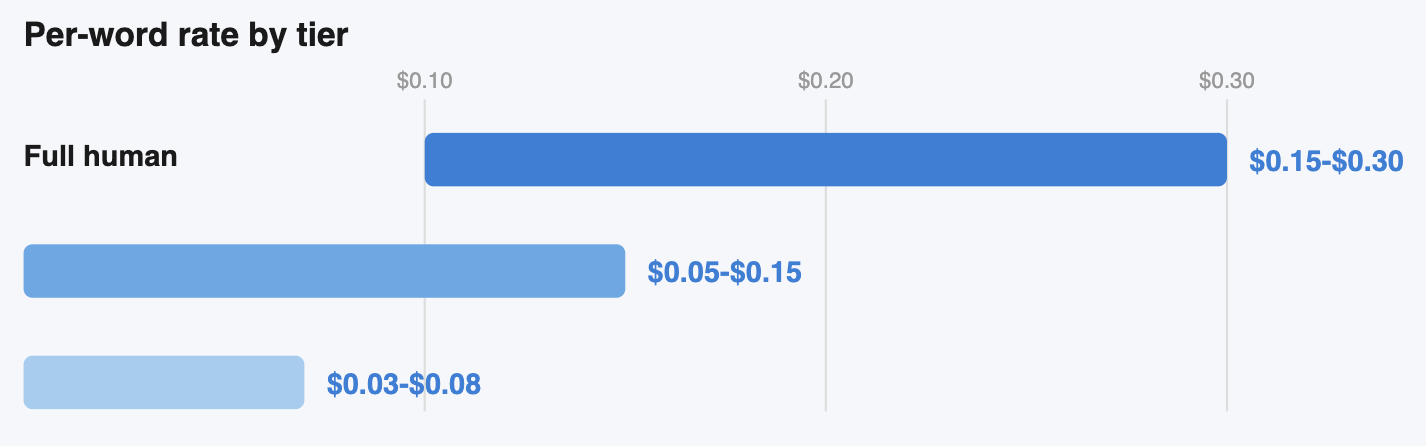
Full MTPE means a machine draft followed by a complete human edit pass for accuracy and fluency. Light MTPE means a machine draft with human review for meaning and major errors only, not a full polish. The content decides which tier fits. Internal communications, e-commerce listings, user-generated content, and knowledge base articles are well suited to a lighter tier. Legal contracts, medical instructions, marketing campaigns, and creative content are not: in those domains, the risk of an undetected error outweighs the per-word savings.
A provider who recommends the same tier for every project, regardless of what that project actually is, is not pricing for your content. Tomedes' own human-in-the-loop model exists to make that tier decision explicit instead of leaving it to chance.
How to get a fair translation price
A good quote comes down to preparation. Know your word count before you ask for one; the AI Word Counter in Tomedes' free tools suite does this in seconds and gives you a real basis for comparing quotes. Be specific about language pair, content type, and deadline; a vague brief gets a vague number back. Ask directly what is included, project management, QA review, file formatting, certification, since hidden fees at invoice stage are a known pain point across the industry, and ask about volume discounts if the work is ongoing.
Two checks are worth doing before you sign anything. Confirm the provider's process credentials: ISO 17100:2015 covers translation services and ISO 18587:2017 covers machine translation post-editing, and both are a real indicator of process rigor rather than a marketing badge. Run a pre-translation check on your source text, since ambiguous phrasing, inconsistent terminology, and formatting issues slow a translator down and add cost before the project even starts. Tomedes' own Pre-Translation Toolkit flags exactly this before work begins.
For a project quote or to talk through which tier fits your content, contact Tomedes. Tomedes works across 270+ languages with subject-matter expert linguists, a dedicated project manager on every project, and a 1-Year Quality Guarantee.
FAQ
Q: What is the average cost of translation per word?
A: Standard human translation typically runs $0.10 to $0.30 per word, depending on language pair, content complexity, and whether the project needs subject-matter expertise. Rare languages and specialized content sit at the higher end. Machine-assisted tiers run lower, from $0.03 to $0.15 per word depending on how much human review is included.
Q: Is machine translation cheaper than human translation?
A: Yes. Full MTPE runs roughly $0.05 to $0.15 per word and light MTPE $0.03 to $0.08, both well under full human translation at $0.15 to $0.30. The tradeoff is quality ceiling: fine for high-volume, lower-stakes content, not appropriate for legal, medical, or creative work.
Q: Why does a rare language cost more to translate?
A: Fewer qualified translators are available, which reduces supply and drives rates up. Some rare language pairs also require relay translation through an intermediate language, adding a translator and time to the project.
Q: What is the difference between certified and standard translation?
A: Certified translation includes a signed statement attesting to accuracy, required for documents like immigration applications, court filings, and academic transcripts. It's typically priced per page rather than per word, since it requires additional formal review.
Q: How much extra does a rush translation cost?
A: Rush fees typically add 25 to 100 percent to standard rates, depending on how tight the deadline is and the provider's current workload. Giving as much lead time as possible is the most reliable way to avoid the surcharge entirely, and building translation into the project timeline before urgency hits is the more durable fix.
Q: Does document format affect translation cost?
A: Yes. Standard formats like Word, Excel, and PowerPoint are straightforward to handle. PDFs, scanned documents, and multimedia files need extra processing, OCR conversion, reformatting, or transcription, which adds to the total project cost.
Q: How long does it take to translate 20,000 words?
A: A single human translator typically covers 2,000 to 3,000 words a day, so 20,000 words takes roughly 7 to 10 business days at standard pace. An agency splitting the work across multiple translators, or an MTPE workflow, can cut that to 2 to 4 days, though splitting across translators adds a consistency-review step.
Q: Is Google Translate free?
A: Yes, the consumer Google Translate app and website are free. It's fine for getting the gist of something. It isn't suitable for business content: no glossary control, no compliance guarantees, and no human accountable for the result if it's wrong.
Q: Does my phone have a built-in translator?
A: Most smartphones now include some translation function, through the OS itself or a built-in camera translation feature. It works for reading a menu or a street sign. It carries the same risk as any free consumer tool for business use: no terminology control, no accountability, and no certification if a document needs one.

Written by Ofer Tirosh
Connect on LinkedInOfer founded Tomedes in 2007 and now leads the company's push to combine two decades of human translation expertise with AI. He writes about where the language industry is actually heading and the shifts nobody's ready for, the bets that paid off, and the ones that didn't.
Share:

Post your Comment