 Add text to get the translation that 22 AI models agree on


EU AI Act Article 50: what it actually requires for AI translation
What Article 50 actually requires
The specific duty that matters for translated text, per the official text of Article 50: deployers using AI to generate or manipulate text that is published to inform the public on matters of public interest must disclose that the text was artificially generated or manipulated. That's narrower than most coverage of the Act suggests, and it's the piece that actually applies to translation.
We checked the competitive field before writing this. No translation or localization company ranks in the top 10 for "EU AI Act Article 50" right now, the organic results are entirely EU institutional sites, international law firms, and AI-compliance tooling vendors. Nobody has interpreted this specifically for translated content yet, which is unusual given that interest in the term jumped from around 110 to 210 a month in the spring to 720 in August, the exact month Article 50 became legally enforceable.
Why this became urgent in August
Article 50 didn't create a new problem for us to solve. It formalized a distinction our review process was already built around: the difference between a machine producing text and a person taking responsibility for it.
Who actually carries the disclosure duty
Article 50 splits four separate duties across two roles, not one blanket rule. We ran into this distinction before the Act existed, in a different context: someone always has to be the one accountable for what a client receives, machine-drafted or not.
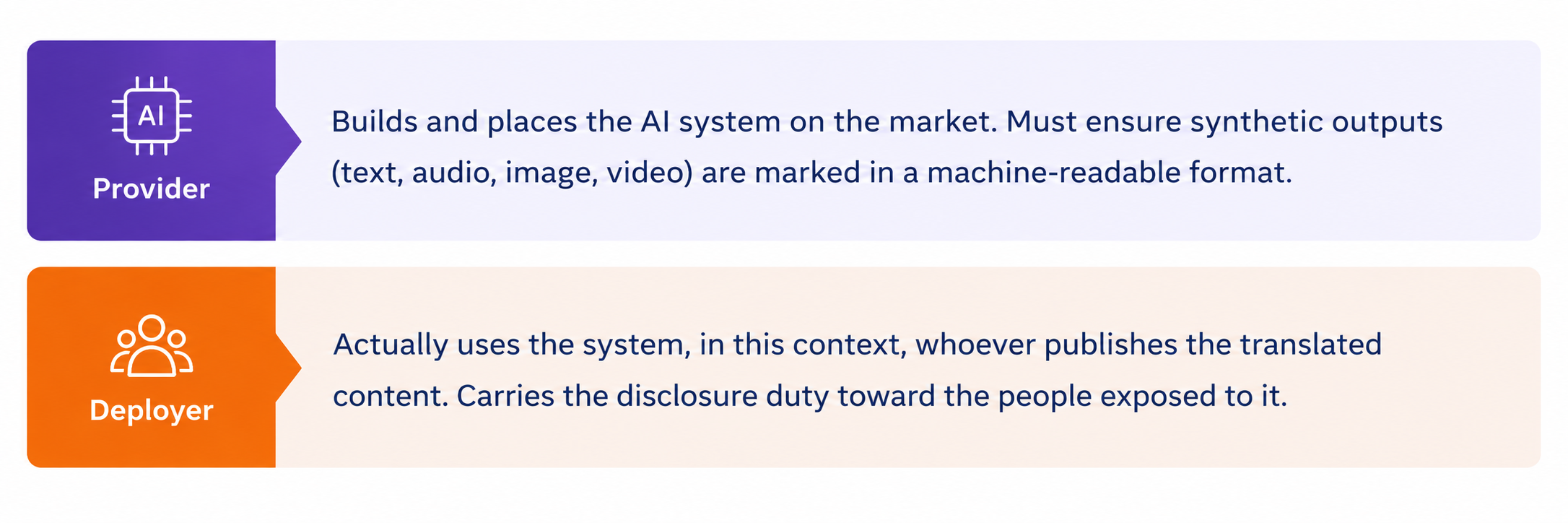
There's no automatic handoff between the two. If a company uses a third-party AI translation tool to publish public-interest content in the EU, that company is the deployer. The obligation sits with them, not the model provider. This is true whether that AI translation is a raw, self-serve tool or a managed service with human oversight built in, the difference shows up in the next section, not this one.
The exception that matters for translation
The text-specific duty is narrow. It applies to AI-generated or manipulated text published to inform the public on matters of public interest, not routine business content, and it doesn't apply where that content has gone through human review or editorial responsibility.
We built human-in-the-loop translation for a different reason entirely, catching what an AI draft gets wrong before a client sees it. It happens to satisfy this exact exception too. A person reviews the AI output, corrects it, and takes responsibility for the final version. Under Article 50's own wording, that's what removes the disclosure trigger, not because the AI wasn't involved, but because someone is now accountable for what shipped.
The EU's own Code of Practice on transparency of AI-generated content is precise about what the disclosure itself is for. It states that a disclosure label informs people of the content's artificial origin, it doesn't vouch for whether that content is trustworthy. Those are two different claims, and the second one still rests entirely on whoever reviewed the translation.
Does your AI-translated content need disclosure?
- Is it text, not audio, image, or video? Audio, image, or video content falls under the deepfake provisions instead, a separate check.
- Is it published to inform the public on matters of public interest? Contracts, marketing, and internal business content generally sit outside this. Public health notices and civic information generally sit inside it.
- Did a human review it and take editorial responsibility? Yes: the exception applies. No: disclosure is required. An AI-translated press release published straight from the model, no review, likely needs a disclosure label. The same release, reviewed under a managed process with a named reviewer, likely doesn't.
Does this reach US or global companies?
Yes. Article 50 follows the content, not the company's home address. A provider or deployer established outside the EU is in scope the moment the AI system's output reaches people inside the Union, which covers a US company publishing AI-generated content aimed at EU audiences, translated or not. We built our own review process without a jurisdiction filter, so this doesn't change how it runs for us, only who now has to check for it explicitly.
None of this required us to build anything new. The review and accountability step Article 50 asks for is the same step our human-in-the-loop workflow already runs on every project. The compliance question turned out to already have an engineering answer.
FAQs
Q: Does the EU AI Act apply to companies outside the EU?
A: Yes. Article 50 applies to providers and deployers established outside the EU when the AI system's output is used inside the Union, including a non-EU company publishing AI-generated content aimed at EU audiences.
Q: Does Article 50 require disclosure for all AI-translated content?
A: No. The text-disclosure duty applies specifically to AI-generated or manipulated text published to inform the public on matters of public interest. Most business translation, contracts, and marketing content fall outside that specific provision.
Q: Does human review remove the Article 50 disclosure requirement?
A: Yes, for the text provision. Article 50 states the disclosure obligation does not apply where AI-generated content has undergone a process of human review or editorial responsibility.

Written by Ofer Tirosh
Connect on LinkedInOfer founded Tomedes in 2007 and now leads the company's push to combine two decades of human translation expertise with AI. He writes about where the language industry is actually heading and the shifts nobody's ready for, the bets that paid off, and the ones that didn't.
Share:

Post your Comment