 Add text to get the translation that 22 AI models agree on


AI translation accuracy: The content types that need multiple rounds of review
Some AI-drafted translations are approved in a single pass. Others go through several rounds of vendor work spread across days before they ship. We looked at a year of Tomedes' own AI-assisted (MTPE) projects, and the difference isn't random: it lines up closely with content type.
Specialized technical and legal content needs the most follow-up rounds. Standard academic and general medical content need almost none. Here's the actual pattern, what the research on post-editing effort says about why, and what it does and doesn't tell us about AI translation accuracy.
What is post-editing in machine translation?
Post-editing is what happens after an AI system produces a first-draft translation: a human reviews it, corrects errors, and finalizes it before delivery. It's the step that turns a fast draft into a deliverable translation.
Researchers studying this process, going back to a foundational 2001 framework by Krings, break the work into three dimensions: temporal effort (how long the correction takes), technical effort (how many actual edits are made), and cognitive effort (the mental work of noticing what's wrong in the first place). Krings' own research treats cognitive effort as the decisive factor, but it's also the hardest one to measure directly, which matters for how we read our own data below.
Is machine translation post-editing worth the effort?
Generally, yes, on productivity grounds specifically. A controlled 2018 study measuring professional literary translators found that post-editing increased translation productivity by 18% when working from statistical machine translation output, and by 36% when working from neural machine translation output, compared to translating the same material from scratch. The same study found post-editing reduced total keystrokes by 9% and 23% respectively.
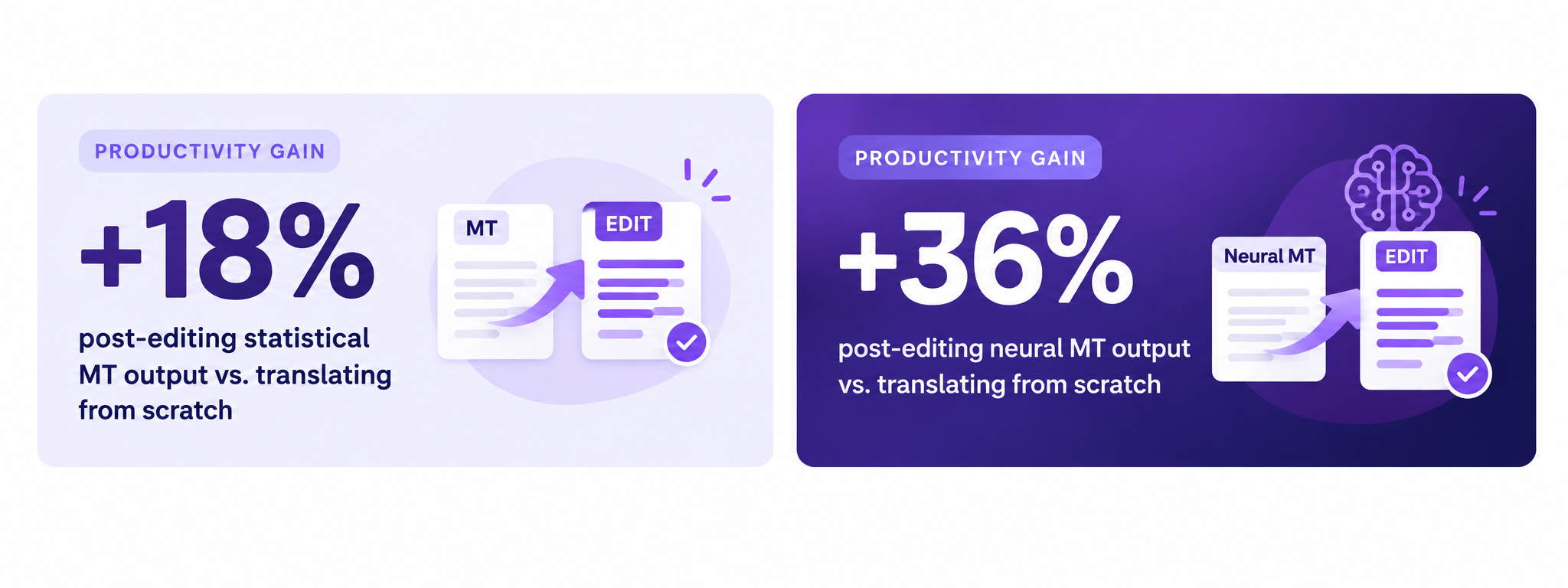
That's a real, measured efficiency gain. But "worth the effort" isn't a single answer across all content, which is exactly what our own project data shows next.
Where the most review rounds actually happen
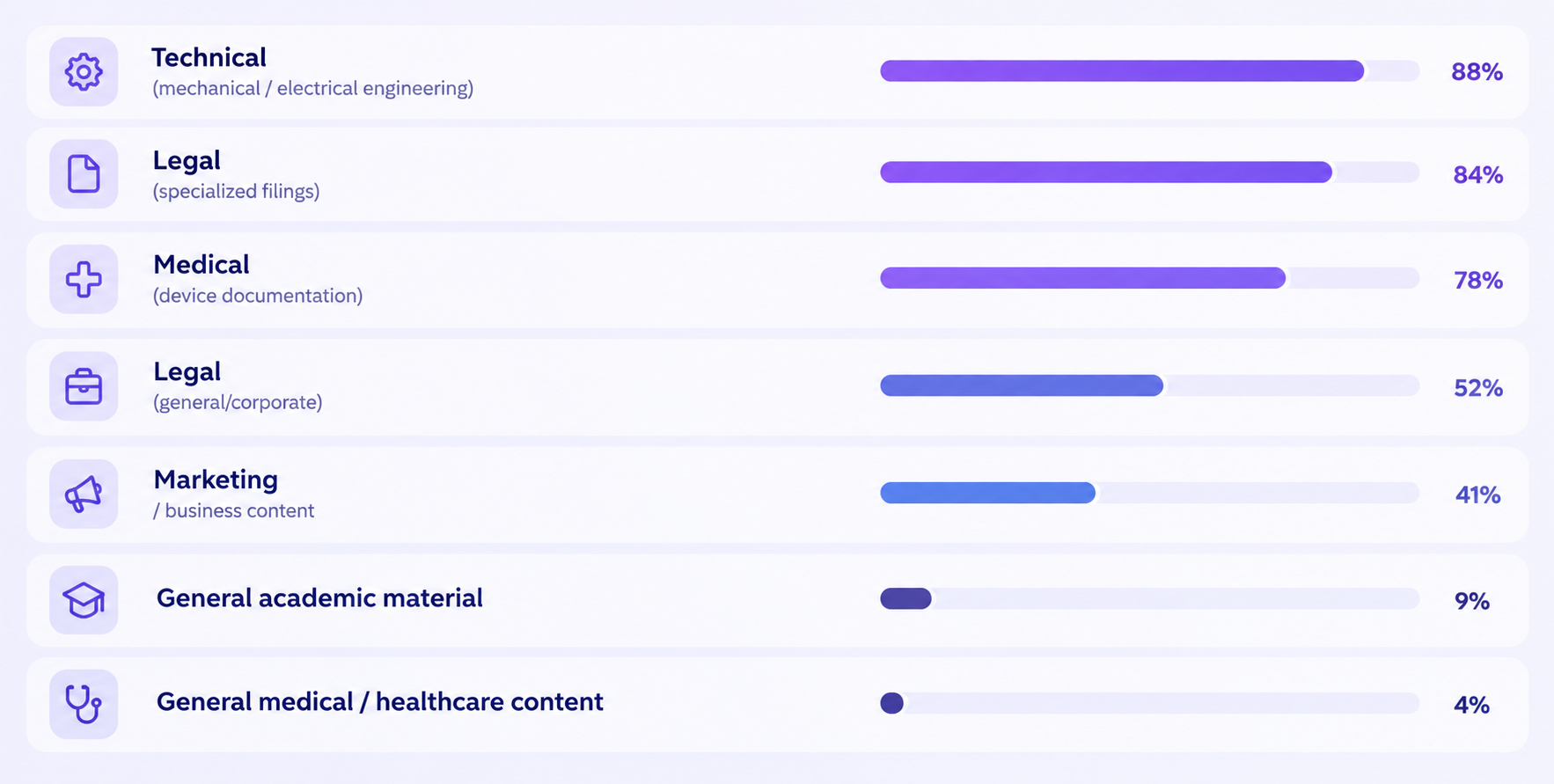
High follow-up work
Engineering specs and legal filings are dense with structure, defined terminology, and consequences for getting a detail wrong. That combination naturally invites more rounds of review, regardless of how good the first AI draft was.
Low follow-up work
Standard academic material often moves through a high-volume, single-pass workflow, more consistent with batch processing than with content requiring close scrutiny segment by segment.
This tells us how much follow-up work a project required, not how accurate the AI's draft was. A content type showing heavy multi-round activity might reflect a genuinely harder translation problem, a stricter internal review standard, or both. A content type showing almost none of it might reflect an easier problem, or simply a process that doesn't loop back for additional rounds by design.
One language pair stood out for a different reason entirely. English-to-Polish AI-assisted projects consistently included an explicit client instruction to scope the review narrowly, fixing only major errors rather than a full polish pass.
What is the typical error rate in AI translation?
There isn't one number, and any single figure quoted as "the" AI translation error rate should be read skeptically. Error rate depends heavily on content type, language pair, and how a model's training data covers that specific combination. This is exactly why Krings' framework separates cognitive and technical effort, the actual severity and type of errors, from temporal effort, the workflow-level signal our own data measures. A project can require several rounds of revision (high temporal effort) without that necessarily meaning the underlying error rate was extreme, and a single-pass project isn't proof the draft was flawless.
What we can say reliably: content types with defined terminology, regulatory stakes, and structural complexity, engineering documentation, specialized legal filings, consistently need more rounds of human involvement in our own data, regardless of which specific error rate produced that need.
Are translators losing jobs to AI?
The honest answer from our own data: the work is shifting, not disappearing. Dense technical and legal content still requires multiple rounds of human review in our projects, regardless of how good the first AI draft is. Human-in-the-loop translation depends on exactly this kind of review capacity, and it's concentrated in precisely the content types our data shows need it most.
What's changed is the shape of the work. Translators are increasingly reviewing, correcting, and finalizing AI drafts rather than producing every word from a blank page, especially for high-volume or lower-stakes content. For dense technical and legal content, translators are still doing something much closer to full translation work, because the review those documents require is substantial regardless of what produced the first draft.
Either way, review scope is a decision worth making explicitly at the start of a project, the same way MTPE itself is a deliberate choice, not something to discover after the fact.
FAQs
Q: What is post-editing in machine translation?
A: Post-editing is the process of a human reviewing and correcting machine-translated text before it's finalized. Researchers typically break the effort involved into three parts: temporal effort (how long it takes), technical effort (how many edits are made), and cognitive effort (how much mental work is needed to spot and fix errors).
Q: Is machine translation post-editing worth the effort?
A: Generally yes for productivity. A 2018 study measuring real translators found post-editing increased productivity by 18 to 36 percent compared to translating from scratch, depending on the machine translation system used. But our own project data shows the amount of effort required varies enormously by content type, so the honest answer depends on what's being translated.
Q: What is the typical error rate in AI translation?
A: There's no single number, because error rate depends heavily on content type and language pair. What we can measure reliably in our own data is workflow intensity, how many rounds of review a project needed, which correlates with effort but isn't the same as a precise error rate.
Q: Are translators losing jobs to AI?
A: The work is shifting, not disappearing. Tomedes' own data shows dense technical and legal content still requires multiple rounds of human review regardless of how good the first AI draft is, while simpler content needs far less. Translators are increasingly doing review and correction work rather than translating every word from scratch.

By Rachelle Garcia
Connect on LinkedInRachelle leads product and AI at Tomedes, where she runs the experiments that turn internal data into better translation experiences. She writes about what actually happens when you build AI products such as MachineTranslation.com — the numbers, the surprises, and the parts that don't go to plan.
Share:

Post your Comment