 Add text to get the translation that 22 AI models agree on


Who's responsible when your AI translation gets it wrong?
I read a piece on X this week arguing there are only four ways to make money.
1. Labor: you trade time for money.
2. Capital: your money earns while you sleep.
3. Arbitrage: you spot something priced wrong and close the gap.
4. Insurance: you get paid to absorb risk other people can't sleep with. Everything else is a story on top.
I ran the translation industry through it. I'm not sure I liked what came out.
Where translation actually sits on this map
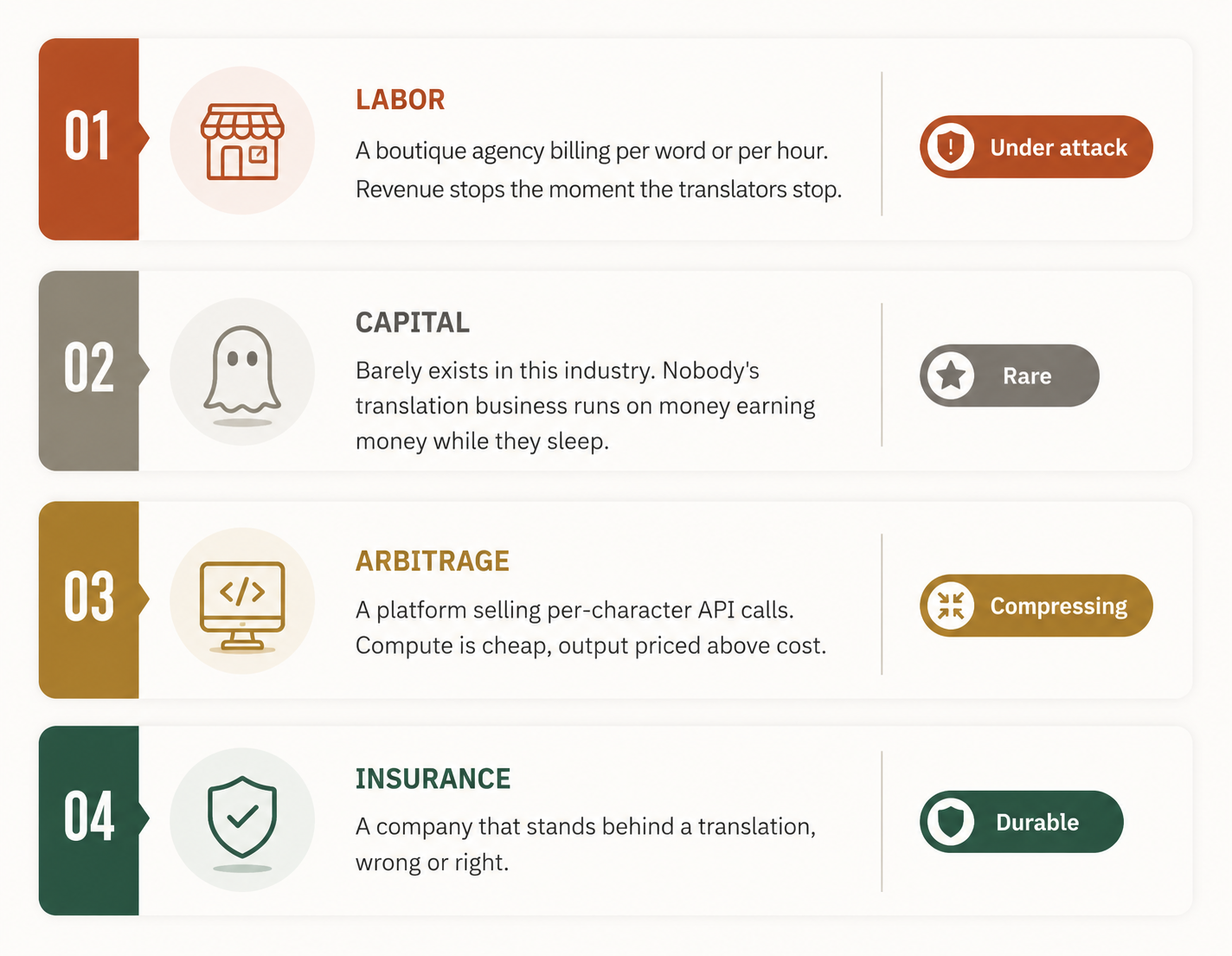
Most of this industry is labor. Hours for words. That's the engine AI is eating, and no pricing model or rebranding changes that. If your revenue stops when your translators stop, you're on engine one, and engine one is the engine under attack.
Capital barely applies here. Almost nobody in this industry makes money while they sleep, translation businesses run on active work, not passive holdings. That's why it's rare rather than compressing or under attack, it was never really in play.
The AI platforms selling per-character API calls, that's arbitrage. Compute is cheap, output priced above cost. That gap closes fast, because the rule applies here too: every gap closes the moment enough people see it. Which is exactly why MachineTranslation.com by Tomedes isn't built as a bare arbitrage play. Compute alone doesn't hold a moat. What holds is what stands behind the output when it's wrong, and that's not something a raw API can manufacture on its own.
What's actually left
A pharma company doesn't pay for a translated label. It pays to not wake up to a recalled batch.
A law firm pays to not discover that clause fourteen means something else in German.
A brand entering a new market pays to not become a screenshot.
The words were never the product. The premium was. That's the durable engine, the one that holds up regardless of how good the AI gets.
Accountability is the one thing in this industry that never got automated.
AI can check AI translation, and it does a decent job on the ordinary mistakes. What it can't do is own the outcome. A company that stands behind a translation, wrong or right, is offering something a raw AI system structurally cannot. When a translation goes wrong, whoever bought it wants a professional company standing behind it, not a chat window. So the real question isn't whether AI can check AI. It's what the person who decides what to trust actually has standing behind them.
Couldn't an AI-only company just build that in?
In theory, yes. Nothing stops a new AI-only translation company from deciding to be accountable and writing that into its terms of service.
In practice, accountability isn't a policy you publish. It's a track record you accumulate, knowing exactly which language pairs break on legal terminology, which domains a model quietly mistranslates without flagging it, which failure modes show up only after the tenth correction, not the first. That knowledge comes from years of catching and fixing real failures across real projects. A new entrant can't buy that history or code it into a model. By the time a company has actually built it, it's no longer a pure AI arbitrage play. It's become an engine-four company, whether it calls itself one or not.
Which is where the article's other line comes in: labor converted into capital. Correcting machine output by hand since 2007 is labor. Knowing where machines break, by language and by domain, because you fixed it every time, that's the asset the labor left behind. That's what MachineTranslation.com is actually built on, not a cheaper way to sell words, but a company that already knew, before it ever shipped an AI product, exactly where machine translation tends to fail and who has to answer for it when it does. This is the same principle behind how human review catches what AI translation misses, and why a company built over two decades of correcting real translation failures has an asset a new AI-only entrant simply hasn't accumulated yet.
What this means if you're choosing a vendor right now
The four-engines framing isn't just industry commentary. It's a filter for a real decision.
1. If a translation is wrong, who is actually accountable, a company, or a chat window with no one behind it?
2. Does the provider know where its own system breaks, by language and by domain, or is it discovering that alongside your for the first time?
3. Is the price you're paying for words, or for someone standing behind the outcome if those words are wrong?
The companies that survive the next five years in this industry will be selling insurance. Not the words. The person standing behind them.
Want a translation partner that owns the outcome?
Tomedes has been correcting machine translation by hand since 2007, the track record behind every AI-assisted project we deliver.
FAQs
Q: Can AI check its own translation for mistakes?
A: Yes, to a point. AI models can catch ordinary translation errors reasonably well. What they can't do is take responsibility when a mistake still gets through, or tell you in advance which language pairs or content types they're most likely to get wrong.
Q: Why do businesses still pay for human-reviewed translation instead of AI alone?
A: Mainly for accountability, not speed. When a legal, medical, or regulated translation goes wrong, the buyer wants a company that stands behind the outcome, not just a tool that produced the words. That's a service AI alone structurally can't offer.
Q: Could a new AI-only translation company build in the same accountability?
A: In theory, yes, but accountability comes from a track record of catching and correcting real translation failures over years, not a policy a company can write on day one. That history has to be accumulated, not built in from the start.
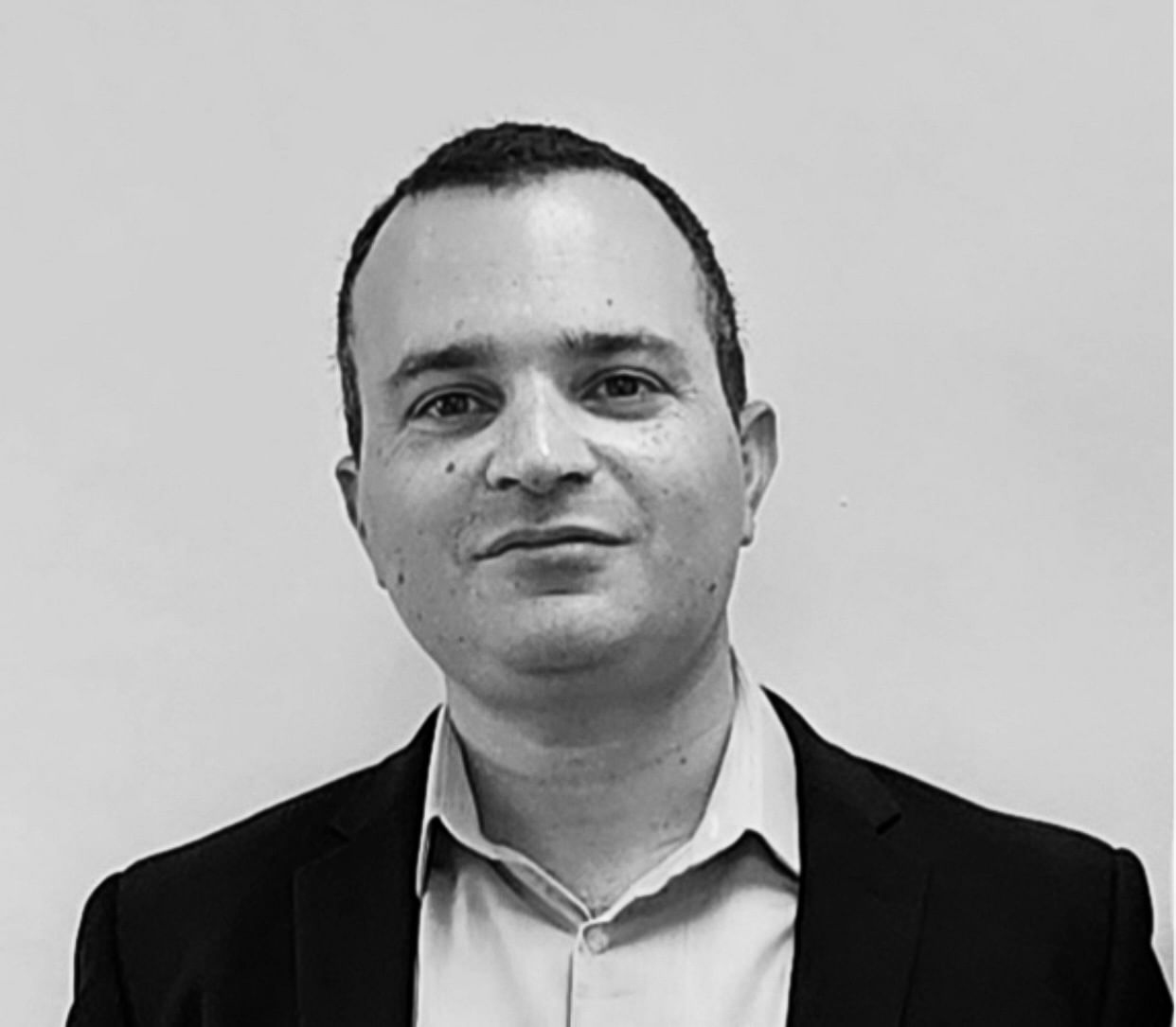
Written by Ofer Tirosh
Connect on LinkedInOfer founded Tomedes in 2007 and now leads the company's push to combine two decades of human translation expertise with AI. He writes about where the language industry is actually heading and the shifts nobody's ready for, the bets that paid off, and the ones that didn't.
Share:

Post your Comment