 Add text to get the translation that 22 AI models agree on


1 in 4 translation projects hit a bottleneck you wouldn't expect
Published onAugust 18, 2026
I wrote recently that DTP (desktop publishing) is becoming a bottleneck in translation work. Not always, but often enough to notice. I used decks and packaging as my example: the kind of client-facing document where layout is the first thing anyone sees, and where AI handles the resize reasonably well but not well enough for anything that goes out the door.
I went and checked Tomedes' own project data before writing anything else about it. The pattern is real. The example I picked wasn't where it actually lives.
Where DTP actually shows up

More than 1 in 4 of Tomedes' orders, 27.1%, include a billed DTP line item. That's a real, recurring part of how translation work gets delivered, not a rare exception.
But it's not decks. Look at where DTP rates actually run highest and lowest across content types:
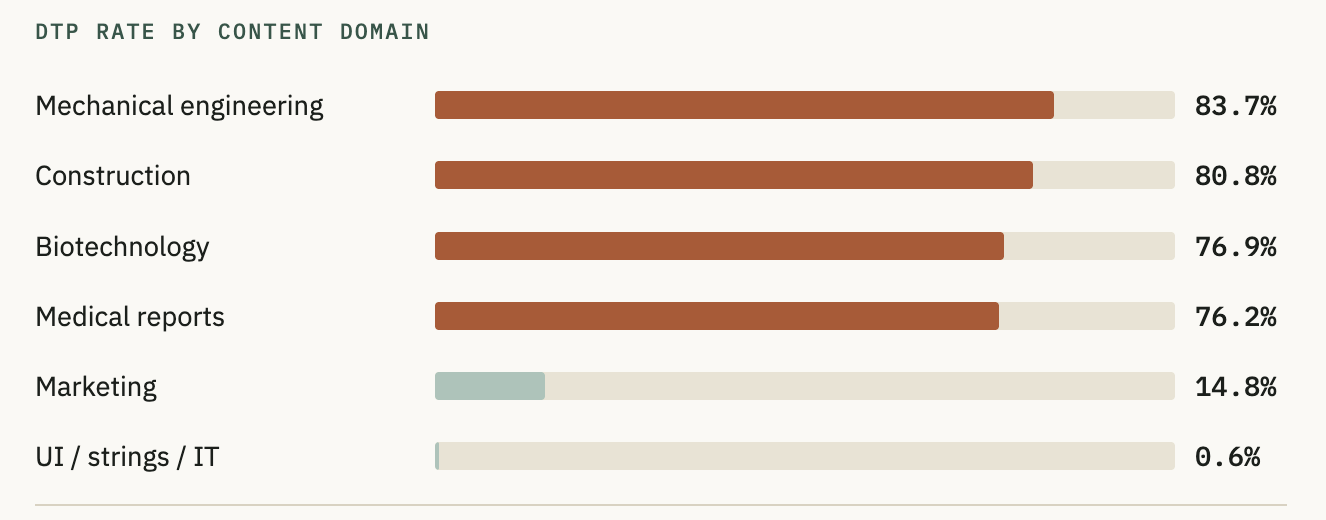
The reason is structural. A deck or a brochure needs layout because someone designed it to look good. An engineering spec or a medical report needs layout because the source document is dense: tables, diagrams, numbered sections, footnotes, all structurally part of the content, not decoration on top of it. Translation doesn't just change the words in that kind of document. It breaks the structure, and someone has to put it back together.
The other pattern I didn't expect
Hebrew and Arabic, right-to-left scripts, account for 41.1% of all Tomedes' DTP orders combined. Every document that moves from right-to-left to left-to-right, or back, needs its layout rebuilt, not just resized. That's a harder problem than text expansion in French or German, and the data shows it clearly.

In legal, medical, and financial documents specifically, the DTP queue and the human review queue don't run one after the other. They run at the same time. A medical report that needs formatting work also needs QA. Both bottlenecks live in the same document, simultaneously, not in sequence.
What this actually means
The words translate fast now. That part of my original point holds completely. What I got wrong was where the waiting happens. It's not primarily in the documents designed to be seen. It's in the documents built to be dense: the technical spec, the medical report, the legal filing, where the structure of the source document is doing as much work as the words inside it.
If your business translates decks, this still applies to you, just less often than I assumed. If your business translates technical documentation or medical materials, this is probably already your actual bottleneck, whether anyone's named it yet or not. UI and gaming content sit at 0.6% and 0%, near the bottom of the whole list.
Tomedes' desktop publishing service works across the file formats this kind of document actually lives in, InDesign, FrameMaker, PDF, Excel, PowerPoint, rebuilding layout rather than just resizing text around it.
Q: What is DTP in translation?
Q: Does every translation project need DTP?
Q: Why does DTP take longer for some languages than others?
Written by Ofer Tirosh
Connect on LinkedInOfer founded Tomedes in 2007 and now leads the company's push to combine two decades of human translation expertise with AI. He writes about where the language industry is actually heading and the shifts nobody's ready for, the bets that paid off, and the ones that didn't.
Share:

Post your Comment