 Add text to get the translation that 22 AI models agree on


Available Online 24/7
1-Year Guarantee
120,000 Business Customers
Tomedes Certifies Arabic Documents for a U.S. Immigration Application
See how Tomedes certified a package of Arabic civil documents for a U.S. immigration application, covering a birth certificate, marriage contract, and national identity document, with handwritten registry annotations translated in full, consistent name transliteration across all three documents, and certification statements that met USCIS requirements.

Trusted by
Satisfied clients worldwide


Arabic civil documents do not translate themselves into USCIS-ready English.
October 21, 2026About the Client
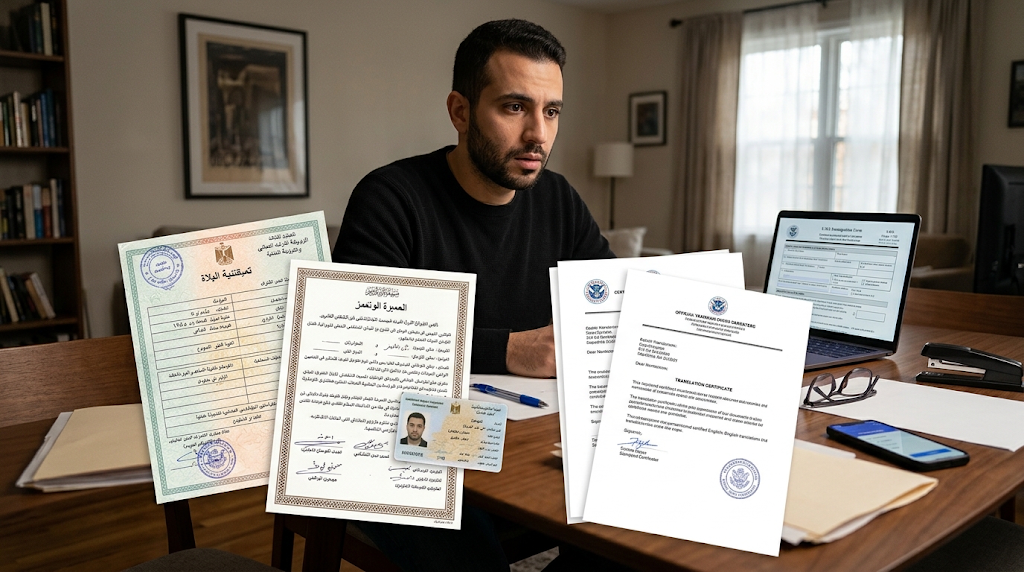
An Arabic-speaking applicant preparing a U.S. immigration petition needed certified English translations of a package of Arabic civil documents: a birth certificate issued by a Middle Eastern civil registry, a marriage contract, and a national identity document. All three were required by USCIS as supporting evidence for the petition.
The documents were in Modern Standard Arabic with handwritten annotations in the local dialect of the issuing authority. Each had a different issuing body, a different format, and a different set of administrative elements that needed to appear in the certified English translation.
Service
What USCIS requires for Arabic document translation
USCIS requires a complete English translation of every foreign-language document submitted with an immigration petition, accompanied by a signed certification from the translator stating that the translation is accurate and complete and that the translator is competent in both languages.
For Arabic documents, that requirement raises two practical questions most applicants do not anticipate: which Arabic is being translated, and how are handwritten or dialect annotations handled. A birth certificate issued in Egypt uses different administrative vocabulary than one issued in Jordan or Saudi Arabia. A marriage contract from a religious court uses legal Arabic that differs from the civil registry language in the same country. Neither the USCIS requirement nor most translation services address this distinction clearly.
The three problems this package presented
1. Each document came from a different issuing authority with its own format
The birth certificate, marriage contract, and national identity document were issued by three separate bodies under three different administrative frameworks. Birth certificates in the relevant country are issued by the civil registry and follow a standardized national format. Marriage contracts are issued by the religious court and use Islamic legal Arabic. National identity documents use government administrative shorthand, including abbreviations and codes that are not spelled out on the document itself.
Translating each correctly required a translator who recognized the issuing authority's format and knew what each field meant in context, not a translator who rendered the printed text and left the administrative codes as-is.
2. Handwritten dialect annotations affected the legal content
Two of the three documents had handwritten entries added by local registry staff. These were not marginal notes. They were official amendments such as corrections to a date, a name spelling variant, and a cross-reference to a subsequent registry entry. They were written in the local dialect, not Modern Standard Arabic, and used abbreviations specific to that registry office.
A translation that omits those annotations or renders them as illegible produces an incomplete certified translation. USCIS treats an incomplete translation the same way it treats no translation: the document does not satisfy the submission requirement.
3. Name transliteration across three documents had to be consistent
Arabic names do not have a single correct English spelling. The same name can be legitimately transliterated in several ways depending on the system used, and the applicant's name appeared in three documents issued at different times, with slightly different Arabic spellings in each. USCIS requires that names match across submitted documents. Where source documents use variant spellings of the same name, the certified translation has to resolve the variation and document the resolution in the certification statement (not simply transliterate each document independently).
What Tomedes did
The three documents were assigned to a single Arabic-to-English certified translator with experience in civil registry, religious court, and government identity document translation from the relevant country. Using one translator across the full package ensured name transliteration and terminology were consistent from document to document.
Before translation began, the translator identified the administrative codes and abbreviations in the national identity document and confirmed their meaning against known registry conventions for that issuing authority. The handwritten annotations were flagged, transcribed, and translated with a note in the certification statement explaining their nature and placement on the source document.
For the name transliteration, the translator adopted a single consistent rendering based on the most complete spelling across the three source documents and noted the source variants in the certification statement. This approach gives USCIS reviewers the information they need to understand the variation without treating it as a discrepancy.
The certification statement for each document confirmed the translator's competence in Arabic and English, stated that the translation was complete and accurate to the best of the translator's knowledge, and identified the document type and issuing authority. Each statement was signed and dated.
According to Tomedes' project data, immigration applications that include a certification statement noting name variant resolution and annotation translation are significantly less likely to generate a Request for Evidence on document translation than applications that leave those elements unexplained.
The result
All three certified translations were delivered as a coordinated package, with consistent name transliteration across all documents and complete translation of all handwritten annotations. The applicant's attorney confirmed the package met USCIS submission standards before filing.
The petition was filed without a Request for Evidence relating to the translated documents.
Are you preparing Arabic civil documents for a U.S. immigration petition? Tomedes provides certified translation for immigration applications across all Arabic document types. Contact Tomedes for a free quote.
Frequently Asked Questions
Q: Does USCIS accept Arabic document translations?
A: USCIS accepts certified translations of Arabic documents when the translation is complete, accurate, and accompanied by a signed statement from a competent translator. The translator does not need to be licensed or accredited. The certification statement must confirm translator competence in both Arabic and English and state that the translation is complete and accurate.
Q: How are handwritten annotations on Arabic documents handled in certified translation?
A: Handwritten annotations that form part of the official document (amendments, corrections, cross-references added by registry staff) must be translated and included in the certified translation. A translation that omits official annotations is incomplete. Tomedes' translators identify and translate all official handwritten content and note its placement and nature in the certification statement.
Q: Why does name transliteration matter for USCIS submissions?
A: USCIS requires that names match across submitted documents. Arabic names can be legitimately spelled multiple ways in English transliteration. Where source documents show variant spellings of the same name, the certified translation should adopt a consistent rendering and note the source variants in the certification statement (so USCIS reviewers understand the variation rather than flagging it as a discrepancy).
Q: What Arabic documents does USCIS most commonly require for immigration petitions?
A: Birth certificates, marriage contracts, divorce decrees, national identity documents, and police clearance certificates are the most common Arabic civil documents required for U.S. immigration petitions. Each document type comes from a different issuing authority and uses different administrative conventions, which is why a single certified translator with civil document experience across multiple document types produces more consistent results than multiple translators working independently.
Why choose us

24/7 Human Support

1 Year Guarantee

120,000 Business Customers
© Copyright 2007-2026 TOMEDES. All Rights Reserved.

