 Add text to get the translation that 22 AI models agree on


The Chief Localization Officer: Why This New Role Is Entering the C-Suite
For decades, "Localization" was a department hidden in the basement. It was viewed as an operational cost center, a box to check after the product was already built. The person in charge was a "Translation Manager," and their only KPI was "don't spend too much money."
In 2026, that era is officially over.
A new title is appearing on organizational charts at Fortune 500 companies and high-growth unicorns: The Chief Localization Officer (CLO).

Why the sudden promotion? Because for most modern companies, international revenue now exceeds domestic revenue. When 60% of your sales come from non-English markets, the person managing those languages shouldn't be a manager; they should be an executive.
Here is why the CLO is the most critical new seat at the boardroom table, and how you can get the benefits of one without the C-Suite salary.
Table of Contents
Why is localization moving from a cost center to a revenue engine?
What does a Chief Localization Officer actually do?
How does the CLO orchestrate the new AI tech stack?
Do you need a full-time CLO?
Why is it dangerous to keep treating localization as just a tactic?
FAQs
Why is localization moving from a cost center to a revenue engine?
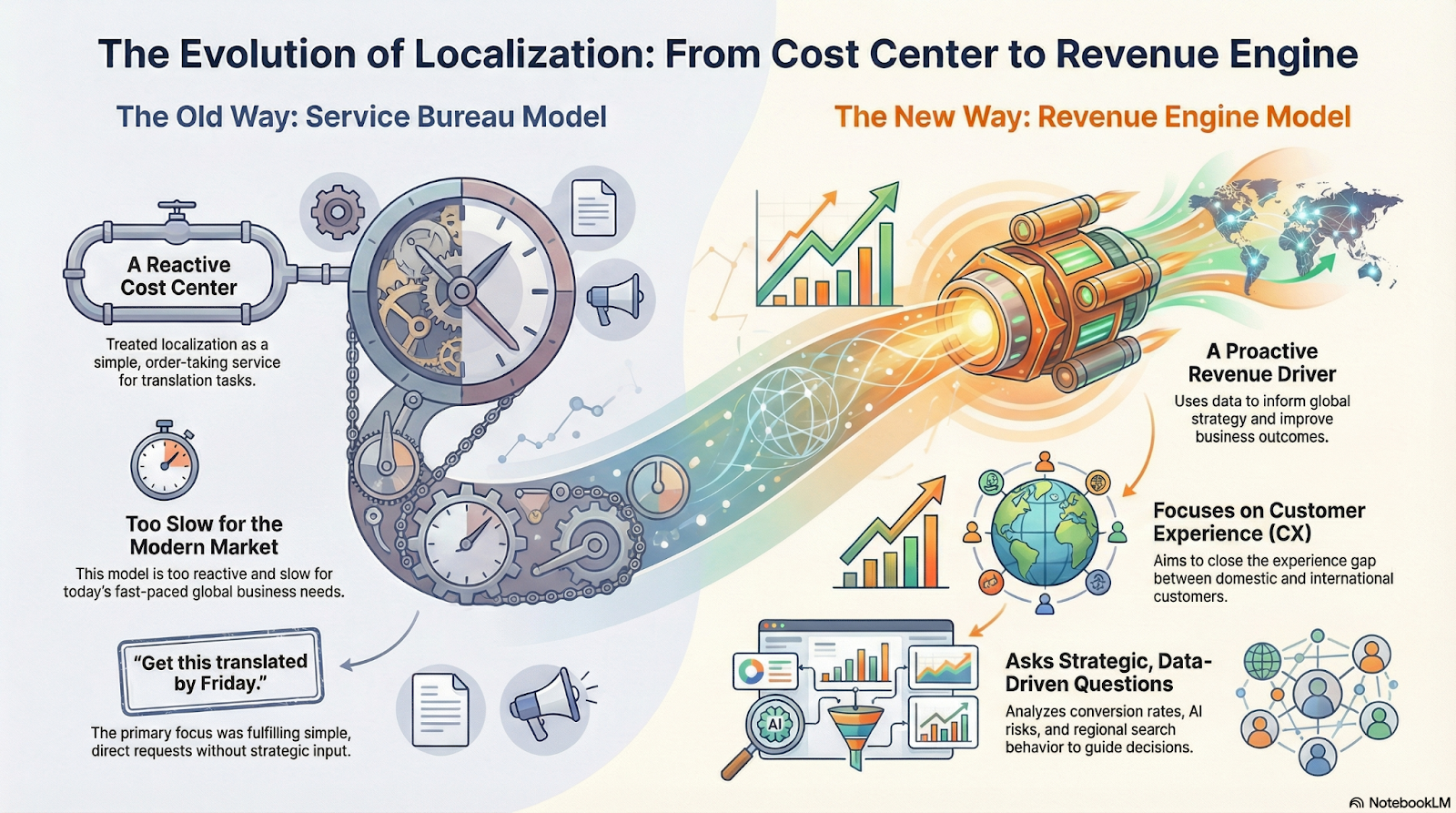
Historically, if a CMO wanted to launch in Japan, they would simply email the Translation Manager: "Get this translated by Friday."
This Service Bureau Model is dead. It is too slow and too reactive for 2026.
The Revenue Engine Model flips the script. Instead of waiting for orders, the CLO uses data to drive strategy. They don't just ask "How do we translate this?"; they ask:
"Why are our conversion rates lower in Germany than in France?"
"Should we use a 'Sovereign AI' model for our Middle East expansion to avoid data risks?"
"Are our keywords in Brazil optimized for Voice Search or Text Search?"
The 2026 Reality: Localization is no longer about words. It is about Customer Experience (CX). If your customer in Tokyo has a worse experience than your customer in New York, you are failing. The CLO exists to close that gap.
What does a Chief Localization Officer actually do?
A CLO is not a linguist. They are a strategist who sits at the intersection of Product, Marketing, and Engineering.
Their Core Responsibilities:
Risk Management: Navigating the complex web of global data laws (like the EU AI Act) to ensure the company doesn't get fined for non-compliant translations.
Cultural "Air Traffic Control": Preventing brand disasters (like using the wrong political map in an ad) before they happen.
Budget Architecture: Moving budget away from "per word" translation and investing in "per outcome" assets like SEO and Multimedia.
How does the CLO orchestrate the new AI tech stack?
The primary reason this role has become executive-level is complexity.
Five years ago, you just needed a few translators and an Excel sheet. Today, a global localization workflow involves:
Agentic AI for research and drafting.
Neural Voice Clones for video dubbing.
API Connectors linking your CMS (Contentful/WordPress) to the translation memory.
Sovereign Models for data privacy.
The CLO acts as the Chief Technology Officer for language. They decide which AI models to trust, how to integrate them, and where to deploy human experts for maximum ROI. Without a CLO, these decisions are left to IT managers who don't understand linguistics, or Marketing managers who don't understand AI.
Do you need a full-time CLO?
However, hiring a full-time Chief Localization Officer is a major financial commitment, with salaries in 2026 often exceeding $250k.
For many enterprises, the smarter route is a strategic partnership that delivers the same oversight without the overhead.
The Managed AI Translation Services from Tomedes provide this exact "Fractional CLO" capability. Instead of struggling to manage AI translations internally, this end-to-end solution designs and runs tailored workflows from start to finish.
A dedicated project manager takes full responsibility for the strategy, acting as a fractional executive to:
Architect Custom Workflows: Rather than a one-size-fits-all approach, a tailored workflow is designed to define exactly when to utilize AI and when to deploy expert human post-editing, ensuring resources are focused on high-priority content.
Optimize Technology & Routing: The most suitable translation engines are selected and routed for each specific language pair and content type, eliminating the need for internal tech management while ensuring consistent quality and brand voice.
Deliver Predictable ROI: By combining the speed of AI with the assurance of human oversight, translation costs are typically reduced by 80-90% compared to traditional methods, all while maintaining strict security standards.
Why is it dangerous to keep treating localization as just a tactic?
If you are treating localization as a "task," you are already behind. Your competitors are treating it as a "strategy."
Whether you hire an internal CLO or partner with a managed service like Tomedes, the goal is the same: Stop translating. Start expanding.
FAQs
Q: What is the difference between a Localization Manager and a CLO?
A: A Manager executes tasks (getting files translated). A CLO sets strategy (deciding which markets to enter and how). A Manager reports to Marketing; a CLO reports to the CEO or COO.
Q: Why is this role emerging now?
A: Three factors: 1) The rise of AI has made workflows technically complex. 2) Non-English revenue is now the primary growth engine for tech companies. 3) New laws (EU Accessibility Act, AI Act) have made localization a legal compliance issue.
Q: Can AI replace the CLO?
A: No. AI is the tool the CLO uses. AI can translate, but it cannot negotiate with a Product VP about roadmap priorities or decide if a brand's tone is "too aggressive" for the Japanese market.
Q: What is a "Fractional CLO"?
A: It is a service where an external agency (like Tomedes) provides high-level strategic consulting – auditing workflows, selecting tech, and planning budgets – alongside execution, acting as your partner rather than just a vendor.
Q: How do I measure the ROI of a CLO?
A: You stop measuring "Cost per Word" and start measuring "Cost per Acquired Customer (CAC)" in each region. A good CLO lowers CAC by improving local conversion rates.
Post your Comment