 Add text to get the translation that 22 AI models agree on


Translation services for small businesses: what you need vs. what you're being oversold
Small businesses entering international markets are routinely sold translation services they do not need. A two-person e-commerce company expanding into Mexico does not need a full localization platform with a translation management system and quarterly terminology audits. A restaurant group adding a Spanish-language menu does not need transcreation. A consultant exporting services to Germany needs a professional translator, not a retainer.
The translation industry has a structural incentive to oversell. Enterprise-grade service packages generate more revenue than single-document translations, and many providers pitch small business clients the same infrastructure they would sell to a multinational. The result is that small businesses either overspend on services they do not use, underspend on the wrong services and get poor results, or avoid professional translation entirely and rely on free tools that create a different set of problems.
According to CSA Research's "Can't Read, Won't Buy" study (based on a survey of 8,709 consumers in 29 countries), 76 percent of online shoppers prefer to buy products with information in their native language, and 40 percent will never buy from a website in another language. The commercial case for translation is clear. The question is which translation, for which content, at which quality tier.
Tomedes works with businesses of every size, from single-person operations to enterprises with global footprints. The 1-Year Quality Guarantee and dedicated project manager model apply regardless of project size. There are no enterprise minimums. But the right place to start is understanding exactly what a small business actually needs, before discussing what any provider is selling.
What translation do small businesses actually need?
The honest answer depends entirely on three things: what markets the business is entering, what content is being used to operate and sell in those markets, and what the legal and regulatory requirements are in the target country.
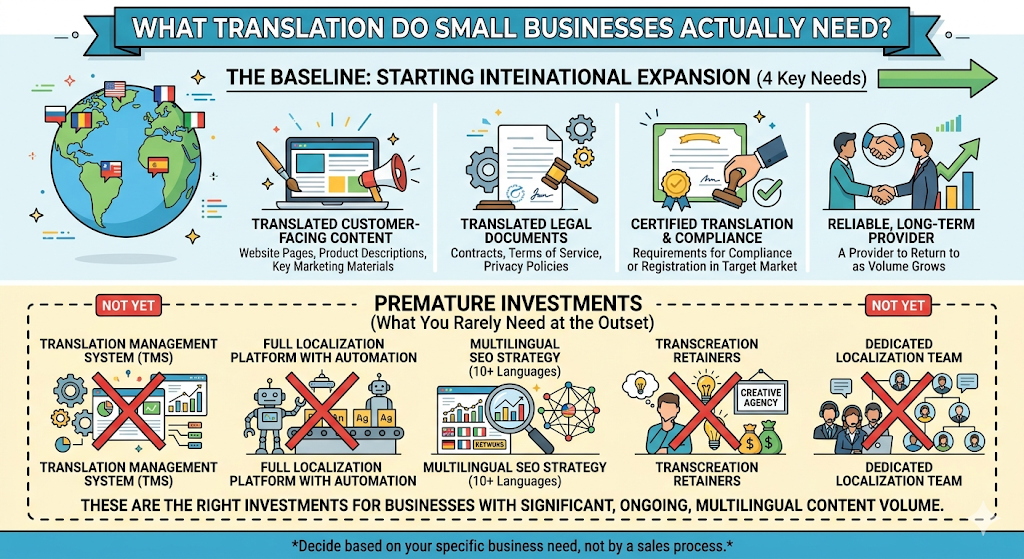
Most small businesses entering a new international market genuinely need four things: translated customer-facing content (website pages, product descriptions, key marketing materials), translated legal documents (contracts, terms of service, privacy policies), any certified translation required for compliance or registration in the target market, and a reliable provider they can return to as volume grows. That is the baseline. Anything beyond it should be driven by a specific business need, not by a sales process.
What small businesses rarely need at the outset: a translation management system, a full localization platform with workflow automation, a multilingual SEO strategy across ten language pairs, transcreation retainers, or a dedicated localization team embedded in their organization. These are the right investments for businesses with significant, ongoing, multilingual content volume. For most small businesses starting international expansion, they are premature.
What is the difference between translation and localization, and does a small business need both?
Translation is the conversion of text from one language to another with accuracy and meaning preserved. Localization goes further – it adapts content to the cultural, legal, and commercial expectations of a specific market. This includes date and currency formats, measurement units, culturally appropriate imagery references, regional legal requirements, and idiomatic language that would otherwise read as foreign even if grammatically correct.
Most small businesses need translation for most of their content. They need localization for content that is specifically market-facing (homepage copy, marketing campaigns, product descriptions intended for a particular regional audience) where generic accuracy is not enough. The distinction matters because localization costs more, takes longer, and requires translators with deeper market knowledge. Paying for localization on an internal document, a policy page, or a terms of service document is unnecessary. Paying for translation only on a brand marketing campaign entering a culturally distinct market is a risk.
The practical rule: translate for accuracy, localize for persuasion. If the goal is compliance or comprehension, translation is sufficient. If the goal is conversion or brand perception, localization is the right investment.
Which content genuinely requires human translation vs. AI translation?
This is the question most translation providers avoid answering honestly, because the honest answer directs some small business content toward lower-cost solutions.
AI translation has improved significantly for major language pairs. For internal communications, general-purpose FAQ pages, product data sheets with standardized terminology, and content where a minor error carries no material consequence, AI translation with a human review pass is often sufficient – and meaningfully less expensive than full human translation from scratch.
Human translation should lead for: legal and compliance documents where terminology precision carries legal weight, customer-facing brand content where tone and cultural resonance matter, certified translations required for government submission, medical or regulated-sector documents, and any content where an error creates material risk (financial, legal, or reputational).
Content type | Recommended approach | Reason |
Legal contracts and terms | Human translation | Terminology errors carry legal liability |
Certified documents (immigration, registration) | Human + certification | Required by receiving authorities |
Website homepage and brand copy | Human translation | Tone and conversion quality matter |
Product descriptions (standard) | AI + human review | Speed and cost efficiency acceptable |
Internal communications | AI translation | Low consequence, high volume |
Marketing campaigns | Human or transcreation | Cultural nuance determines effectiveness |
Technical manuals | Human translation | Precision and safety requirements |
Customer service FAQs | AI + human review | Reasonable quality at manageable cost |
Tomedes is certified under ISO 18587:2017 for machine translation post-editing, which means the hybrid workflow Tomedes uses is not improvised. AI translation output is reviewed and refined by qualified human linguists as a documented, audited process. Client data is handled with the same security standards across all workflow tiers.
"Small businesses often ask whether they can use AI translation to save money. The question we ask back is: which content, and what happens if it is wrong? For internal drafts and general-purpose content, a hybrid approach makes sense. For anything that faces a customer, a government body, or a counterparty in a contract – human expertise is not a premium option. It is the baseline."
— Ofer Tirosh, CEO, Tomedes
What are the signs a translation provider is overselling you?
Small business buyers are not always in a position to know what they do not need. These are the signals that a provider is pitching services beyond what the project genuinely requires.
They lead with a platform, not with a project. A provider whose first recommendation is a translation management system or a technology platform (before understanding your content volume, language requirements, and business stage) is selling infrastructure before they have assessed the need.
They bundle services that should be priced separately. Localization, transcreation, multilingual SEO, and desktop publishing are distinct services with distinct costs. A provider who bundles them into a single package price without explaining what each element does is making it difficult for you to evaluate whether each component is necessary.
They quote for all languages before you have committed to a market. Translating into five European languages before you have a confirmed customer base in any of them is a speculative investment. A good translation partner helps you prioritize (starting with the language that represents the largest confirmed commercial opportunity) rather than encouraging broad coverage at the outset.
They discourage AI-assisted options without explaining why. For small businesses, a well-managed hybrid workflow is a legitimate cost-efficiency tool for appropriate content types. A provider who insists every word requires full human translation, without distinction by content type, is either not offering a hybrid option or is not willing to recommend a lower-cost approach that would genuinely serve your needs.
They set minimums that exclude your actual volume. Enterprise-focused providers sometimes impose minimum order values, minimum word counts, or retainer structures that make them impractical for small business volumes. This is a structural misalignment, not a quality signal.
How much should a small business spend on translation?
There is no single correct budget figure – it depends on volume, language pairs, content type, and how central language is to the business model. But there are useful reference points for planning.
For a small business beginning international expansion, a reasonable first-year translation budget covers: translated website core pages (homepage, about, products or services, contact), translated key legal documents (terms of service, privacy policy, any required contracts for the target market), and any certified translations required for business registration or compliance in the target country. Beyond that, additional spend should be tied to specific, confirmed commercial activity – not speculative coverage.
The most reliable cost signal is a transparent, itemized quote from a provider who has reviewed your actual content. Per-word or per-page pricing on a reviewed document is a more accurate basis for planning than a packaged estimate based on category alone.
Hidden cost factors to watch for (regardless of business size) include rush surcharges for compressed timelines, desktop publishing fees for formatted documents, certification or notarization charges on top of translation pricing, and revision charges if the brief changes after work has started. A trustworthy provider surfaces these before the project begins, not after delivery.
Tomedes provides transparent pricing with no hidden fees and no enterprise minimums. Every project (regardless of size) includes a dedicated project manager and is backed by the 1-Year Quality Guarantee.
What does a good small business translation workflow look like?
A practical translation workflow for a small business does not need to be complex. At its simplest:
Start with a content audit. Before approaching any provider, list every piece of content that needs to exist in the target language to operate the business: the customer-facing website pages, the legal documents, the product materials, and any compliance filings. This defines the scope, and prevents scope creep driven by a sales process.
Match content type to quality tier. Using the framework above, identify which content requires full human translation, which is appropriate for AI translation with human review, and which genuinely needs certified translation for official submission. This drives both the budget and the provider selection.
Provide a clear brief. The single fastest way to reduce translation cost and improve quality is to give the translator context before work begins: who is the audience, what is the tone, are there brand terms or product names that should not be translated, what format is the deliverable required in. A well-briefed project produces fewer revisions.
Build a glossary from day one. Even a simple list of your brand terms, product names, and preferred terminology in the target language (developed with your translator on the first project) creates consistency across every subsequent translation. This is not a complex infrastructure investment. It is a document that grows over time and reduces per-project cost as volume increases.
Use website translation as the entry point for market presence. For most small businesses entering a new market, the website is the first and most commercially critical translation investment. A professionally translated website in the target language is the foundation from which all other market activity proceeds.
Which languages should a small business translate into first?
The answer is the language of the market where you have the strongest confirmed commercial opportunity, not the broadest possible coverage.
For U.S.-based small businesses, English to Spanish translation represents the single largest domestic and cross-border opportunity, covering more than 500 million native speakers globally and the second-largest online consumer market in the United States. For businesses with confirmed interest from specific international markets, the starting language is the one that unlocks that market – not a speculative list.
A useful framework for language prioritization: start with the language pair that has the largest confirmed customer or partner base, add languages only when that market is generating revenue, and expand to additional pairs as volume justifies the investment. This approach keeps translation spend proportional to commercial return, and avoids the common mistake of translating into five languages before any of them have produced a customer.
What are the most common translation mistakes small businesses make?
Using free machine translation for customer-facing content. Raw AI output from publicly available tools is not reviewed, is not consistent, and carries errors that are visible to native speakers. It signals to the target audience that the business did not invest in communicating with them seriously. The cost of a professional translation is small relative to the brand impression it protects.
Translating without a brief. A translator working without context (audience, tone, brand terms, format requirements) produces a technically accurate translation that may not serve the intended purpose. The brief is not an overhead; it is the input that determines whether the output is usable.
Treating certified translation as optional for compliance. For business registration, product licensing, or document submission to government bodies in the target market, certified translation is not a premium option – it is a requirement. A non-certified translation submitted to a regulatory body is rejected, causing delays that cost more than the certification itself.
Choosing a provider on price alone. The cheapest option is rarely the most cost-effective option when revision cycles, rework, and the downstream cost of errors are factored in. A small business translating a supplier contract into Chinese does not save money by using an unqualified translator if the error in the contract creates a dispute six months later.
Neglecting consistency across projects. Small businesses often commission each translation as a standalone project, with no reference to previous translations. The result is inconsistent terminology, different rendering of the brand name, and a disjointed experience for the target audience. A simple glossary (maintained across projects) solves this at almost no cost.
FAQs
Q: Do small businesses really need professional translation, or is AI good enough?
A: It depends on the content and the consequence of an error. AI translation is appropriate for internal communications, general-purpose informational content, and high-volume low-stakes material where a human review step is included. Professional human translation is necessary for legal documents, certified filings, customer-facing brand content, and any material where an error carries legal, financial, or reputational risk. For most small businesses, the right answer is a hybrid approach – AI for appropriate content types, human expertise wherever accuracy is non-negotiable.
Q: How do I know how many languages my small business actually needs?
A: Start with one: the language of the market where you have the strongest confirmed commercial opportunity. Add languages only when the first market is generating revenue and a second market opportunity is confirmed. Broad multilingual coverage is a valid investment for businesses with established international operations. For a small business beginning international expansion, it is premature (and expensive).
Q: What is a certified translation, and does my small business need one?
A: A certified translation is a translation accompanied by a signed statement from the translator or translation company confirming that it is complete and accurate. It is required by government agencies, courts, regulatory bodies, and many institutions that accept foreign-language documents. If your small business is registering in a new country, applying for permits, submitting documents to a regulatory authority, or entering into legally binding agreements with a foreign counterpart, certified translation is required – not optional. Tomedes provides certified translations backed by the 1-Year Quality Guarantee.
Q: Can a small business get professional translation without a minimum order?
A: Yes. Tomedes provides professional translation services with no enterprise minimums. Every project (including single-document translations) includes a dedicated project manager and is backed by the 1-Year Quality Guarantee. Small business clients receive the same quality infrastructure as enterprise accounts, scaled to the project at hand.
Q: What should I include in a translation brief to keep costs down?
A: A useful brief includes: the intended audience (who will read this, in what context), the required tone (formal, conversational, technical), any brand terms or product names that should not be translated, the format the translated document should be delivered in, and the submission deadline. A clear brief reduces revision cycles and allows the translator to work efficiently, which directly reduces cost on both sides.
Ready to get the translation your small business actually needs?
Tomedes provides professional translation services for businesses of every size, from single-document projects to ongoing multilingual programs. No enterprise minimums. No hidden fees. Every project includes a dedicated project manager and is backed by a 1-Year Quality Guarantee.
Request a free quote and describe your project. A Tomedes specialist will outline exactly what your business needs, and nothing more.
Post your Comment