 Add text to get the translation that 22 AI models agree on


Best translation companies for European languages in 2026: a practical buyer's guide
Europe is one of the most linguistically complex regions in the world to translate for. The European Union alone recognizes 24 official languages – and across the continent, more than 200 languages are spoken by populations with distinct cultural expectations, legal frameworks, and consumer behaviors. For businesses expanding into European markets, choosing the right translation partner is not simply a procurement decision. It determines whether your contracts hold up in a German court, whether your French pharmaceutical documents meet ANSM standards, and whether your Italian e-commerce copy converts or confuses.
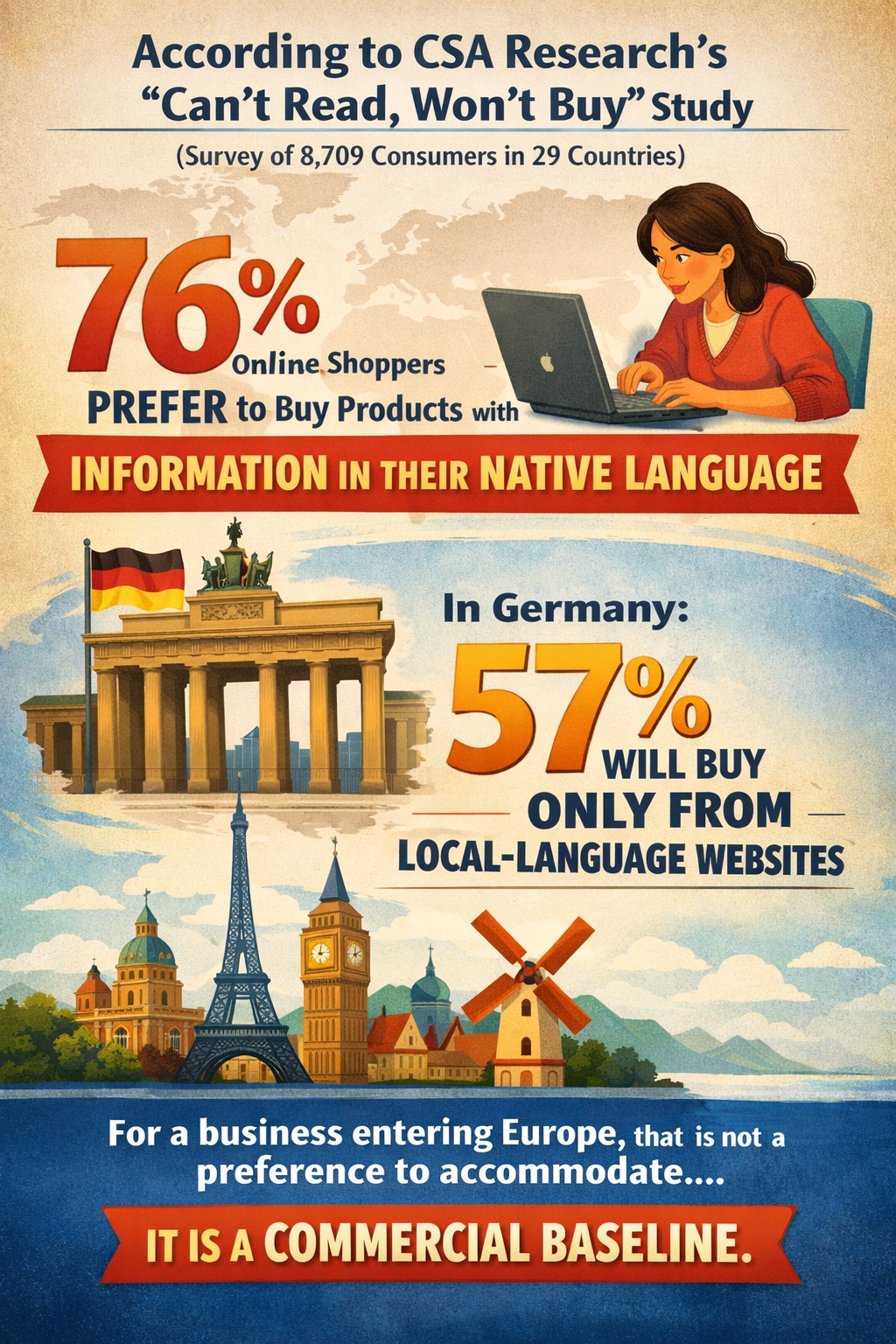
According to CSA Research's "Can't Read, Won't Buy" study (based on a survey of 8,709 consumers in 29 countries), 76 percent of online shoppers prefer to buy products with information in their native language. In Germany specifically, 57 percent will buy only from local-language websites. For a business entering Europe, that is not a preference to accommodate. It is a commercial baseline.
This guide is written for buyers who need to make a well-informed decision: which translation company is actually equipped to handle European language complexity, and what separates a capable partner from a vendor who treats every language pair as interchangeable?
Why is European language translation more complex than it looks?
The most common mistake buyers make is treating European translation as a straightforward process – input English, receive German, done. In practice, European languages carry layers of complexity that go well beyond vocabulary and grammar.
Legal and regulatory variation is significant. Each EU member state has its own legal system. French contract law operates under civil law principles distinct from common law traditions. German privacy regulation (the DSGVO) requires specific legal phrasing that differs from GDPR translations accepted in other jurisdictions. A translation company without legal specialization in the target country will not catch these distinctions.
Regional variants require active decisions. Spanish spoken in Spain differs meaningfully from Spanish spoken in Mexico, Argentina, or Colombia – in vocabulary, register, and idiomatic usage. The same applies to Portuguese (European vs. Brazilian), French (France vs. Belgium vs. Quebec), and German (Germany vs. Austria vs. Switzerland). A buyer expanding into Spain and Mexico simultaneously needs a translation company that coordinates variant strategy, not one that defaults to a single standard.
Grammatical complexity affects production timelines and costs. Polish has seven grammatical cases. German compound nouns frequently have no direct English equivalent and must be reconstructed semantically. A translation team without native-speaker expertise in these languages cannot produce reliable output, AI-assisted or not.
Key European languages: translation challenges and demand by sector
Language | Speaker base | Key translation challenges | High-demand sectors |
French | ~77M native | Legal register distinctions, formal/informal address, Swiss/Belgian variants | Legal, government, luxury, pharmaceutical |
German | ~90–95M native | Compound nouns, gendered articles, Austrian/Swiss variants, DSGVO compliance | Engineering, automotive, financial services, legal |
Spanish | ~460M native globally | Castilian vs. Latin American variants, regional idiom, false friends with Italian | E-commerce, legal, healthcare, consumer goods |
Italian | ~65M native | Formal register, regional dialects, legal terminology | Fashion, luxury, legal, manufacturing |
Dutch | ~23M native | Gendered nouns, Belgian vs. Netherlands variants, technical vocabulary | Tech, logistics, financial, legal |
Polish | ~45M native | Seven grammatical cases, no articles, complex declension system | Legal, manufacturing, tech, e-commerce |
Portuguese | ~10M native in Portugal | European vs. Brazilian Portuguese — substantially different registers | Legal, financial, automotive |
Swedish | ~10M native | Formal vs. informal pronoun shift, government document requirements | Tech, gaming, public sector |
What languages does your European expansion actually require?
Before approaching a translation company, buyers should map their language requirements to their actual market entry strategy – not to the full map of Europe. A business entering Germany and Austria needs German with awareness of Austrian legal terminology. A business expanding into the Iberian peninsula and Latin America simultaneously needs a coordinated Spanish variant strategy.
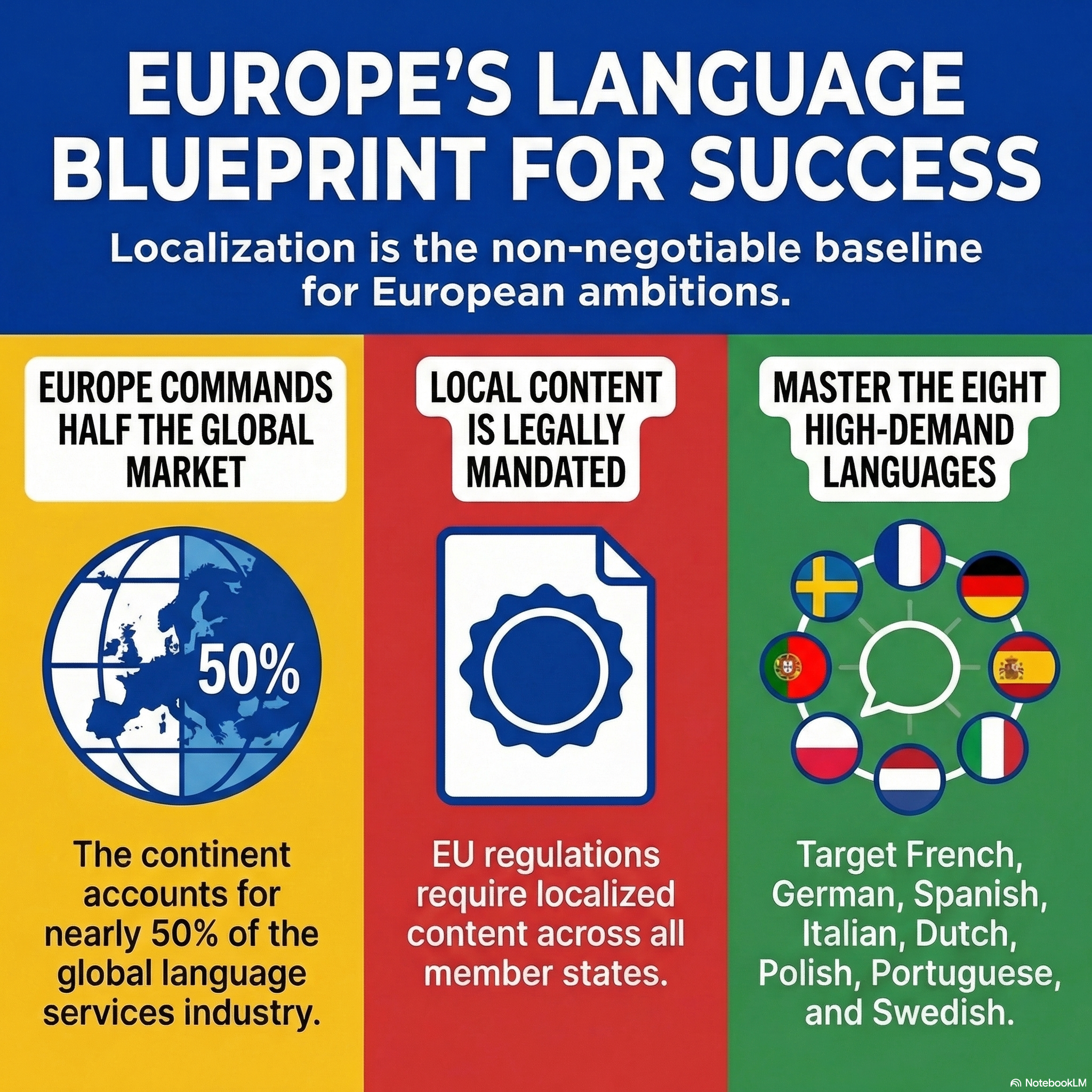
The eight highest-demand European languages for business translation are French, German, Spanish, Italian, Dutch, Polish, Portuguese, and Swedish. Europe accounts for nearly half of the global language services market, according to Statista – a share driven by the continent's linguistic diversity and the regulatory requirement for localized content across EU member states. For any business with serious European ambitions, covering the major language pairs is not optional infrastructure. It is the baseline.
Beyond the major eight, buyers entering Eastern European markets frequently underestimate demand for Czech, Romanian, Hungarian, and Bulgarian. These are not long-tail edge cases, they are the official languages of EU member states with significant consumer markets and active regulatory environments that require certified translation for compliance documents.
What should you look for in a translation company for European languages?
Not every language services provider is equipped for European complexity. The following criteria distinguish capable partners from generic vendors.
Subject-matter expertise by language and sector. A translation company should be able to name the qualifications and specializations of the linguists assigned to your project. For legal translation into French, the translator should have legal expertise – not just fluency. For medical device documentation into German, the linguist should understand the Medical Device Regulation requirements that govern terminology in the EU market. Ask any prospective vendor how they assign translators to projects, and whether they can demonstrate sector-specific expertise for your target language.
ISO 17100:2015 certification. ISO 17100:2015 is the international standard for translation services. It specifies requirements for the core processes, resources, and other aspects necessary to deliver quality translation. Certification requires external audit and ongoing compliance. For buyers procuring European translation for regulated industries (legal, medical, financial, pharmaceutical) – ISO 17100 certification should be a baseline requirement, not a differentiator.
Capacity across your full language list. A translation company that handles French, German, and Spanish reliably may not have the same depth for Polish, Dutch, or Swedish. Before committing, ask for evidence of prior work in your specific language pairs – volume, sector, and client references if available. A credible LSP will be direct about where its network is strongest rather than overpromising across every language pair.
Sworn and certified translation coordination. Many European countries require sworn or certified translation for legal and official documents. In Germany, court-admitted sworn translators (vereidigte Dolmetscher und Übersetzer) must be used for documents submitted to government bodies. In France, traducteurs assermentés are required for documents submitted to French courts and public authorities. A translation company operating across Europe should be able to coordinate sworn translation through accredited linguists in the target jurisdiction, not simply provide a generic certified translation letter.
How do you evaluate quality assurance for European translation?
Quality assurance in European translation is a process, not a checkbox. The following questions help buyers assess whether a prospective partner has genuine QA infrastructure or is simply describing one.
Does the company operate a review workflow where a second linguist checks the translation before delivery? ISO 17100 requires this as standard.
How does the company handle terminology management across a multi-language project? Consistent terminology is critical in regulated sectors and for brand integrity.
What happens if a delivered translation contains an error? Is there a documented remediation process, and is there a quality guarantee that covers post-delivery corrections?
How does the company use translation memory and glossaries? These tools reduce inconsistency in long-running projects, particularly for technical documentation and legal content where terminology must remain stable across versions.
Tomedes backs every translation with a 1-Year Quality Guarantee – a commitment to address any quality issue that emerges after delivery, at no additional cost. This is not standard practice in the industry. Most vendors limit their quality commitments to the moment of delivery. The guarantee reflects a different operating philosophy: that quality is a long-term accountability, not a handover event.
What does a hybrid AI + human workflow mean for European translation projects?
The language services industry has changed materially over the past three years. AI translation quality has improved substantially for well-resourced European languages (particularly French, German, Spanish, and Italian), where large training datasets are available. Buyers who ignore this reality are overpaying. Buyers who rely on it uncritically are taking on quality risk they have not accounted for.
The practical question is not whether to use AI translation, it is how to use it responsibly. A hybrid workflow pairs AI translation output with human post-editing by a subject-matter expert. The linguist corrects errors, resolves ambiguities the AI has not recognized as ambiguities, applies sector-specific terminology, and ensures the register and tone are appropriate for the target audience. The AI handles volume and speed; the human handles accuracy and meaning.
For European languages, this distinction matters most in three areas: legal documents (where mistranslation creates liability), regulated sectors such as medical and pharmaceutical (where terminology errors have compliance consequences), and marketing and consumer-facing content (where cultural nuance and brand tone cannot be replicated by AI output alone).
"Businesses ask us whether they should use AI translation or human translation for their European expansion. That is the wrong question. The right question is: which parts of your content can absorb risk, and which cannot? Tomedes builds the workflow around that answer – AI for speed and scale where quality tolerance allows, human expertise leading wherever accuracy is non-negotiable. And client data security is never a trade-off in either case." – Ofer Tirosh, CEO, Tomedes
Tomedes is certified under ISO 18587:2017, the international standard for machine translation post-editing. This means the hybrid workflow is not improvised; it follows a documented, audited process. Client data is handled with the same security standards regardless of whether AI tools are part of the workflow – a point that matters for buyers in financial services, legal, and healthcare sectors operating under GDPR and sector-specific data obligations.
How do the leading translation companies compare for European languages?
The translation industry ranges from global enterprises to boutique agencies specializing in single language pairs. For buyers with European language needs, the relevant comparison is not simply scale – it is whether the provider can combine breadth of language coverage with genuine depth of subject-matter expertise and a quality framework that holds across languages.
What to compare | Tomedes | Lionbridge | TransPerfect | Boutique LSPs |
Language pairs covered | 240+ | 200+ | 170+ | 150+ |
ISO 17100:2015 certified | Yes | Yes | Yes | Varies |
MTPE (ISO 18587:2017) | Yes | Varies | Varies | No |
1-Year Quality Guarantee | Yes | No | No | No |
Dedicated project manager | All projects | Enterprise only | Enterprise only | Varies |
24/7 human support | Yes | Yes | Varies | No |
Free AI tools suite | Yes | No | No | No |
No minimum word count | Yes | No | No | Varies |
Sworn translation coordination | Yes | Varies | Varies | No |
⚠️ Competitor data is illustrative. Buyers should verify current service offerings directly with each provider.
The comparison highlights a structural difference: larger enterprise LSPs often require minimum volumes or dedicate their deepest expertise to enterprise retainer clients. Boutique agencies may offer genuine depth in one or two language pairs but limited coverage for a multi-language European expansion. A full-service LSP with ISO certifications, a dedicated project management model, and genuine depth across major and long-tail European languages represents the most practical choice for most buyers.
What are the most common mistakes buyers make when expanding into Europe?
Treating all European languages as equivalent in complexity. Polish and Swedish are not equivalent translation challenges. A procurement process that evaluates LSPs only on per-word pricing without considering linguist qualifications by language pair will surface cost savings that evaporate in rework.
Selecting a tool instead of a partner. Pure-technology translation platforms offer speed and low cost. They also offer no accountability, no dedicated project management, and no quality guarantee. For a business entering a regulated European market, a vendor who takes accountability for outcomes is worth more than a platform that optimizes for throughput.
Underestimating sworn and certified translation requirements. Buyers regularly discover mid-project that the translation they have received cannot be submitted to a European government authority because it was not produced by a sworn translator. This is not a minor administrative issue, it delays market entry and requires the project to be recommissioned.
Failing to coordinate variant strategy across markets. A business expanding into Spain and Mexico simultaneously needs an explicit decision on which Spanish variant governs each market, and consistency across all content. Without this, marketing materials, legal documents, and product content will carry inconsistent register and terminology, which undermines both brand credibility and legal reliability.
Ready to expand into European markets?
Tomedes provides professional translation services across all major and long-tail European languages – certified under ISO 17100:2015, backed by a 1-Year Quality Guarantee, and supported by dedicated project managers for every client. Whether your project covers a single language pair or a full multi-market expansion, Tomedes builds the workflow around your content requirements, timeline, and quality standards.
Request a free quote to discuss your European translation project with a Tomedes specialist.
FAQs
Q: What is the best translation company for European languages?
A: The best translation company for European languages is the one that can demonstrate subject-matter expertise in your specific language pairs, holds ISO 17100:2015 certification, offers a documented quality assurance process, and has transparent project management. Scale matters less than depth of expertise in your target languages and sectors.
Q: Do I need a different translation company for each European country?
A: No, but you need a translation company with genuine expertise in each target language and jurisdiction. A single, full-service LSP with broad European language coverage and certified linguists across your required language pairs is more practical and cost-effective than managing separate vendors per country.
Q: Is AI translation good enough for European business documents?
A: For some content types (internal communications, first-draft reference material, high-volume product descriptions) AI translation with human post-editing delivers acceptable quality at significantly lower cost. For legal documents, regulated sector content, sworn translations, and consumer-facing marketing, human expertise must lead. The answer depends on which parts of your content can absorb risk and which cannot.
Q: How much does European language translation cost in 2026?
A: Translation pricing varies by language pair, content type, volume, and required quality tier. Major European languages (French, German, Spanish) are typically lower per-word than less-resourced languages (Polish, Hungarian, Finnish). Legal and technical translation commands a premium over general content. Request a detailed quote that itemizes the workflow (translation, review, project management) to evaluate true cost rather than headline per-word rate.
Q: What is ISO 17100 and why does it matter for European translation?
A: ISO 17100:2015 is the international standard for translation services. It specifies that translation must be reviewed by a second qualified linguist before delivery, and sets requirements for linguist qualifications, project management, and quality control. For buyers procuring translation for regulated European markets, ISO 17100 certification is the minimum credible quality signal.
Q: How do I handle sworn translation requirements in European countries?
A: Sworn translation requirements vary by country. In Germany, only vereidigte Dolmetscher und Übersetzer can produce translations accepted by courts and public authorities. In France, traducteurs assermentés fulfill this role. An LSP with European coverage should be able to coordinate sworn translations through accredited linguists in each relevant jurisdiction, ask for this capability explicitly before committing.
Post your Comment