 Add text to get the translation that 22 AI models agree on


Rush translation services: what turnaround is actually realistic – and what it costs
The request arrives with one sentence: "I need this translated by tomorrow." It is one of the most common messages a translation company receives, and one of the most consequential to handle well. Rush translation is a real service with real infrastructure behind it. It is also one of the most misunderstood parts of the industry, where buyers routinely encounter fees they were not expecting, turnarounds they cannot actually use, and quality that does not survive the speed.
The most important thing to understand about rush translation is that it is not simply fast translation. It is a different resource allocation problem. A standard project can be planned, assigned, and reviewed over a normal working schedule. A rush project requires immediate linguist availability, compressed review cycles, and in some cases parallel translator teams working simultaneously on a single document (with a dedicated project manager coordinating terminology consistency across every translator involved). All of that has a cost, and understanding where that cost comes from is the first step toward managing it.
According to industry benchmarks, a professional human translator working on quality-focused output produces approximately 2,000 to 2,500 words per day for standard content (and as few as 1,500 words per day for complex legal or technical material). Those numbers do not change because a client has a deadline. What changes is how many translators are assigned, how the workflow is restructured, and what premium is applied to compensate for the disruption to the linguist's normal schedule.
Tomedes provides urgent translation services across more than 270 languages, with 24/7 human support and a dedicated project manager on every urgent project. The 1-Year Quality Guarantee applies regardless of delivery speed, because urgency is never a reason to reduce the standard.
What counts as a rush translation, and how is it different from standard delivery?
Rush translation is any project where the requested delivery window falls below what the standard workflow (translation, review, quality check, delivery) would normally require for a document of that length and complexity. In practice, most providers define rush as a 24-hour or same-day turnaround, though the threshold varies by document length and language pair.
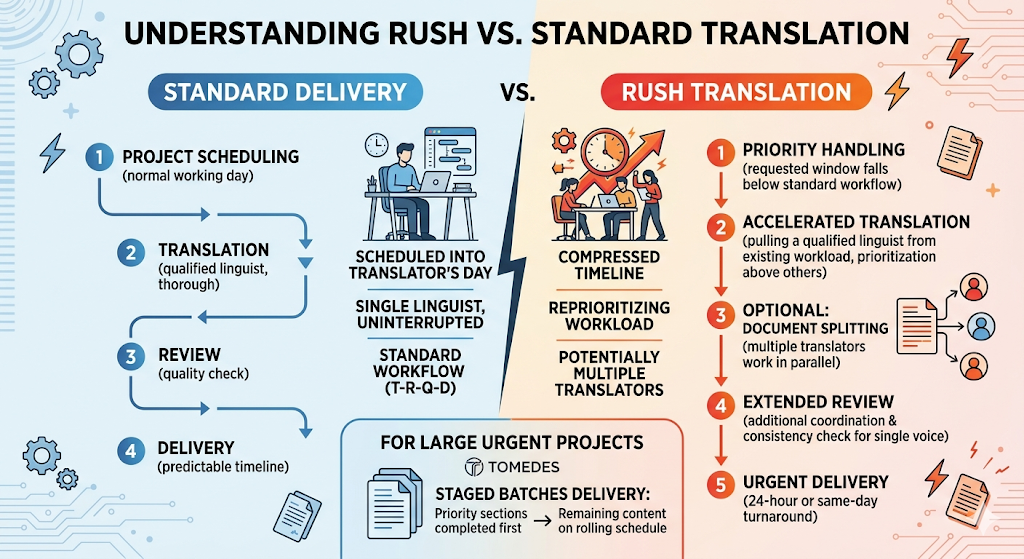
The operational difference matters. A standard translation project is scheduled into a translator's normal working day. A rush project requires pulling a qualified linguist away from their existing workload, prioritizing your project above others, and in some cases splitting a document across multiple translators to compress the timeline (which then requires additional coordination and consistency review to ensure the final output reads as a single voice). For large urgent projects, Tomedes can also deliver in staged batches, with priority sections completed first and remaining content following on a rolling schedule.
What is a realistic turnaround time for professional translation?
Realistic turnaround depends on word count, content type, language pair, and whether a review step is included. The following table reflects industry-standard expectations for a single professional translator producing quality-reviewed output.
Document length | Standard turnaround | Rush turnaround (realistic) |
Up to 500 words (1–2 pages) | Same day to 24 hours | 6–12 hours |
500–1,500 words (2–6 pages) | 1–2 business days | 24 hours |
1,500–3,000 words (6–12 pages) | 2–3 business days | 24–48 hours |
3,000–5,000 words (12–20 pages) | 3–4 business days | 48–72 hours |
5,000–10,000 words (20–40 pages) | 4–6 business days | 3–5 days (multi-translator team) |
10,000+ words | Project-dependent | Multi-day, team required |
Note: Turnarounds for legal, medical, or highly technical content should be extended by 20–30% to account for terminology research and specialist review. These figures include a review step, translation without review is faster but not recommended for any professional or official use.
The industry benchmark for a professional translator is 2,000–2,500 words per day for standard text, and closer to 1,500 words per day for legal or technical content. These numbers are physics, not policy. A provider who claims to deliver 10,000 words of accurate, specialist-reviewed legal translation in 12 hours from a single translator is either using machine translation without disclosure, or cutting the review step entirely.
Which factors make a rush translation faster or slower?
Several variables determine whether a rush timeline is achievable, and at what cost.
Language pair availability. Major European languages (French, German, Spanish, Italian) have deep translator networks and higher availability on short notice. Less common pairs, such as Vietnamese or Hebrew, have smaller pools of qualified translators. Rush availability for rare pairs cannot be guaranteed at the same rate as major languages. Tomedes supports over 270 languages and assigns native specialists matched to the subject matter of each project.
Subject matter complexity. General business and personal documents are faster. Legal contracts, medical records, pharmaceutical documentation, and technical manuals require translators with domain expertise (and those specialists are not always immediately available). Rushing a complex legal document is categorically different from rushing a birth certificate translation.
Document format. A clean, clearly typed digital document is faster to translate than a handwritten certificate, a scanned image with poor resolution, or a document with heavy formatting requirements. Most editable formats can be handled urgently; scanned PDFs, photos, and handwritten documents are also supported, but may require additional processing time for layout and OCR work.
Review requirements. ISO 17100:2015 specifies that a quality translation includes a second linguist review before delivery. Skipping this step is faster, but it increases error risk (particularly for documents submitted to courts, government agencies, or regulatory bodies). Any reputable rush service includes review. If a provider does not mention review as part of the rush process, ask directly whether it is included.
How much does rush translation cost, and where do the fees come from?
Rush translation costs more than standard translation for a specific set of reasons, none of them arbitrary. Understanding the structure helps buyers evaluate whether a quote is reasonable.
Standard translation pricing is typically quoted per word or per page. Rates vary by language pair, content type, and provider. Specialist translation (legal, medical, technical) commands a higher per-word rate than general content under any timeline.
Rush surcharges are applied on top of the standard rate to compensate for: priority scheduling that displaces other work, extended working hours or weekend availability required to meet the deadline, and in some cases the cost of assigning multiple translators to split the document and meet the window. Weekend or holiday coverage can be arranged for urgent projects at Tomedes, though rush surcharges apply.
What drives the total cost up unexpectedly:
Hidden cost factor | When it applies |
Same-day or weekend surcharge | Any project delivered within 12–24 hours, or across non-business days |
Multi-translator coordination fee | Projects over 3,000–5,000 words requiring team assignment |
Format conversion | Scanned images, PDFs requiring layout recreation, or handwritten documents |
Certification fee | When official certified translation is required (e.g., for USCIS, courts, or government submission) |
Notarization | When the receiving institution requires a notary in addition to certification |
Revision after delivery | If the brief changes post-delivery, additional rounds are chargeable |
"The buyers who are surprised by rush translation costs are usually the ones who planned for a standard timeline and then needed an urgent change. Rush is not expensive because translation companies mark it up arbitrarily – it is expensive because urgency requires dedicating resources immediately, often outside normal working hours, with no lead time to schedule efficiently. The most effective way to reduce rush costs is to build translation into the project timeline before urgency becomes a factor."
– Ofer Tirosh, CEO, Tomedes
Tomedes provides an instant quote service for urgent projects, with transparent pricing confirmed after file review. Same-day and 24-hour delivery options are available where feasible for the language pair and document type.
Does rush translation affect translation quality?
It does not have to – but it can, depending on the provider and the workflow.
The risk is not speed itself. An experienced specialist translator working intensively for six hours can produce a high-quality translation of a 1,000-word legal document. The risk is what gets cut to achieve the speed. Review is the most common casualty. When a provider claims a six-hour turnaround on a 3,000-word document from a single translator, the math often only works if the review step is reduced or removed. A second linguist check (the step that catches terminology errors, inconsistencies, and meaning shifts) typically adds 30–50% of the translation time. If that step disappears, quality risk increases proportionally.
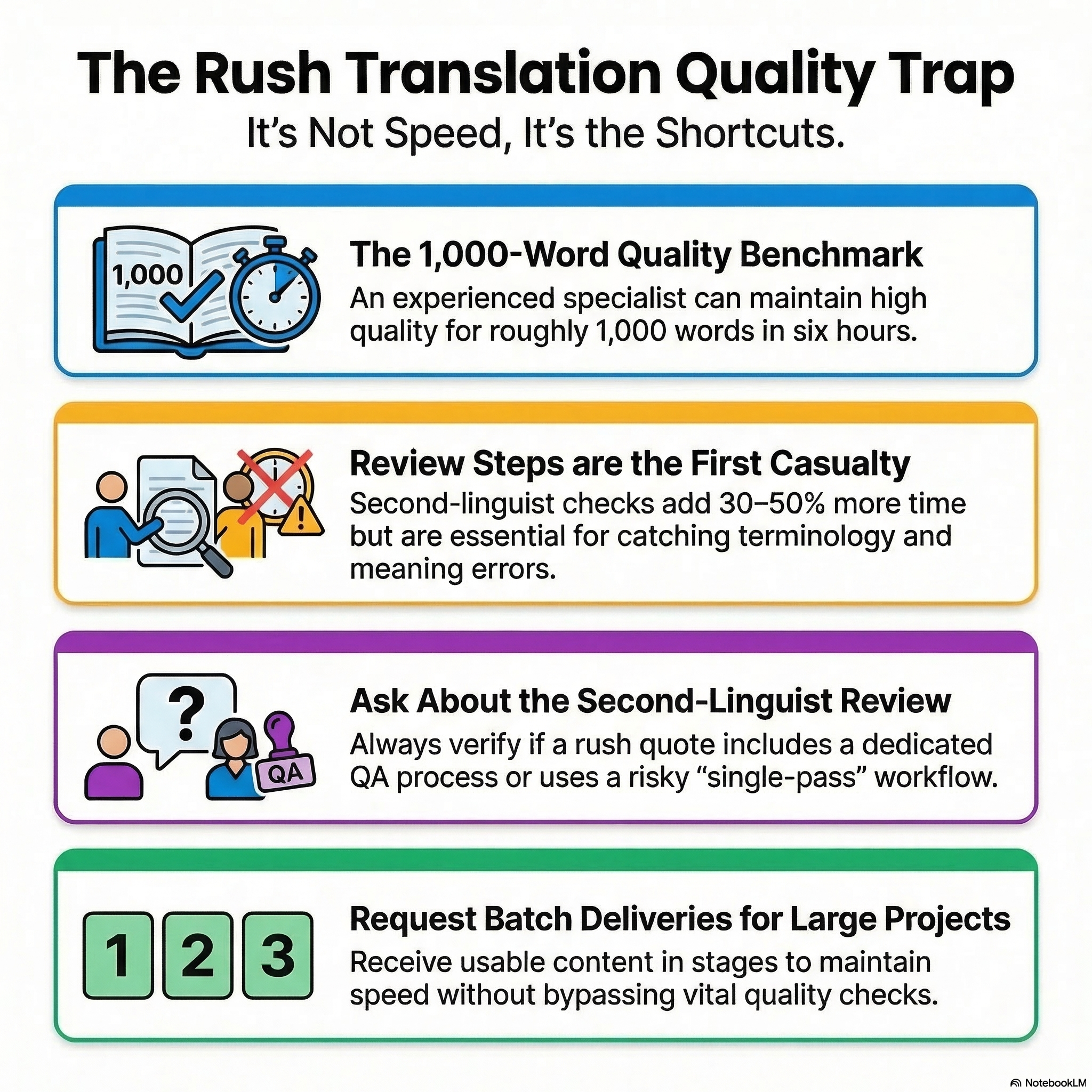
The safest question to ask any provider: does the rush turnaround include a second-linguist review, and what is the QA process for urgent projects? A provider that cannot answer this clearly is likely using a single-pass workflow.
At Tomedes, urgent projects are coordinated by a dedicated project manager who assigns native linguists, manages unified glossaries across translator teams, and oversees quality checks before delivery. For large projects, sections are delivered in batches based on priority (so clients receive usable content as early as possible without waiting for the full document). The 1-Year Quality Guarantee applies to rush translations without exception.
What documents are most commonly requested as rush translations?
Rush translation requests cluster around a predictable set of document types, most of which have external deadlines driving the urgency.
Immigration documents: Birth certificates, marriage certificates, divorce decrees, passports, police clearance records, visa applications, asylum requests, and permanent residency papers – all commonly required urgently for USCIS filings, consular appointments, or court proceedings with fixed submission deadlines.
Legal documents: Contracts, court documents, and affidavits required urgently for active legal proceedings.
Medical records: Patient records required for treatment abroad, insurance claims, or hospital admissions (particularly time-sensitive in cross-border healthcare situations).
Business materials: Proposals, reports, presentations, and business plans required for imminent meetings or time-sensitive decision-making.
Academic credentials: Transcripts and diplomas required for university enrollment deadlines or professional licensing applications.
Technical and financial documents: Technical manuals for imported equipment requiring immediate use, and financial statements, audit reports, or merger documents with regulatory or deal-driven deadlines.
For certified translation requirements (particularly for immigration or legal submission), the rush process must produce the required certification statement alongside the translated text. That is a separate deliverable with specific format requirements depending on the receiving institution. Notarization can also be arranged where needed, though timing for this depends on local availability and may extend beyond same-day delivery.
Can you get a certified translation in 24 hours?
Yes, for documents of appropriate length. A single-page or two-page certified document (a birth certificate, marriage certificate, or short legal declaration) can realistically be translated, reviewed, and certified within 24 hours by a qualified professional translation service with the right language pair available.
The constraints are the same as for any rush project: language pair availability, complexity of the content, and whether a qualified subject-matter specialist is immediately accessible. A birth certificate in Spanish is a realistic 24-hour certified translation. A 20-page certified legal contract in a less common language pair is not.
When ordering a 24-hour certified translation, confirm with the provider: that the certification statement is included in the quoted turnaround, that the format meets the requirements of the institution you are submitting to, and that a review step is included in the workflow. A certified translation that has not been reviewed by a second linguist carries quality risk that is amplified when used for official submission.
What are the most common mistakes buyers make when ordering rush translation?
Confusing turnaround claims with guarantees. A provider who advertises 12-hour translation for any document length is making a claim the math does not always support. Confirm the realistic turnaround for your specific word count and language pair before committing.
Not providing usable source files. A rush project loses hours when the source document is a low-resolution scan or a file format that requires manual extraction before translation can begin. Providing a clean digital source file is the fastest single action a buyer can take to accelerate a rush project.
Assuming rush means skipping the brief. For specialist documents (legal, medical, technical), the translator needs context: what is the document for, who is the audience, are there preferred terminology choices. Skipping this step to save time often produces a longer revision cycle after delivery.
Not confirming whether review is included. Review is the most common quality shortcut in rush workflows. Always confirm it is part of the quoted service.
Ordering rush when standard delivery would work. Many buyers pay a rush premium when the actual submission deadline is several days away. Confirm the real deadline before choosing a rush timeline, and build translation into project planning early enough that urgency becomes avoidable.
FAQs
Q: How much does rush translation typically cost compared to standard?
A: Rush surcharges vary by provider, language pair, and timeline. Same-day or 12-hour delivery typically commands a higher premium than 24-hour delivery. The total cost depends on the per-word or per-page rate, the applicable rush surcharge, and any additional fees for certification, format conversion, or weekend delivery. Tomedes provides a firm quote after file review, with options for same-day or 24-hour delivery confirmed based on the specific document and language pair.
Q: Is same-day translation possible for all language pairs?
A: No. Same-day delivery depends on immediate availability of a qualified translator in the required language pair and subject area. Tomedes supports over 270 languages, but availability for same-day delivery varies by pair. Major European and global language pairs typically have stronger short-notice availability. Confirm availability for your specific pair before committing to a same-day timeline.
Q: Does rush translation affect accuracy?
A: Not necessarily, but it depends on the provider's workflow. Rush translation that includes a full second-linguist review carries the same accuracy potential as standard delivery. Rush translation that skips the review step carries elevated error risk. At Tomedes, a dedicated project manager oversees every urgent project, coordinating linguists and QA regardless of the delivery speed.
Q: What is the fastest realistic turnaround for a legal document?
A: For a short legal document (one to two pages, clean source file, major language pair), a qualified professional service can deliver a reviewed and certified translation within 12–24 hours. For longer or more complex legal documents, or for less common language pairs, a 48–72 hour rush window is more realistic. Specialist legal content cannot be safely compressed below the time required for accurate terminology research and review.
Q: How do I reduce the cost of a rush translation?
A: Provide a clean digital source file, supply any reference materials or glossaries upfront, confirm the exact submission deadline before ordering rush, and build translation into project timelines early so urgent requests become avoidable. For ongoing translation needs, a relationship with a dedicated LSP such as Tomedes allows projects to be scheduled efficiently rather than triggered reactively.
Need a translation delivered on a tight deadline?
Tomedes provides urgent translation services across 270+ languages (with same-day and 24-hour delivery options, 24/7 human support, and a dedicated project manager on every project). The 1-Year Quality Guarantee applies at every delivery speed.
Request a free quote and confirm your deadline. A Tomedes specialist will provide a realistic turnaround and a transparent cost breakdown before the project begins.
Post your Comment