 Add text to get the translation that 22 AI models agree on


Per word vs. Per hour vs. Flat rate: Which translation pricing model is right for you?
You have received three quotes for the same translation project. One charges $0.09 per word. Another charges $55 per hour. The third offers a flat project fee. All three translation pricing models can produce very different final invoices from the same starting material, and understanding why is the first step to evaluating what you are actually being offered. According to the Slator Pro Guide on Translation and Localization Pricing and Procurement, pricing structures vary widely across the industry, and a quote that appears competitive on its face often carries costs that are only visible once a project is underway.
"The rate on a quote is not the same as the cost of a project. A low per-word figure can quietly become an expensive engagement once you factor in minimum fees, revision rounds, desktop publishing, and the complexity premium for your subject matter. Buyers who understand the pricing model before they sign a statement of work make better decisions and end up with fewer surprises on their final invoice." - Ofer Tirosh, CEO, Tomedes
This article breaks down every major translation pricing model (per word, hourly, flat rate, and machine translation post-editing (MTPE)), so that first-time translation buyers, procurement managers, marketing leads, and localization managers can compare quotes on equal terms. The figures throughout this article draw on current industry benchmarks from Slator, CSA Research, Nimdzi, and PayScale. By the time you reach the end, you will know which model fits your project type, what questions to ask before signing, and what to watch for in the fine print.
What are the main translation pricing models?
There are four primary translation pricing models in active use: per-word pricing, hourly pricing, flat-rate or project-based pricing, and MTPE (machine translation post-editing) pricing. Each model is suited to different project types, word counts, and complexity levels, and each carries different risk profiles for buyers managing a budget.
The most common model globally is per-word pricing, which ties cost directly to the volume of source text. Hourly pricing is more often used for tasks that are difficult to measure by word count, such as editing, transcription review, or terminology development. Flat-rate pricing is applied when the full scope of a project is well-defined in advance — website localization, marketing campaigns, or packaged document sets. MTPE pricing is an emerging hybrid model in which machine translation output is reviewed and corrected by a human specialist, reducing cost relative to full human translation while maintaining a quality standard appropriate for many commercial uses. Understanding all four is necessary to compare quotes meaningfully.
Table 1: Side-by-side comparison of all four translation pricing models
| Pricing Model | How It Works | Best For | Watch Out For |
|---|---|---|---|
| Per word | Cost is calculated by multiplying the source word count by a per-word rate | High-volume content, repeat document types, projects with clear word counts | Minimum fees, complexity surcharges, revision and DTP charges billed separately |
| Hourly | Cost is calculated by tracking hours spent on a task at an agreed rate | Editing, terminology work, transcription review, consulting, DTP | Scope creep, no fixed ceiling on total hours without a cap agreement |
| Flat rate / Project-based | A single agreed fee covers all work within a defined scope | Website localization, marketing campaigns, well-defined deliverable sets | Change orders if scope expands; limited transparency on unit economics |
| MTPE | Machine translation output is post-edited by a human translator | High-volume, time-sensitive content where full human translation cost is prohibitive | Quality ceiling below full human translation for complex or regulated content |
How does per-word pricing work, and when does it make sense?
Per-word pricing charges a fixed rate for every word in the source document, making total cost directly proportional to word count. It is the most transparent and widely used translation pricing model because both the buyer and the provider can calculate cost before work begins.
Current market rates for per-word translation vary significantly by content type and language pair. According to the Slator Pro Guide on Translation and Localization Pricing and Procurement and the Jobbers Language Pair Rate Database 2026, general content typically falls in the $0.08-$0.15 per word range. Legal, medical, and technical content commands $0.15-$0.30 per word, reflecting the additional expertise and liability involved. Rare or complex language pairs (those with smaller translator pools or fewer reference resources) can reach $0.20–$0.35 per word.
Table 2: Per-word rate ranges by content type and specialization
| Content Type | Rate Range (per word) | Notes |
|---|---|---|
| General content (marketing, web, general business) | $0.08 – $0.15 | Standard language pairs, no specialized knowledge required |
| Legal translation | $0.15 – $0.30 | Requires legal terminology expertise and accuracy standards |
| Medical translation | $0.15 – $0.30 | Regulated content; ISO 17100 compliance expected |
| Technical / IT translation | $0.15 – $0.25 | Terminology consistency critical; often paired with TM tools |
| Rare or complex language pairs | $0.20 – $0.35 | Smaller translator pool; longer sourcing and QA time |
Sources: Slator Pro Guide on Translation and Localization Pricing and Procurement; Jobbers Language Pair Rate Database 2026.
Per-word pricing works best when the source text is clearly bounded and the word count is fixed before work begins. It gives buyers a predictable cost ceiling for standard document translation and allows for easy comparison between providers. The model is less suitable for projects that require significant revision rounds, reformatting, or cultural adaptation, because those services are typically billed in addition to the per-word translation fee. Localization (the process of adapting content for a target culture, not just a target language) costs 30–50% more than straight translation, according to the Slator Pro Guide, because it involves judgment calls that go beyond word-for-word equivalence.
For deeper breakdowns of translation rates by language pair and direction, Tomedes publishes detailed figures at .
How does hourly pricing work, and when is it the right choice?
Hourly pricing charges buyers based on the actual time a linguist or specialist spends on a task, rather than on word count. It is the standard model for work that is difficult to measure in words — editing a document that was already translated, building or maintaining a termbase, reviewing machine translation output at a high level, or performing desktop publishing and layout adaptation.
Current hourly rates span a wide range depending on task type and specialization. Entry-level or basic content translation runs $15–$30 per hour. Intermediate work involving localization, translation memory management, or SEO adaptation commands $30–$75 per hour. Specialist tasks (legal, medical, and IT translation) bill at $75 or more per hour. Editing, terminology development, and desktop publishing (DTP) typically fall in the $35–$100 or more per hour range, according to Slator, PayScale 2026, and industry benchmarks.
The primary risk in hourly pricing is scope uncertainty. Unlike per-word pricing, hourly billing does not produce a firm cost ceiling unless the provider and buyer agree to a maximum hours cap before work begins. A buyer who receives an hourly quote without a ceiling has no contractual protection against a project running significantly over budget. Best practice is to request an estimated hour range and a not-to-exceed figure in writing before authorizing hourly work. Hourly pricing is most appropriate for revision-heavy, judgment-intensive, or consulting-type tasks where word count is not a meaningful unit of measure.
What is flat-rate or project-based translation pricing?
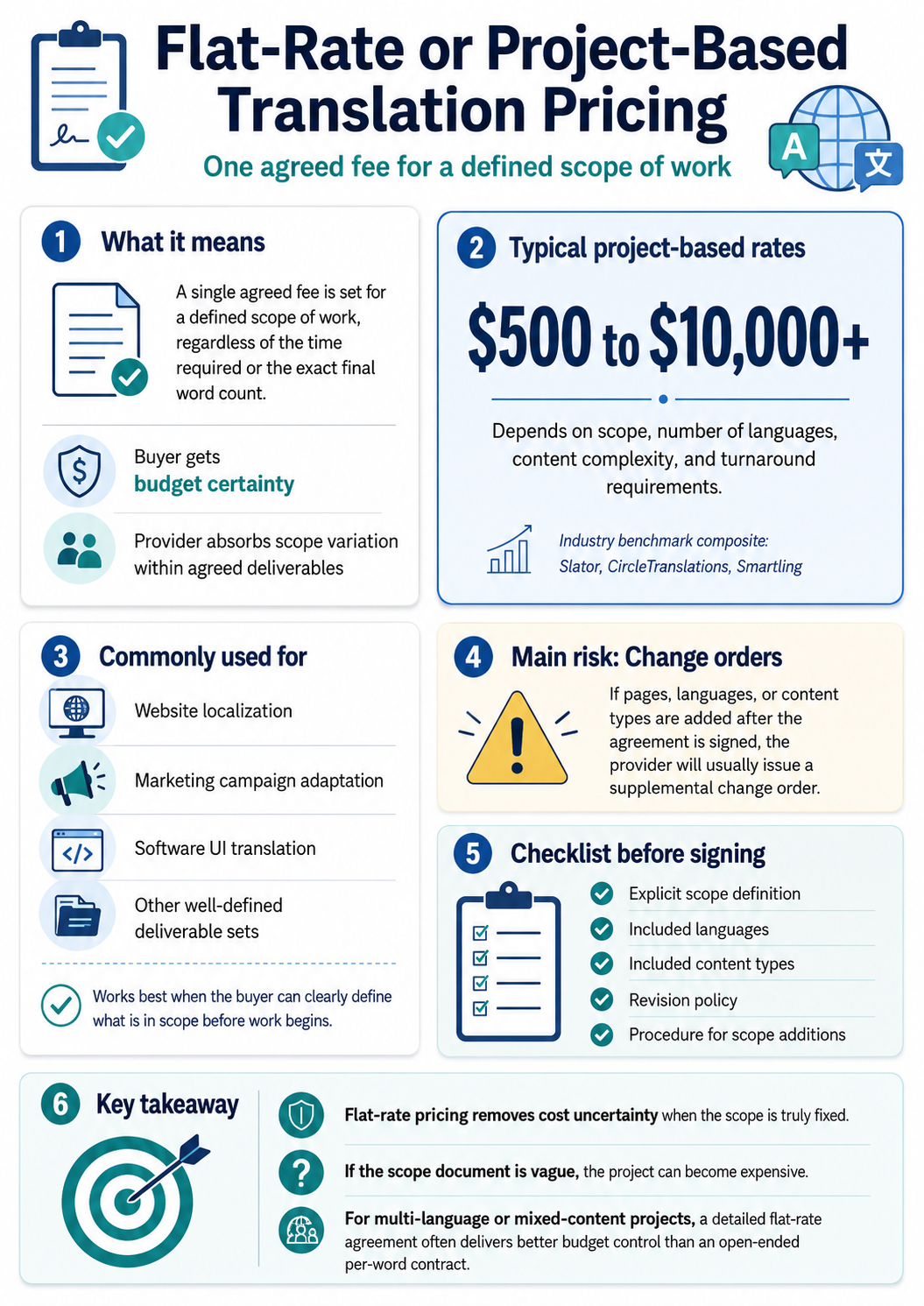
Flat-rate or project-based pricing sets a single agreed fee for a defined scope of work, regardless of the time it takes or the precise word count involved. The provider bears the risk of scope variation within the agreed deliverables, and the buyer gets budget certainty.
Project-based rates typically range from $500 to $10,000 or more, depending on scope, language count, content complexity, and turnaround requirements, according to an industry benchmark composite drawn from Slator, CircleTranslations, and Smartling. This model is most commonly applied to website localization projects, marketing campaign adaptation, software UI translation, and other well-defined deliverable sets where the buyer can specify exactly what is in scope before work begins.
The main risk for buyers is the change order. If a buyer adds pages, languages, or content types after a flat-rate agreement is signed, the provider will typically issue a change order at a supplemental rate. Buyers should ensure that the flat-rate agreement includes an explicit scope definition, a list of included languages and content types, a revision policy, and a clear procedure for handling scope additions before signing. Flat-rate pricing removes cost uncertainty on both sides when the scope is genuinely fixed, but it can become expensive if the scope document is vague. For that span multiple languages or content types, flat-rate agreements with detailed scope definitions often produce better budget outcomes than open-ended per-word contracts.
What is MTPE pricing, and how does it compare to human translation?
MTPE (machine translation post-editing) is a pricing model in which raw machine translation output is reviewed, corrected, and refined by a human translator or editor to bring it to an acceptable quality standard. It is not the same as unreviewed machine translation, and it is not the same as full human translation. It occupies a specific quality and cost band between the two.
MTPE typically costs approximately 65–75% of full human translation, according to Nimdzi. Enterprise adoption of MTPE has grown substantially: roughly 26% of enterprise language buyers were using MTPE in 2022, rising to approximately 46% by 2024, according to Nimdzi research. This growth reflects both the improving quality of neural machine translation engines and the increasing volume of content that organizations need to translate at speed and scale.
MTPE pricing is appropriate for high-volume, time-sensitive content where the cost of full human translation is prohibitive and where the content does not carry the legal, medical, or reputational risk that demands full human authorship throughout. It is generally not appropriate for contracts, clinical documentation, regulatory filings, or literary content. Two ISO standards are directly relevant: ISO 17100:2015 governs the requirements for full human translation services, while ISO 18587:2017 governs the post-editing of machine translation output. Buyers should confirm which standard a provider is certified against before treating MTPE and human translation quotes as interchangeable. For a full explanation of the process and quality considerations, Tomedes covers in detail.
Separately, tools can accelerate human translation workflows without necessarily following the formal MTPE structure — buyers evaluating AI-assisted services should ask providers to specify exactly where human review occurs in the process.
What hidden costs should buyers watch for in any pricing model?
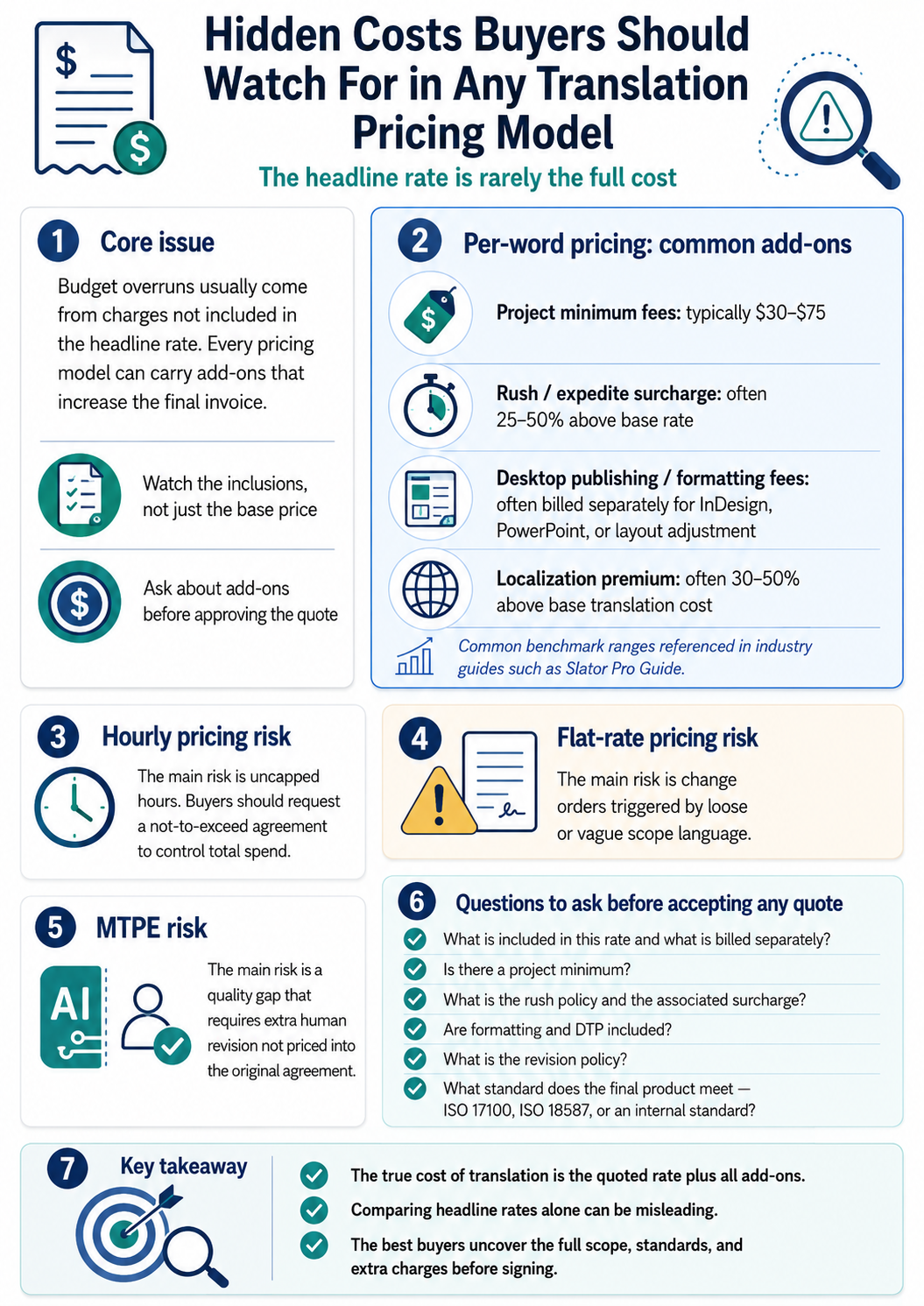
The most common source of budget overrun in translation projects is not the headline rate, it is the charges that the headline rate does not include. Every pricing model carries its own set of potential add-ons, and buyers who do not ask about them in advance are frequently surprised by the final invoice.
For per-word pricing, the most common additional charges are: project minimum fees (many agencies apply a flat minimum charge regardless of word count, typically $30–$75), rush or expedite surcharges (often 25–50% above the base rate for tight turnaround), desktop publishing or formatting fees (charged separately when translated text requires layout adjustment, especially in InDesign or PowerPoint files), and localization premiums (30–50% above base translation cost, per the Slator Pro Guide). For hourly pricing, the risk is uncapped hours without a not-to-exceed agreement. For flat-rate pricing, the risk is change orders triggered by loose scope language. For MTPE, the risk is a quality gap that requires additional human revision not priced into the original agreement.
Buyers should ask every prospective provider the following questions before accepting any quote: What is included in this rate and what is billed separately? Is there a project minimum? What is the rush policy and the associated surcharge? Are formatting and DTP included? What is the revision policy? What standard does the final product meet — ISO 17100, ISO 18587, or an internal standard? These questions will surface the true cost of a project far more reliably than comparing headline rates alone.
How do you choose the right pricing model for your project?
Choosing the right pricing model depends on three variables: how well-defined the project scope is, what type of content is being translated, and what quality standard the output must meet. No single model is universally superior.
Per-word pricing is the right default for most standard document translation projects where the source text is fixed and the word count is known. It is predictable, auditable, and easy to compare across providers. Hourly pricing is the right choice for revision work, consulting, terminology development, or any task where the unit of value is professional judgment rather than words converted. Flat-rate pricing is the right choice for well-scoped projects (particularly website localization or campaign adaptation) where budget certainty matters more than unit-price transparency. MTPE pricing is the right choice when volume and speed are primary constraints and the content type and risk profile are compatible with post-edited machine output.
A practical decision framework: start with the question of risk. If your content is regulated, sensitive, or carries legal or medical significance, full human translation under ISO 17100:2015 is the appropriate standard regardless of pricing model. If your content is high-volume and time-sensitive but does not carry that risk profile, MTPE under ISO 18587:2017 can deliver acceptable quality at lower cost. If your project scope is fixed and large, negotiate a flat rate with a detailed scope document. If your project is a standard document with a known word count, use per-word pricing and ask every provider to quote on identical scope so the comparison is valid.
The ROI case for investing in the right translation approach is well established. CSA Research reports that organizations receive an average return of $25 for every $1 invested in localization, and the global language services industry reached $51.9 billion in 2024, reflecting the scale at which businesses treat translation as a core operational investment rather than a discretionary expense (CSA Research). Choosing the wrong pricing model does not just create invoice surprises, it can also create quality gaps that undermine the return on that investment.
How does Tomedes structure its translation pricing?
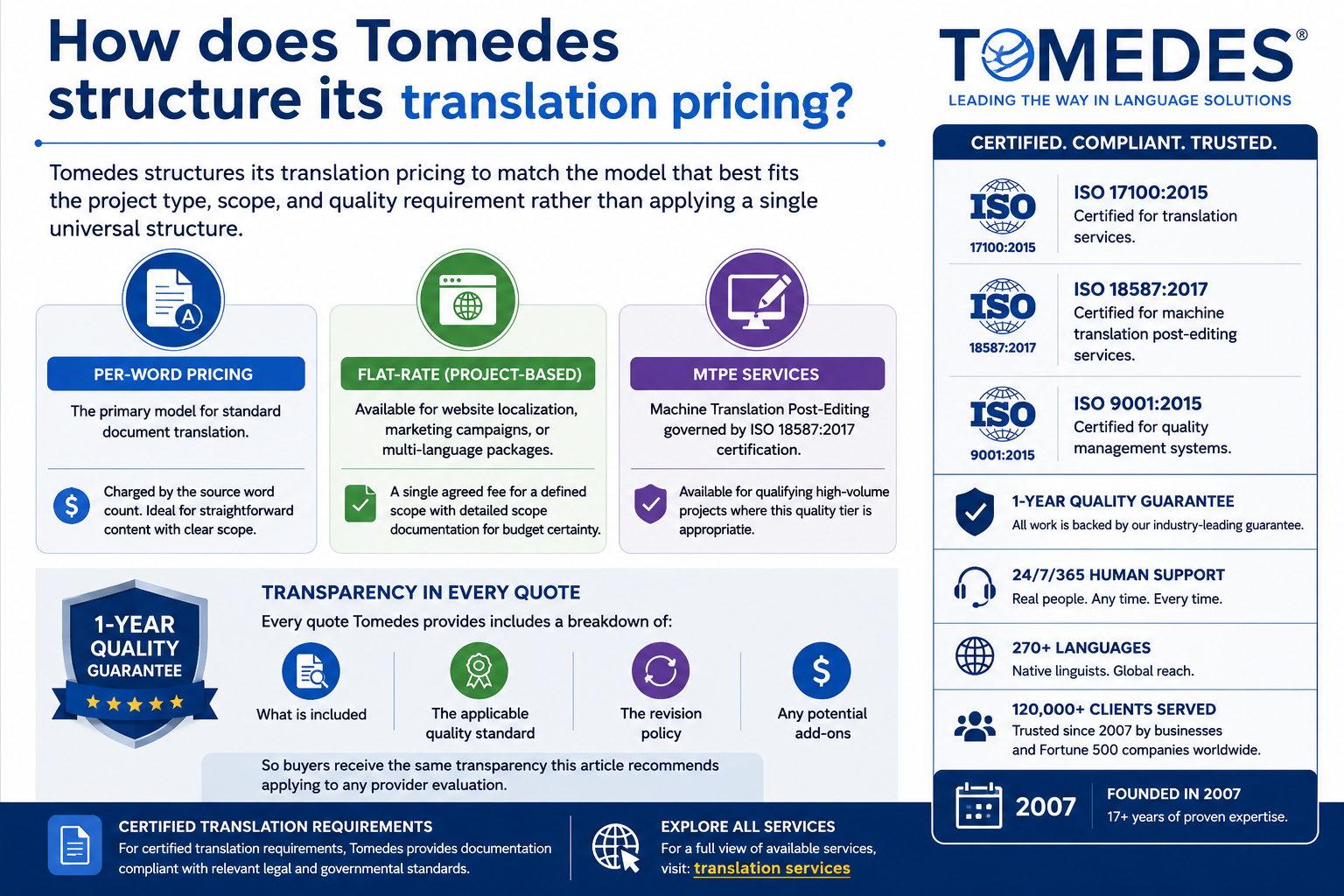
Tomedes structures its translation pricing to match the model that best fits the project type, scope, and quality requirement rather than applying a single universal structure. For standard document translation, per-word pricing is the primary model. For project-based work (website localization, marketing campaigns, or multi-language packages), flat-rate agreements are available with detailed scope documentation. MTPE services, governed by ISO 18587:2017 certification, are available for qualifying high-volume projects where that quality tier is appropriate.
Tomedes holds ISO 17100:2015 certification for translation services, ISO 18587:2017 for machine translation post-editing services, and ISO 9001:2015 for quality management systems. All work is backed by a 1-Year Quality Guarantee. Tomedes operates with 24/7/365 human support across 270+ languages, and has served more than 120,000 clients since its founding in 2007, including Fortune 500 companies.
Every quote Tomedes provides includes a breakdown of what is included, the applicable quality standard, and the revision policy — so buyers receive the same transparency this article recommends applying to any provider evaluation. For requirements, Tomedes provides documentation compliant with relevant legal and governmental standards. For a full view of available services, visit .
FAQs
Q: Is per-word or hourly translation pricing cheaper?
A: Neither model is inherently cheaper, the total cost depends on project type. Per-word pricing is typically more cost-efficient for standard document translation with a fixed word count, because the total is calculable before work begins. Hourly pricing can be more cost-efficient for short editing or revision tasks where the word count is large but most of the text needs only minor correction. The risk with hourly pricing is that without a not-to-exceed cap, total cost is not fixed until the work is complete.
Q: Why do translation quotes vary so much between agencies?
A: Translation quotes vary because providers are not always quoting on the same scope. One provider may include desktop publishing in the base rate while another bills it separately. One may apply a localization premium while another quotes straight translation. Subject matter specialization, language pair direction, certification standards, and revision policies all affect cost. Buyers should request itemized quotes and ask each provider to list explicitly what is and is not included before treating headline rates as comparable.
Q: Does a lower per-word rate always mean a better deal?
A: No. A lower per-word rate can become the most expensive option in the final invoice if it is accompanied by high minimum fees, aggressive rush surcharges, separate billing for formatting and DTP, or a quality standard that requires additional revision rounds. Buyers should evaluate the total cost of a completed, delivered project at the required quality standard — not the per-word figure in isolation.
Q: What pricing model does Tomedes use?
A: Tomedes uses the pricing model that best fits the project. Per-word pricing applies to standard document translation. Flat-rate or project-based pricing is available for well-scoped localization and campaign work. MTPE pricing, governed by ISO 18587:2017, is available for qualifying high-volume projects. All quotes include a clear breakdown of what is covered, the applicable quality standard, and the revision policy.
Q: How does MTPE pricing compare to standard human translation?
A: MTPE typically costs approximately 65–75% of full human translation, according to Nimdzi. The cost difference reflects the reduced time required when a human translator is correcting and refining machine output rather than translating from scratch. The quality standard is also different: MTPE under ISO 18587:2017 is appropriate for many commercial content types but is generally not suitable for legal contracts, clinical documentation, regulatory filings, or content where accuracy risk is high. Full human translation under ISO 17100:2015 remains the appropriate standard for regulated and high-stakes content.
Request a translation quote from Tomedes
If you have a project in hand and are ready to compare pricing models with a clear scope, Tomedes provides transparent, itemized quotes with no obligation. Every quote specifies the applicable pricing model, quality standard, and revision policy — so you can evaluate it against any other quote on equal terms.
Tomedes has served more than 120,000 clients across 270+ languages since 2007, holds ISO 17100:2015, ISO 18587:2017, and ISO 9001:2015 certifications, and backs all work with a 1-Year Quality Guarantee. Translation support is available 24/7/365 from human project managers.
To request a quote or discuss pricing for your project, visit .
Written by Ofer Tirosh
Connect on LinkedInOfer founded Tomedes in 2007 and now leads the company's push to combine two decades of human translation expertise with AI. He writes about where the language industry is actually heading and the shifts nobody's ready for, the bets that paid off, and the ones that didn't.
Share:

Post your Comment