 Add text to get the translation that 22 AI models agree on


I built a word game. I'm a translation company CEO. Here's why that's not weird.
There is a version of this story where I explain that Parley is a strategic asset — a linkable tool designed to generate organic backlinks, drive brand awareness, and demonstrate Tomedes' capabilities at scale. That version is also true. But it is not why I built it.
The honest version starts like this: I have spent almost 20 years watching people believe that translation is simpler than it is. Not because they are careless. Because language is deceptively familiar. You speak it. You read it. You use it every day. And so when someone tells you that rendering a sentence from English into Japanese is a complex act requiring cultural fluency, subject-matter expertise, and genuine human judgment — it can feel like an oversell. It can feel like a professional guild protecting its turf.
Parley is my answer to that skepticism. Not an argument. A game.
What is Parley, and how does it work?
Parley is a free daily translation puzzle. Each day, you receive five English words to identify. Instead of letter tiles or definitions, your clues are translations — drawn from 12 languages, each paired with a national flag and spoken aloud when you tap it.
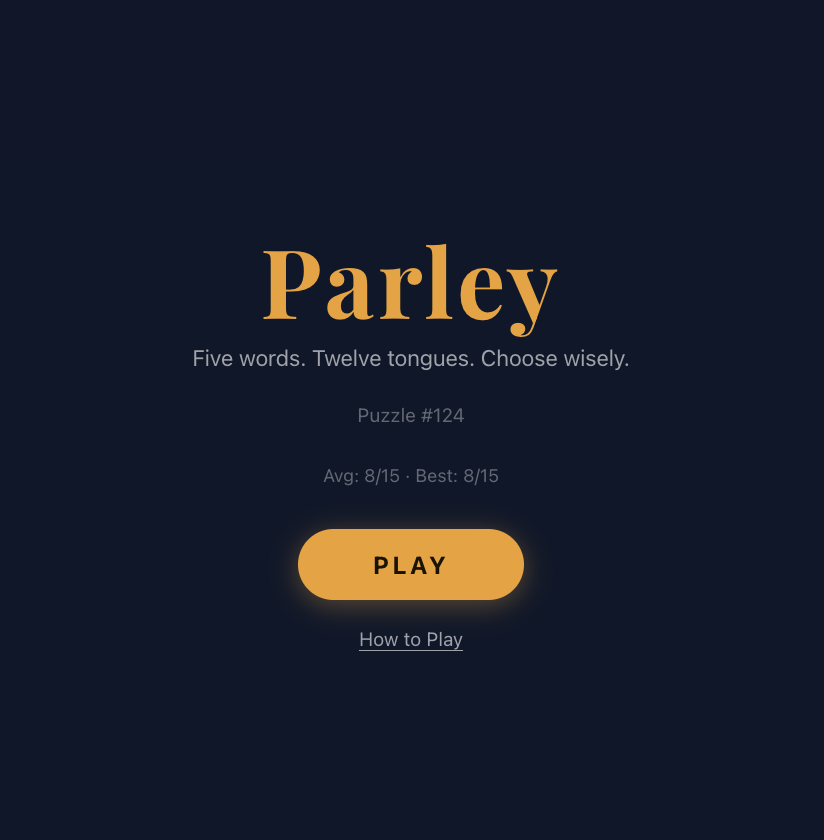
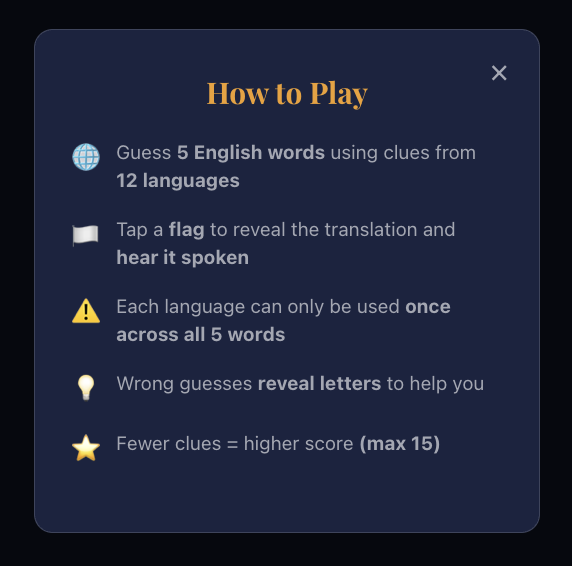
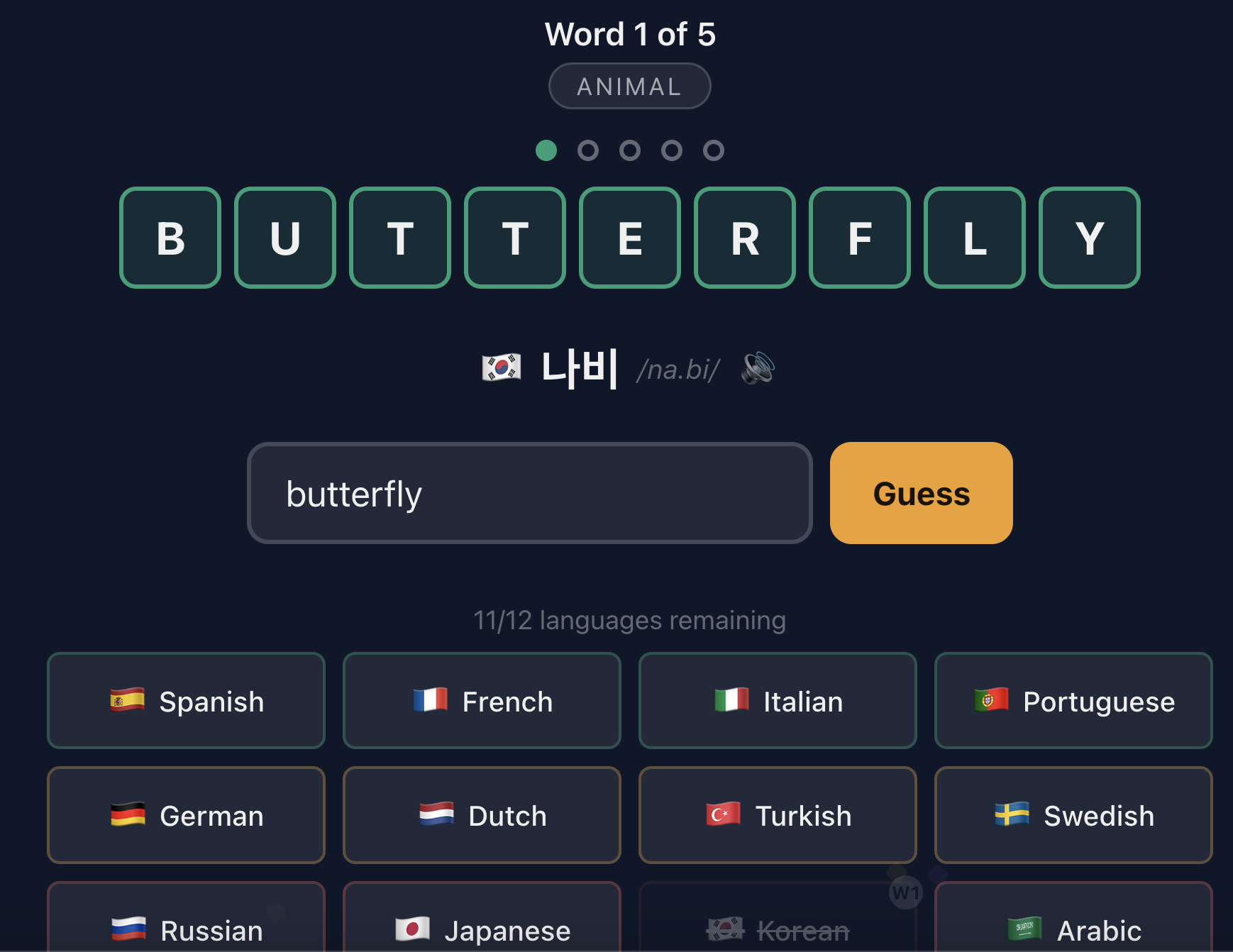
The catch is this: each language can only be used once across all five words. You have 12 languages and 5 words, which means every clue decision costs you a future one. Use Spanish on the first word and you cannot use it again. Guess wrong, and letters are revealed to narrow the search. The fewer clues you use, the higher your score — with a maximum of 15 points for a perfect round.
It is, in structure, a strategy game. The translation element is not decorative. It is the mechanism. To score well, you need to know which languages offer the most distinctive phonological or orthographic signals for each word — or you need to be strategic about saving your strongest languages for the words you expect to struggle with most.
Why would a translation company build a word game?
The short answer: because most people's mental model of translation is wrong, and no amount of writing about it changes that.
Tomedes has published hundreds of articles about the complexity of translation. About register and tone. About the 270+ languages Tomedes works in. About the fact that Nimdzi's 2025 research found that 9 in 10 international users will ignore a product not available in their native language. (Source: Nimdzi 2025.) These are important facts. They are also easy to scroll past.
Parley is not easy to scroll past. It is easy to lose at.
The first time you tap the Japanese flag for the word "harbor" and hear the pronunciation but still cannot place the English word, that is not an intellectual argument about translation complexity. That is translation complexity, experienced in about four seconds. It lands differently.
I also want to be direct about something the SEO literature rarely says: tools that are genuinely enjoyable earn links that no outreach campaign can manufacture. Parley is built to be shared because it is built to be played. The off-page SEO value is real. But it is a byproduct of building something people actually want to use, not the other way around.
What does Parley actually teach you about translation?
More than I expected when I designed it.
The mechanic of choosing which language to use as a clue forces a question most people have never consciously considered: which language would make this English word most recognizable? And the answer is almost never obvious.
Cognates behave differently by language family. Germanic languages preserve some English roots. Romance languages share Latin ancestry but diverge sharply in pronunciation. Japanese renders foreign loan words in katakana, which can make an English word either immediately transparent or completely unrecognizable depending on how the sound has been adapted. Arabic and Hebrew carry roots that are invisible to most English speakers.
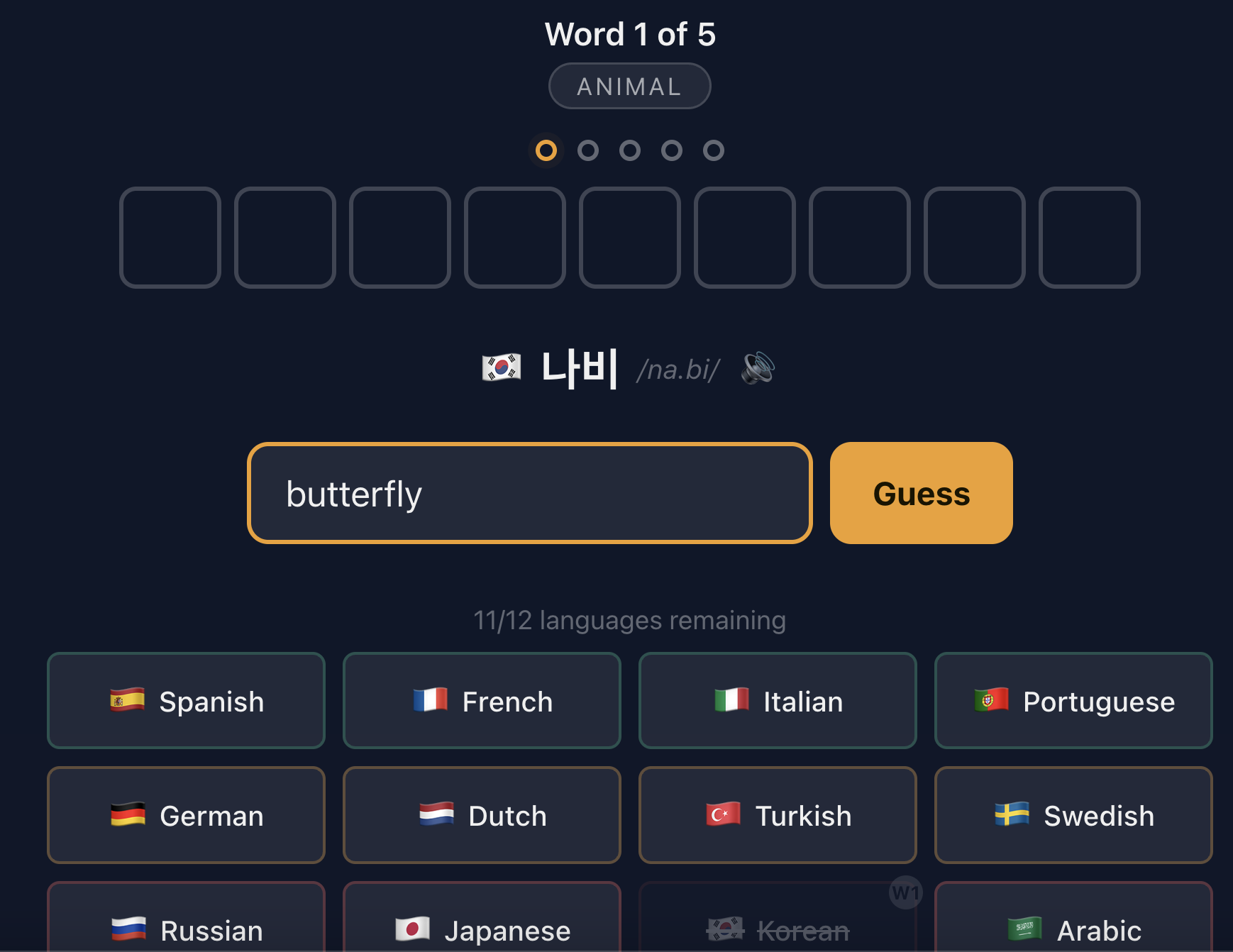
When you play Parley strategically, you are (without necessarily knowing it) reasoning about linguistic distance, about how meaning travels across language families, and about the asymmetry of translation in different directions. A word that is easy to recognize in French may be opaque in Turkish. A Japanese translation might be a phonetic borrowing that resolves instantly, or a native Japanese word that gives nothing away.
That is not a simplified model of what Tomedes' linguists do. It is a simplified version of the same underlying problem. Scale it up by several orders of magnitude, add domain specificity, add cultural context, add a client deadline — and you have professional translation.
Is language learning through games effective?
Research on this question is more nuanced than the edtech industry typically acknowledges.
Spaced repetition, gamified vocabulary acquisition, and immersive play-based learning have demonstrated genuine retention benefits (particularly for vocabulary and phonological awareness) in studies from MIT's Department of Brain and Cognitive Sciences and in Duolingo's own longitudinal learning data.
But Parley is not designed to teach you a language. It is designed to show you something about language — specifically about the relationship between words across languages, about how meaning is encoded differently in different systems, and about why translation requires human judgment rather than pattern-matching.
If you finish a round of Parley and find yourself wondering what the Japanese word for "harbor" actually means, or why the Arabic translation looks nothing like the English word but the French one almost does — that curiosity is the point. Parley does not want to be your language teacher. It wants to make you curious enough to want one.
What does "strategic" mean for a clue in 12 languages?
This is the design question I found most interesting to solve.
The 12 languages in Parley were not chosen randomly. They represent a deliberate spread of language families, writing systems, and typological distance from English: Spanish, French, German, Italian, Portuguese, Japanese, Arabic, Chinese, Russian, Turkish, Hindi, and Swahili.
Each family creates a different type of clue. Using a Romance language on a word with Latin roots gives a strong signal. Using a Germanic language on a word of Germanic origin in English reveals etymological kinship that many players are surprised to notice. Using Arabic or Chinese on the same word gives almost nothing, which is itself a clue about language distance.
A skilled player learns to read not just the translation, but the language family it belongs to. That is a form of metalinguistic awareness — knowing something about how languages work, not just knowing words in them. It is also, in a modest but real way, the same skill that professional translators develop over years of practice.
Who is Parley for?
Honestly? Everyone. But some players get more out of it than others.
If you are a professional translator or linguist, Parley is going to be either very easy or very revealing — depending on your language combinations. The game will quickly surface your strongest and weakest language family intuitions.
If you are a localization buyer (someone who commissions translation at scale but does not speak the target languages), Parley is the most efficient two-minute demonstration of why "just translate it" is not a procurement strategy. Play it once and the phrase "it's just words" will never sit quite as comfortably again.
If you are a language learner, Parley is not a substitute for study. But it is a useful mirror. The languages where you can identify the English word instantly are the ones you know. The ones that leave you guessing reveal exactly how far you still have to go.
And if you are none of those things (if you just like daily word puzzles and want one that is harder and stranger than the ones you are used to), Parley will do that for you.
A new puzzle goes live every day at tomedes.com/games/parley. It takes about three minutes. You will probably lose the first few times. That is, as it turns out, the point.
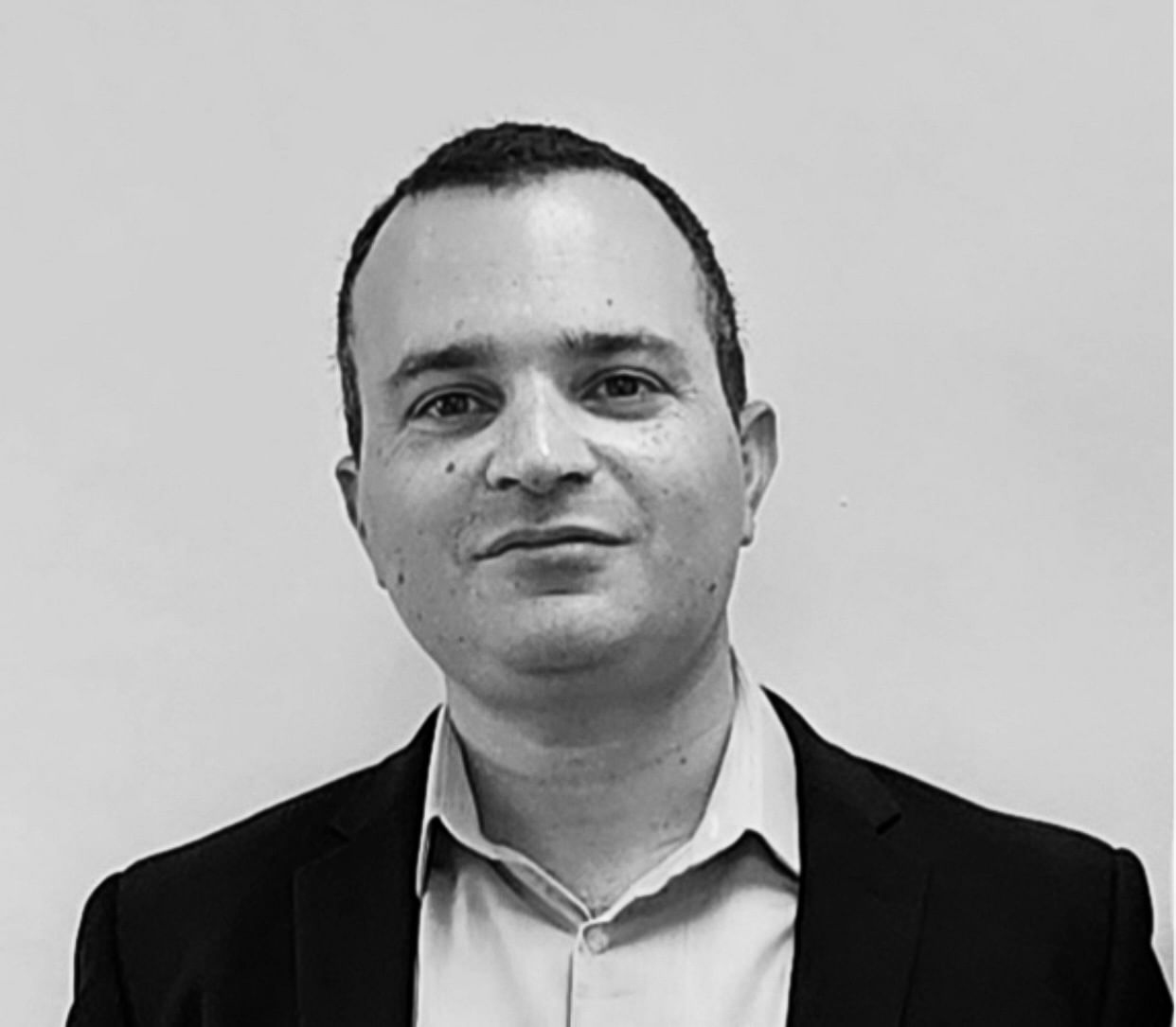
Written by Ofer Tirosh
Connect on LinkedInOfer founded Tomedes in 2007 and now leads the company's push to combine two decades of human translation expertise with AI. He writes about where the language industry is actually heading and the shifts nobody's ready for, the bets that paid off, and the ones that didn't.
Share:

Post your Comment