 Add text to get the translation that 22 AI models agree on


Stop managing AI translations alone: How global brands scale 70% faster
In 2026, the "DIY AI" experiment has reached a tipping point. Enterprises that rushed to implement raw AI translation for global scaling are hitting the same wall: quality debt.
Fragmented workflows, inconsistent brand voices, and "smooth hallucinations" (errors that look correct but are factually wrong) are now the primary bottlenecks to global growth. For a brand to scale 70% faster without 70% more risk, the transition from "Managing AI" to Managed AI Translation Services is no longer optional.
This article outlines the shift from a "typist" mindset to a language architect model – ensuring your global expansion is fast, secure, and defensible.
Why is managing AI internally a bottleneck?
Managing AI translations in-house often leads to "shadow AI" – where different teams use different tools (DeepL, ChatGPT, Gemini) without central oversight. This results in:
Inconsistent tone: Marketing assets sound "playful" while support documentation remains "robotic."
No accountability: When an automated error leads to a legal dispute, there is no "human owner" of the result.
Layout failures: AI doesn't understand that German text can be 30% longer than English, frequently breaking UI and print designs.
Quality anxiety: Constant back-and-forth between reviewers and stakeholders eats into schedules and leads to missed deadlines.
How does SMART eliminate quality anxiety?
The core of the Tomedes solution is SMART, a proprietary technology designed to remove the "gamble" of trusting a single AI model.
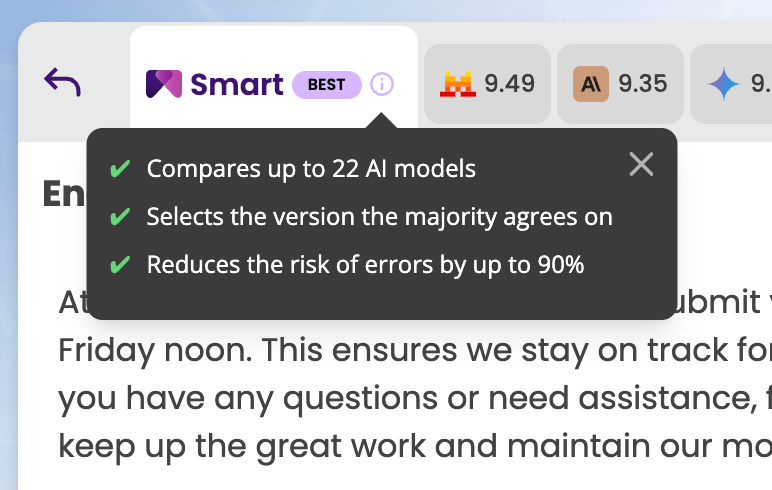
Relying on one AI model is a risk; models can hallucinate facts or miss cultural nuances. SMART removes this risk by comparing outputs from 22 top AI models (including Google, DeepL, Claude, and Microsoft) and combining them into one trusted translation based on sentence-by-sentence consensus.
The Result: Internal evaluations show that consensus-driven choices reduce visible AI errors and stylistic drift by 18-22% compared to relying on a single engine.
What’s the role of the language architect?
A language architect is the strategic lead provided by Tomedes. They move beyond "checking words" to designing the entire technical and cultural pipeline for the brand.
The Old Way (DIY AI / Project Manager) | The New Way (Tomedes Language Architect) |
Manual Selection: Guessing which AI engine is best for the pair. | SMART: Automatically uses 22-model consensus. |
Fragmented QA: Sampling content and hoping for the best. | Continuous Governance: 85-100 quality scores on every file. |
Hidden Costs: Staff time lost to rework and layout fixes. | Predictable ROI: Up to 90% cost reduction vs. human-only. |
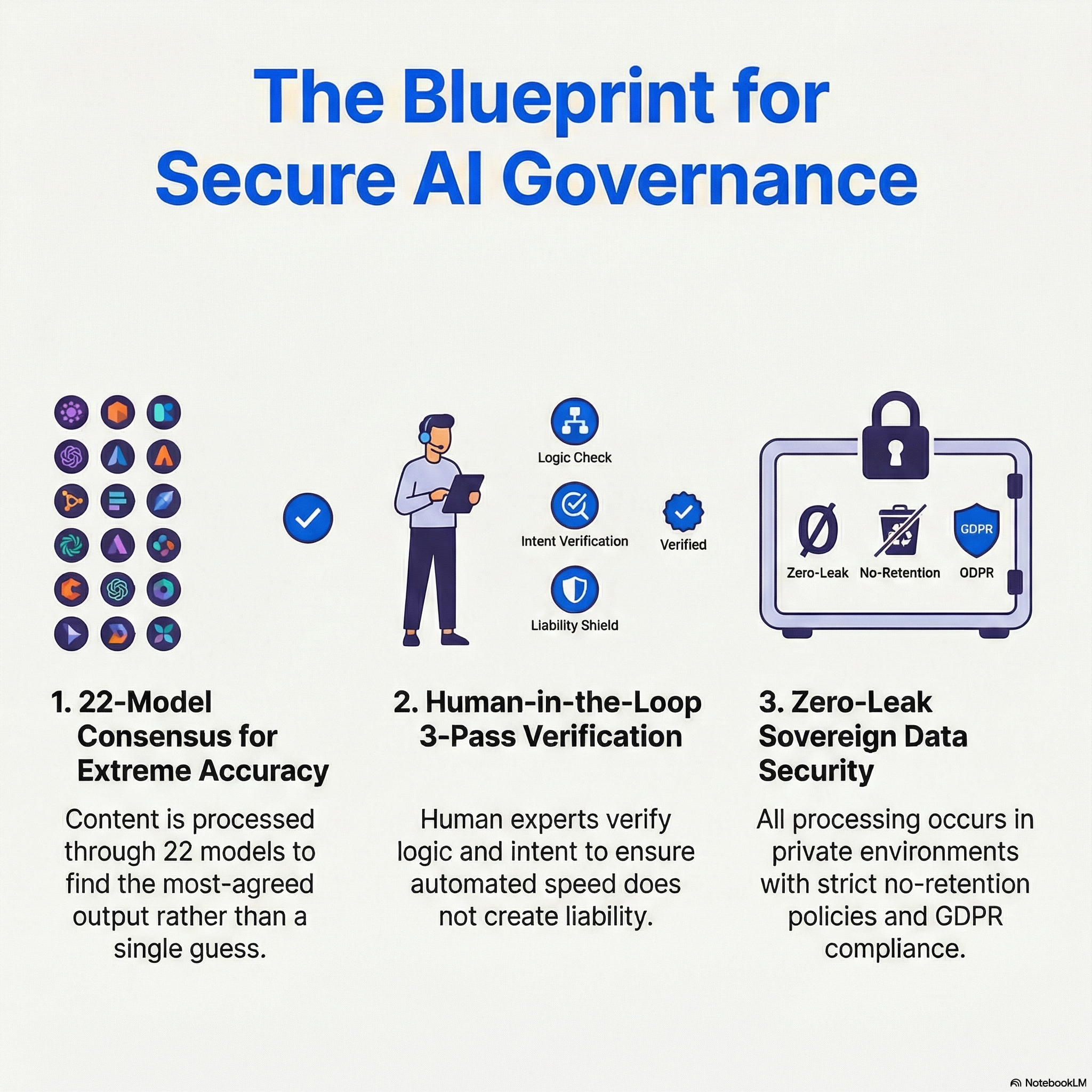
Step 1: Architecting multimodal routing with 22-model consensus
In 2026, "one AI for everything" is a mistake. A language architect uses multimodal routing to match content with the "brain" best suited for it.
SMART: Content is processed through up to 22 AI models to find the most-agreed translation, not merely the highest-ranked candidate.
Risk Triage: High-risk legal documents move from AI consensus to 100% human-led review; low-risk internal chats stay on automated streams with sampling.
Step 2: Implementing 'Human-in-the-Loop' (HITL) governance
Speed is a liability without a safety net. Managed AI incorporates a 3-Pass Verification process to ensure "70% faster" doesn't mean "70% riskier."
Automated QA: Catching number flips, date-format errors, and terminology mismatches.
Logic Review: A human expert verifies the intent. Did the AI turn a "must" into a "may"?
DTP & Layout: Multilingual Desktop Publishing specialists fix "text expansion" issues so files are ready to publish immediately.
Step 3: Ensuring sovereign data security
Using public AI is a data leak. For global brands, security is a non-negotiable prerequisite for scale.
Secure Environments: All processing happens in a Microsoft Azure environment with strict no-retention policies.
Confidentiality: Professional handling ensures sensitive information is never used to train public models.
GDPR Compliance: Settings ensure data privacy adheres to regional international laws, protecting your brand from regulatory risk.
How to scale speed without risking the brand?
Brands scaling 70% faster in 2026 aren't just using faster machines; they are using better governance. By transitioning to a Managed AI Service, the operational burden – from engine routing to human QA and DTP – is placed in the hands of a dedicated architect.

FAQs
Q: How does SMART ensure better accuracy than ChatGPT?
A: ChatGPT is a single model. SMART queries 22 top AI models and selects the translation that the majority agree on. This consensus significantly filters out "hallucinations" and factual errors that a single model might produce.
Q: What is the ROI of Managed AI compared to DIY?
A: DIY AI often results in "hidden costs" like staff time spent on rework. Tomedes Managed AI typically offers 80-90% savings over pure human workflows while maintaining 98% terminology consistency and 85-100 quality scores.
Q: Is my data safe with SMART?
A: Yes. All translations are managed on a secure Microsoft Azure environment with strict no-retention policies. Your proprietary content is never used to train global AI models.
Q: Can Managed AI handle complex file formats?
A: Yes. Unlike DIY tools that only output raw text, our service includes Integrated DTP support. Multilingual designers handle fonts, spacing, and layout so your files are ready to print or publish immediately.

Written by Rachelle Garcia
Connect on LinkedInRachelle leads product and AI at Tomedes, where she runs the experiments that turn internal data into better translation experiences. She writes about what actually happens when you build AI products such as MachineTranslation.com — the numbers, the surprises, and the parts that don't go to plan.
Share:

Post your Comment