 Add text to get the translation that 22 AI models agree on


How Agentic AI Empowers Human Translators (2026)
For the last few years, the translation industry has been haunted by a single, anxious question: "Will AI replace humans?"
In 2026, the answer is becoming clear: No. But it is changing how humans work in a profound way.
We are moving away from the era of "Generative AI" (where you ask a bot to do the job) and entering the era of "Agentic AI" (where you manage a team of digital assistants).
You must view this not as a replacement of human talent, but as the liberation of it.
Think of the best translator you know. Now, imagine giving them a team of three tireless assistants to handle their research, terminology checks, and formatting. That translator doesn't get fired; they get superpowers.
This article explores the "Super-Team" model – where human expertise is amplified, not automated.
From "tool" to "teammate": What is agentic AI?
To understand why this is good for linguists, we have to distinguish between "Old AI" and "New AI."
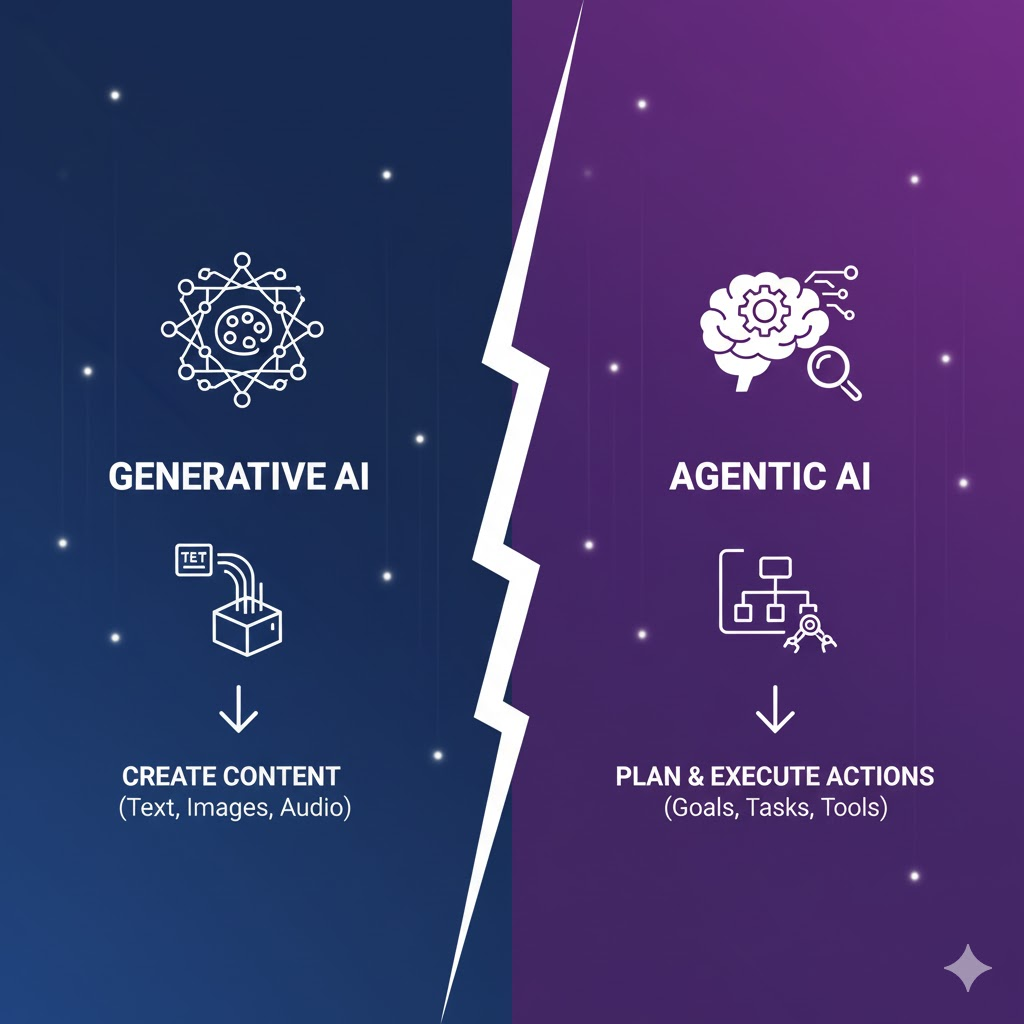
The Old Way (Generative AI):
You paste a text into a chatbot. It spits out a translation. It’s fast, but often messy. The human translator has to clean up the mess (Post-Editing). It feels like janitorial work.
The New Way (Agentic AI):
You assign a goal to an "Agent." The Agent doesn't just guess; it works. It browses the web to check facts. It reads your style guide. It creates a glossary. It prepares the file before the human translator starts the "real" work.
The Shift: Instead of asking humans to fix bad AI output, Agentic AI works for the human, handling the tedious preparation and quality checks so the human can focus on nuance and style.
The digital support crew: Who is on the team?
In a typical agentic workflow, don't leave the human translator alone on an island. Surround them with a "Digital Support Crew."
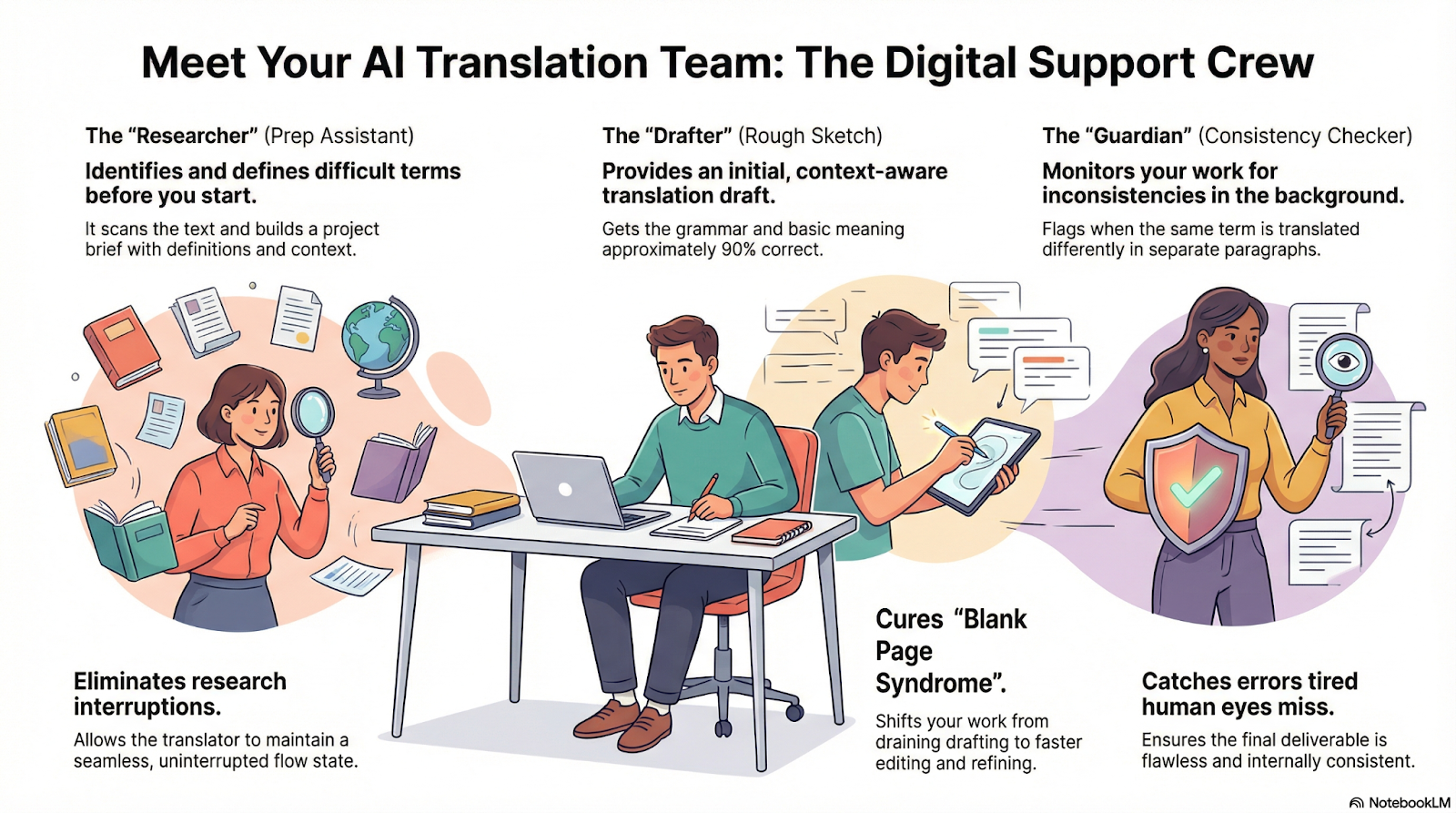
1. The "Researcher" (The Prep Assistant)
Every translator knows the pain of stopping every five minutes to Google an obscure acronym or a company-specific term.
-
The Agent's Job: Before the project starts, this agent scans the source text, identifies difficult terms, and builds a "Project Brief" with definitions and context links.
-
The Human Benefit: You start translating with all the answers already on your desk. Flow state is uninterrupted.
2. The "Drafter" (The Rough Sketch)
This agent provides the initial translation layer. But unlike a basic chatbot, it is "context-aware" – it knows the project history and tone guidelines.
-
The Agent's Job: Laying the foundation. Getting the grammar and basic meaning down 90% correctly.
-
The Human Benefit: The "Blank Page Syndrome" is gone. You are editing and refining, which is faster and less cognitively draining than drafting from scratch.
3. The "Guardian" (The Consistency Checker)
This agent runs in the background as you work. It is the "Editor" that never gets tired.
-
The Agent's Job: "Wait, in paragraph 3 you translated 'Drive' as 'Conduire', but in paragraph 10 you used 'Pilot'. Which one do you want?"
-
The Human Benefit: It catches the mechanical errors that human eyes miss after 8 hours of work, ensuring the final deliverable is flawless.
The human architect: Why you are still in charge
If the agents do the research, drafting, and checking... what does the human do?
The Human provides the Soul.
Agents are logical. Language is emotional. In this new workflow, the human role elevates from "Translator" to "Language Architect."
-
Cultural "Vibe" Checks: An AI can translate a joke literally. Only a human knows if it will actually make a French audience laugh.
-
Strategic Decisions: "Should this marketing slogan be formal or rebellious?" Agents can't make taste-based decisions. Humans can.
-
Liability & Ethics: For legal or medical docs, a human signature is the ultimate safety net. An agent can't take responsibility; a human expert can.
Tomedes insight: “Technology isn’t the goal, it’s the tool. The goal is trust.” – Read more on Tomedes’ philosophy: Future of Translation Built by People
The result: Better work, less burnout
This collaboration isn't just about speed; it's about quality of life for the translator and quality of results for the client.
-
For the Client: You get the consistency of a machine with the creativity of a human.
-
For the Translator: You spend less time on "boring" tasks (formatting, dictionary lookups) and more time on the "fun" tasks (finding the perfect word, crafting the tone).
The 2026 Reality:
The best translation agencies aren't replacing their humans. They are equipping them. The "Super-Team" of Human + Agents is beating the "Human-Only" and "AI-Only" models in every benchmark that matters.
Conclusion: The best of both worlds
We believe the future of translation is Human-Centric, supported by AI-Efficiency.
By embracing Agentic workflows, we aren't removing the human touch. We are protecting it. We are using technology to strip away the mechanical noise so that the human voice can come through clearer than ever.
FAQs
Q: Does Agentic AI mean I don't need a human translator?
A: No. Agentic AI handles the logic and data; humans handle the meaning and emotion. For any content that affects your brand reputation or legal standing, the human expert is the essential "Captain" of the ship.
Q: How is this different from standard Machine Translation?
A: Standard machine translation is a "black box" – you put text in, you get text out. Agentic AI is transparent and collaborative. It prepares research, checks glossaries, and asks the human for guidance, acting more like a junior partner than a software tool.
Q: Will this lower the quality of my translation?
A: On the contrary. Because the "Researcher" and "Guardian" agents catch factual and consistency errors early, the human translator can focus entirely on style and flow, often resulting in higher quality output than human-only workflows.
Q: Is my data safe with these Agents?
A: Yes. "Sovereign" agents are deployed to operate within secure environments. Unlike public chatbots, these agents do not learn from your data or share it externally. Read more about these security protocols.
Q: How much faster is the Super-Team workflow?
A: Clients typically see a 30-40% reduction in turnaround time. The "Researcher" agent alone saves hours of manual lookup time for the human linguist.
Post your Comment