 Add text to get the translation that 22 AI models agree on


How we set up French interpretation for a fast-moving workshop in Nairobi
A workshop is a hard room for an interpreter. People interrupt each other, the agenda moves faster than the printed schedule, and the vocabulary is whatever the organizers have been using for months. If the interpreter walks in cold, the participants who need the interpretation pay for it first.
I am the Global Client Solutions Manager at Tomedes. My view is that most of what makes a workshop interpretation work is decided before the first session, in what the interpreter knows and who the interpreter can ask. This article walks through one on-site French and English workshop in Nairobi, booked in April 2026 by a nonprofit organization.
The client left a verified review on Trustpilot in May 2026, and I quote only a few words from it.
Key takeaways
- The client described the sessions as workshop-style and interactive, and the topic as niche, which shaped how the interpreter had to be prepared.
- The client offered to share materials in advance and to arrange a short preparation session with its own colleagues so the interpreter could learn the key terminology.
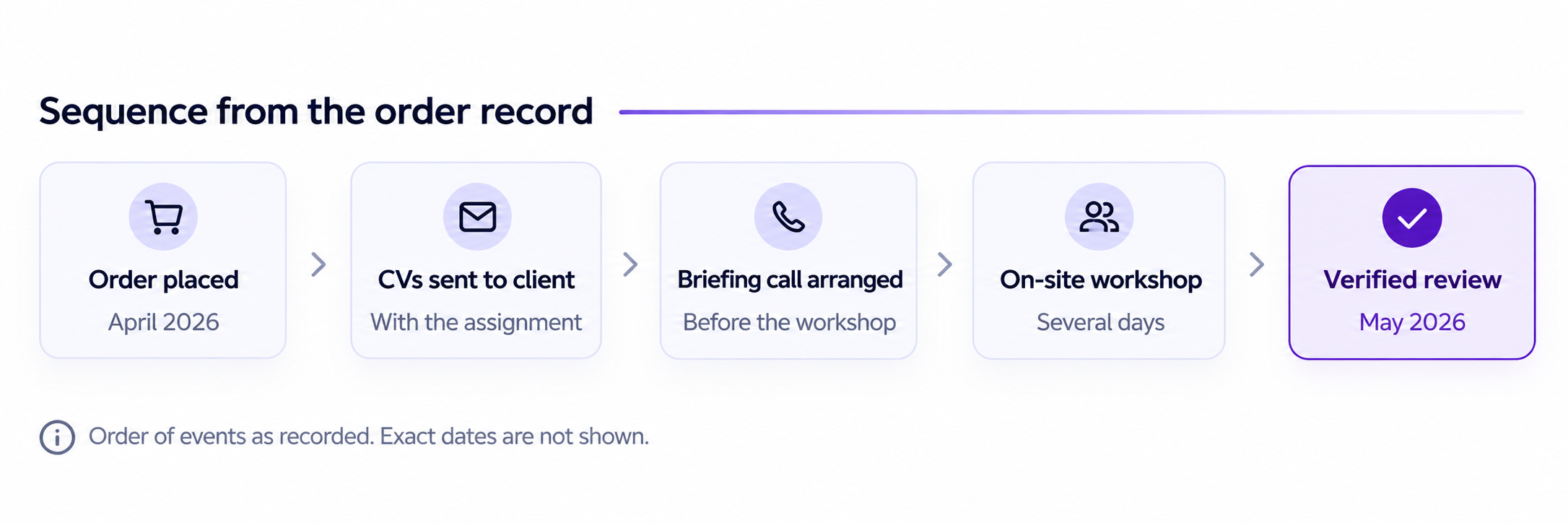
- A one-hour introductory briefing call over Microsoft Teams was arranged before the workshop, and interpreter CVs went to the client with the assignment.
- In a public Trustpilot review from May 2026, the client said the interpreter’s support made a real difference to participation by its francophone colleagues.
- I believe the most useful thing a buyer can do for a workshop interpreter is send the agenda and the vocabulary early.
What did the client need for the Nairobi workshop?
A nonprofit organization needed French and English interpretation, in both directions, on site at a workshop in Nairobi in spring 2026. The client described the sessions as workshop-style and interactive, with a niche subject, and the final schedule was still to be confirmed when the order was placed.
An interactive format changes the interpreter’s job. In my view, people in a workshop speak in short bursts, talk over each other, and expect the interpreter to keep up, which is different from interpreting a prepared speech.
What the order record shows
| Topic | What the order record shows |
|---|---|
| Format | French and English in both directions, on site in Nairobi, workshop-style and interactive |
| Interpreter selection | Interpreter CVs sent to the client with the assignment |
| Briefing | A one-hour introductory briefing call over Microsoft Teams, arranged before the workshop |
| Terminology | The client offered materials in advance and a short preparation session with its colleagues |
| Logistics | Several days on site, a transportation line, and a schedule still to be confirmed at booking |
| Outcome | No changes or incidents recorded, and a verified public review in May 2026 |
For more on how we work in this language, see our French language page. The order was delivered in May 2026.
How was the interpreter chosen and briefed?
Interpreter CVs were sent to the client when the interpreter was assigned, and the booking included a one-hour introductory briefing call over Microsoft Teams ahead of the workshop. The order record does not say who joined the call or what it covered.
In my opinion, a briefing belongs in the booking from the start, because the interpreter has little chance to ask the client’s team questions once a session is running. Sharing the CVs lets the client see the interpreter’s background before the day.
Our guide to hiring a qualified interpreter covers the general checks.
How does terminology preparation work for a niche topic?
On this order, the client offered to share materials in advance and to arrange a short preparation session with its own colleagues so the interpreter could learn the key terminology, because the subject was niche. The order record does not show which materials were sent.
In my view, the vocabulary of a niche topic is the first thing to break an interpreter’s pace. Acronyms and internal shorthand are things people outside the organization rarely guess.
I would ask for the agenda, the participant list, any slides, and a short glossary if one exists, and I would ask who on the client’s team can answer terminology questions.
What logistics did the order include?
The order covered several days of on-site interpretation, and a transportation line was part of the booking. The schedule was still to be confirmed when the order was placed, so the final timetable came later. No equipment or booth line appears on the order.
The setting was interactive and the order has no equipment line, so the interpreter worked consecutively.
In my opinion, an unconfirmed schedule at booking is normal for a workshop, and the interpreter’s availability for every day should be locked before the agenda is final. As of November 2026, Tomedes delivers interpretation on site and online, and the on-site interpretation service is the one used for this workshop.
What did the client say afterward?
The client left a verified five-star review on Trustpilot in May 2026, titled as excellent support for a complex multilingual workshop. It credited the interpreter’s work and said the support enabled meaningful participation by francophone colleagues, in a workshop with specialized terminology and a fast-moving agenda.
The reviewer wrote that communication was responsive and helpful throughout, and that the interpreter’s work was highly appreciated. The reviewer said the support “made a real difference in enabling meaningful participation.”
I take the comment about the fast-moving agenda as the most useful part, because it names the conditions the interpreter worked in. A review shows how one participant experienced the work, and I cannot say how the sessions went minute to minute.
What should I prepare before booking an on-site interpreter for a workshop?
Send the interpreter the agenda, the participant list, any slides, and a short glossary of your organization’s terms, and arrange a briefing call before the first session. In my view, confirm the dates, the venue, and the working mode early, because workshop agendas tend to move.
These are the six questions I would work through with a client before an on-site workshop.
- What materials can you send in advance, and by when?
- Who on your team can answer terminology questions before and during the workshop?
- Will there be a briefing call, and who should join it?
- What are the dates and the venue, and what changes if the schedule moves?
- Which working mode fits the format, and does it need equipment?
- How will the interpreter and the project manager stay in contact during the workshop?
I think early questions are most of what a project manager adds before a workshop. For an organization that works with nonprofits and aid programs, our guide to Spanish interpretation for NGOs shows how the same checks apply in another language.
If you are planning a multilingual workshop, send us the dates, the languages, and the topic through the quote form, and we will take it from there.
FAQs
Q: Does Tomedes provide on-site French interpreters for workshops?
A: Yes, because Tomedes delivered on-site French and English interpretation, in both directions, for a multi-day workshop in Nairobi in spring 2026. Availability depends on the dates, the city, and the topic, so share those details when you ask for a quote.
Q: Should I brief an interpreter before a workshop?
A: Yes, because an interpreter has little chance to ask your team questions during a session. On this order, a one-hour briefing call was arranged before the workshop, and the client offered materials and a terminology session in advance. In my view, send the agenda and a short glossary at the same time.
Q: How far ahead should the schedule be confirmed for an on-site interpreter?
A: As early as the dates are known, because the interpreter must be booked for every day. On this order the final schedule was still to be confirmed when the order was placed, which I would expect for a workshop, so confirm availability first and the timetable second.
Written by Denis Carvalho
Connect on LinkedInDenis manages client solutions for Tomedes' global accounts, where his job is simple to describe and hard to do: tell clients the truth early, then make sure the truth holds. He writes about what actually happens on a real translation project such as the timelines, the surprises, and the work that keeps a promise on schedule.
Share:

Post your Comment