 Add text to get the translation that 22 AI models agree on

Available Online 24/7
1-Year Guarantee
120,000 Business Customers
Tomedes Localizes a Fintech SaaS Platform for Arabic-Speaking GCC Markets
See how Tomedes localized a fintech SaaS platform from English into Gulf Arabic — resolving right-to-left UI challenges, financial regulatory terminology alignment, and cultural adaptation requirements for GCC market entry.

Trusted by
Satisfied clients worldwide


A fintech platform built for English speakers does not automatically work for Arabic speakers — not in language, not in layout, not in regulation.
March 17, 2026The Client
Company name: Qareeb Financial Technologies (pseudonym)
What does the company do? A European B2B SaaS company offering an expense management and corporate payments platform, expanding its first major footprint into Gulf Cooperation Council (GCC) markets.
Deadline: 18 business days
What do they need? Qareeb required full UI localization of their web application and mobile interface into Arabic – covering navigation labels, onboarding flows, error messages, tooltip text, transactional notifications, and a 45-page in-app help center. The localized product had to be launch-ready for Saudi Arabia and the UAE simultaneously, meaning it needed to satisfy both markets without maintaining two separate language builds.
The Challenges
Software localization is not translation. Every string in a UI exists inside a live interface, with spatial constraints, user expectations, and technical dependencies that a translated document does not have. For this project, Qareeb faced three challenges that made the work genuinely difficult.
First, right-to-left interface rendering with no visual context
Arabic is written right-to-left, which means the entire spatial logic of a UI flips – navigation moves to the right rail, buttons realign, icons mirror, and text truncation behaves differently in constrained elements. The localization team received exported string files with no access to the live application during the initial translation phase, which is standard for SaaS handoffs but creates a specific risk: strings that fit perfectly in an LTR layout at 32 characters may overflow or truncate in their RTL-rendered equivalent. A button label that reads "Confirm Payment" in English might render correctly at that length in English but break the UI layout entirely once expanded into its Arabic equivalent. Every string had to be evaluated not just for accuracy but for spatial viability in an interface the translators could not directly see.
Second, Islamic finance terminology and regional compliance language
Qareeb's platform handles corporate expense approvals, payment workflows, and financial reporting – categories where Arabic terminology is not uniform across markets. Saudi Arabia's financial sector uses terminology shaped by SAMA (Saudi Central Bank) regulatory guidance and Islamic finance principles, where certain transactional concepts have specific sanctioned phrasings. The UAE market, while overlapping, has its own regulatory framing under the CBUAE. Terms like "interest," "credit facility," and "payment approval" carry different connotations and in some cases different permitted phrasings depending on the regulatory context. Using a generic Arabic equivalent for any of these terms risked either confusing users or appearing non-compliant with local financial norms.
Lastly, dialect calibration across a shared codebase
Qareeb's decision to serve both Saudi Arabia and the UAE from a single Arabic language build created a dialect tension. Modern Standard Arabic (MSA) is mutually intelligible across both markets and is standard for formal business software, but Gulf Arabic colloquial terms appear in certain UX contexts (particularly onboarding copy and empty states) where a warmer, more conversational register improves completion rates. The localization had to be calibrated between formal MSA for transactional and compliance-sensitive strings, and a Gulf-appropriate register for engagement-oriented copy, without the product feeling inconsistent to users in either market.
Why Tomedes?
Qareeb selected Tomedes for its combination of software localization experience and Arabic linguistic depth across Gulf markets. The project required a team that understood both the technical constraints of UI string localization and the regulatory language landscape of GCC financial services, a pairing that rules out generalist translators.
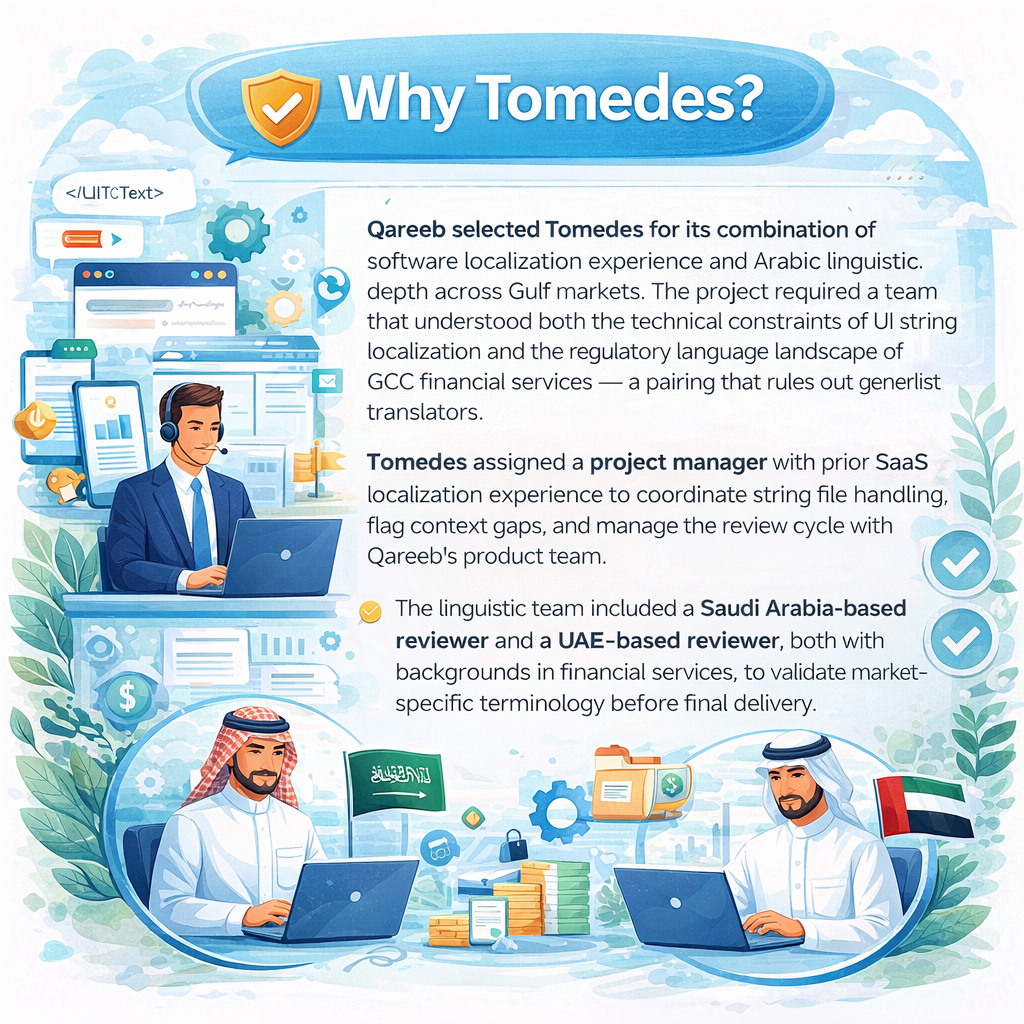
Tomedes assigned a project manager with prior SaaS localization experience to coordinate string file handling, flag context gaps, and manage the review cycle with Qareeb's product team. The linguistic team included a Saudi Arabia-based reviewer and a UAE-based reviewer, both with backgrounds in financial services, to validate market-specific terminology before final delivery.
The Solution
First, a string audit and context-gap report before translation began
Before any translation work started, Tomedes ran the exported string files through the Pre-Translation Toolkit to identify strings that lacked sufficient context for accurate localization – including strings with placeholder variables, strings shorter than five characters with no surrounding context, and strings that appeared in multiple UI locations with potentially different meanings. Tomedes returned a context-gap report to Qareeb's engineering team listing 114 strings that required clarification or screenshots before accurate localization was possible. Qareeb provided annotated screenshots for the flagged strings, which were incorporated into the translation environment before work began. This step alone eliminated the most common cause of SaaS localization rework cycles.
Second, a terminology glossary built for dual-market compliance
Working with Qareeb's legal and compliance team, Tomedes built a 60-term bilingual glossary covering all financially sensitive and regulatory-adjacent terminology in the platform. Each entry specified the approved Arabic rendering, the markets it applied to, and the source of the term standard (SAMA guidance, CBUAE guidance, or MSA financial convention). Where a term required different phrasings for Saudi Arabia versus the UAE, the glossary captured both variants and flagged the relevant strings for market-specific review. This glossary was locked before translation began and applied consistently across all 9,000 strings.
Lastly, a two-stage linguistic review with market-specific sign-off
Following the translation pass, the Saudi Arabia-based and UAE-based reviewers each conducted independent reviews of the strings most relevant to their markets – transactional flows, compliance disclosures, and onboarding copy. Discrepancies between their recommendations were escalated to a senior Arabic localization lead for resolution, with Qareeb's regional product managers consulted on three terms where regulatory framing was ambiguous. The final delivery included the localized string files in the original export format, the approved bilingual glossary, and a localization notes document summarizing market-specific decisions for Qareeb's internal reference during future updates.
Conclusion
Entering Gulf fintech markets with a poorly localized product is not just a UX problem, it signals to users and regulators alike that a company does not understand the market it is entering. By the time Qareeb's platform launched in Saudi Arabia and the UAE, every string in the interface had been reviewed by a linguist with direct knowledge of that market's financial language norms. The launch proceeded without a localization-related support escalation in either market during the first 60 days.
Are you preparing a SaaS product for Arabic-speaking markets or expanding into the GCC? Contact Tomedes today for a free consultation.
Key Details
Document type | SaaS UI strings – web app, mobile interface, in-app help center |
Language pair | English → Arabic (MSA + Gulf variants) |
Industry | Fintech / SaaS |
Service type | Software localization + linguistic review |
Scope | 9,000+ UI strings, 45-page help center |
Turnaround | 18 business days |
Certification | ISO 17100:2015 |
Tools used | Pre-Translation Toolkit, bilingual glossary |
Why choose us

24/7 Human Support

1 Year Guarantee

120,000 Business Customers
© Copyright 2007-2026 TOMEDES. All Rights Reserved.

