 Add text to get the translation that 22 AI models agree on


Spain's Ethnic Groups: A Comprehensive Guide to Spain's Regional Identities (2026)
Spain is not one people with one language. It is a constitutional monarchy of 17 autonomous communities, each with its own historical identity, and in many cases its own co-official language recognized alongside Castilian Spanish. The population of Spain stood at 49,570,725 inhabitants as of January 2026, a record high driven substantially by immigration. As of January 2026, the foreign-born population in Spain represented 20.3% of the total population.
Understanding Spain's ethnic and linguistic diversity is essential context for anyone doing business in Spain, localizing content for Spanish audiences, or working with Spanish-language communities across the Iberian Peninsula. The "Spanish market" is not a single, uniform audience. A campaign crafted in Castilian Spanish for a Madrid audience may land very differently in Barcelona, Bilbao, or Santiago de Compostela, where regional languages carry deep cultural and political significance.
This guide covers Spain's major ethnic groups, their regional languages, their historical identity, and what that diversity means in practice for language and communication.
Table of Contents
- What ethnic groups make up Spain's population?
- Who are the Castilians and what language do they speak?
- Who are the Catalans and what is Catalonia's linguistic status?
- Who are the Basques and why is Euskera unique?
- Who are the Galicians and how does their language relate to Portuguese?
- Who are the Andalusians and what defines Andalusian culture?
- Who are the Valencians and what language do they speak?
- What other regional identities exist in Spain?
- What are Spain's other recognized regional languages?
- Who are the Romani people in Spain?
- How has immigration changed Spain's ethnic composition?
- What does Spain's diversity mean for translation and localization?
- FAQs
What ethnic groups make up Spain's population?
Spain does not collect official ethnic group data in the way that countries like the United Kingdom or the United States do. Spanish law and the Spanish Constitution focus on nationalities and regional identities rather than ethnicity. Nonetheless, Spain's distinct ethnolinguistic communities are widely recognized in scholarship, political life, and the country's own constitution.
The Spanish Constitution of 1978 generically recognises contemporary entities called nationalities and regions within the context of the Spanish nation. Spain has been described as a de facto plurinational state. The identity of Spain accrues from an overlap of different territorial and ethnolinguistic identities rather than a sole Spanish identity. Distinct traditional identities within Spain include the Basques, Canarians, Catalans, Galicians, Andalusians and Valencians, although to some extent all 17 autonomous communities may claim a distinct local identity.
The five largest and most historically rooted ethnic groups in Spain are the Castilians, Catalans, Basques, Galicians, and Valencians. Andalusians and Canarians are also widely recognized as distinct cultural groups. The Romani people have lived in Spain for over five centuries and represent a distinct, nationally recognized minority.
Who are the Castilians and what language do they speak?
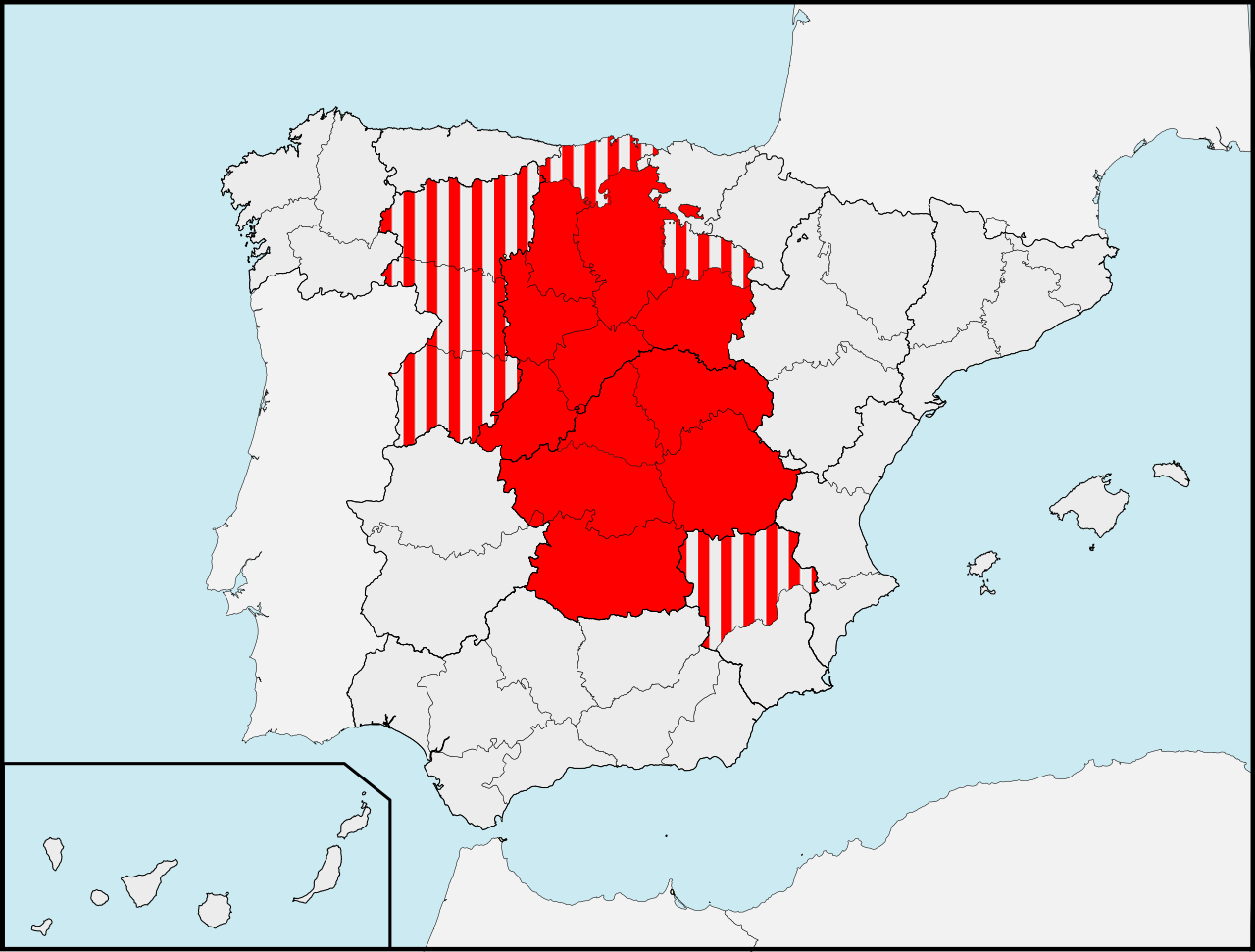
The Castilians are the ethnic group descended from the historic Kingdom of Castile, which dominated the Iberian Peninsula through the Reconquista and the unification of Spain under the Catholic Monarchs in the 15th century. Castile's cultural and linguistic dominance shaped what the world now calls "Spanish", the Castilian language (Castellano) is the official language of the entire Spanish state and the basis of the Spanish spoken across Latin America.
Castilian is spoken nationwide and serves as the language of government, media, and education. Over 99% of Spaniards speak Castilian as either a primary or secondary language. Castilian is a Romance language descended from Vulgar Latin, with significant Arabic vocabulary absorbed during the centuries of Moorish rule (711--1492).
In many parts of Spain (Castile and León, Cantabria, Navarre, Extremadura, La Mancha, Murcia, and Rioja), most people do not sense a conflict between their Spanish national identity and their regional identity. These regions are predominantly Castilian-speaking and form the cultural and demographic heartland of the Spanish state.
Who are the Catalans and what is Catalonia's linguistic status?
The Catalans originate from the northeastern region of Catalonia, exhibiting a profound sense of ethnic identity. Their distinguished Catalan language and unique cultural traditions set them apart from other Spanish ethnic groups. Their persistent endeavors for greater autonomy and the acknowledgment of their cultural and linguistic heritage underscore a complex interplay between ethnic and national identities within Spain.
Catalonia's population stands at approximately 8.1 million as of 2025 (Source: INE, 2025). The Catalan ethnic and cultural identity extends beyond Catalonia itself: Catalan is spoken by around 9 million people across Catalonia, the Balearic Islands, and the Valencia region (where it is known as Valencian), and the Catalan ethnic group reaches into southern France, Andorra, and parts of Sardinia in Italy.
Catalan is a Romance language closely related to Occitan (the medieval language of southern France) and more distantly related to Castilian Spanish. It developed as a distinct language during the medieval Crown of Aragon, when it served as a language of administration, literature, and commerce across the western Mediterranean. Today, 23.3% of Spain's population as a whole speak Catalan or Valencian.
Key cultural traditions of the Catalans include the Castell (competitive human tower building), the Sardana dance, and a rich tradition in architecture shaped by figures including Antoni Gaudi. The ongoing question of Catalan independence represents one of the most significant political dynamics in contemporary Spain, with legally contested referendums in 2017 and continued debates about the extent of Catalan autonomy within the Spanish constitutional framework.
Who are the Basques and why is Euskera unique?

The Basque people are one of the oldest ethnic groups in Europe. The Basque people are indigenous to the Basque Country in northern Spain and southwestern France. Their profound sense of community and identity is reflected in their rich traditions, which include unique culinary customs, folk music, and dance. The Basque Country autonomous community in Spain has a population of approximately 2.2 million, while the broader Basque cultural region also encompasses parts of Navarre and the French Pays Basque.
What makes the Basques linguistically exceptional is their language: Euskera (also written Euskara) is a language isolate with no known relationship to any other language in the world. Unlike Castilian, Catalan, or Galician, Basque is not a Romance language and has no known linguistic relatives anywhere in the world. It predates the Romanization of the Iberian Peninsula and is considered one of Europe's oldest living languages. Basque is spoken in the Basque Country and Navarre by about 700,000 people.
3% of Spain's total population speak Basque. Basque uses a case system in which words change with suffixes depending on their grammatical role, a structure that makes it structurally distant from any European language a non-native speaker would typically know. The language's survival through centuries of political suppression, including active prohibition during the Franco dictatorship (1939-1975), is widely regarded as one of the most remarkable stories of linguistic resilience in European history.
The Basque Country has a distinct culinary tradition (including the pinxtos culture of San Sebastian, now an internationally recognized gastronomic destination), a strong tradition of cooperative economics (centred on the Mondragon Corporation), and a history of political activism ranging from mainstream nationalist parties to the now-dissolved armed organization ETA.
Who are the Galicians and how does their language relate to Portuguese?
Galicians are from Galicia in Spain's northwestern corner, a region bordering Portugal to the south and the Atlantic Ocean to the west. Galicia has an estimated population of 2.7 million. Their cultural heritage is deeply imbued with Celtic influences, distinguishing them within Spain's diverse ethnic landscape. The Galician language exhibits notable similarities to Portuguese, underscoring the historical and cultural interconnections of the Iberian Peninsula.
The linguistic connection between Galician and Portuguese is not coincidental. Both languages descended from the same medieval language, Galician-Portuguese, spoken across the northwestern Iberian Peninsula in the Middle Ages. When the County of Portugal broke away to form an independent kingdom in the 12th century, the two varieties diverged over time, with Galician developing under Spanish political influence while Portuguese evolved as an independent national language. Galician is spoken by approximately 2.4 million people in Galicia, sharing a close historical relationship with Portuguese.
Galicia's cultural identity is marked by Celtic folk traditions including the gaita (bagpipe), distinctive seafood cuisine, and the ancient pilgrimage to Santiago de Compostela -- one of the most important destinations in medieval European Christianity and still one of the most walked pilgrimage routes in the world. Unlike the Basque Country and Catalonia, Galicia does not have a strong independence movement, though Galician nationalist parties do exist and Galician cultural pride is strong.
6.2% of Spain's total population speak Galician.
Who are the Andalusians and what defines Andalusian culture?
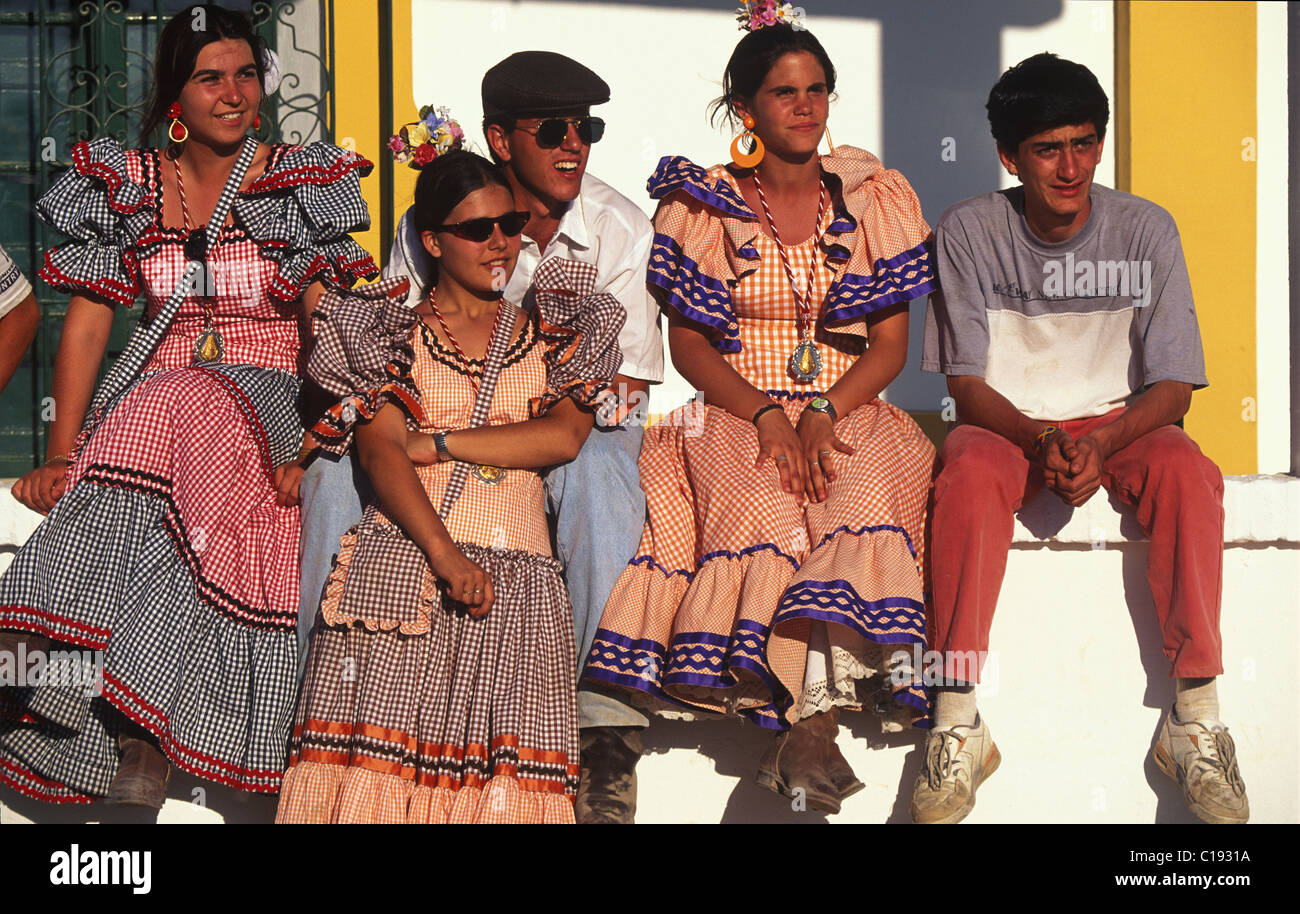
Andalusia is Spain's most populous and southernmost region, with a population of approximately 8.5 million people (Source: INE, 2025). Andalusians are celebrated for their dynamic and expressive culture, whose roots stretch across Phoenician, Greek, Roman, Visigothic, and Moorish civilizations -- a layering of influences that produced one of the most distinctive cultural identities in Europe.
The most internationally recognized expression of Andalusian culture is flamenco -- a music, song, and dance tradition that blends Moorish, Romani, and Castilian influences and was inscribed on UNESCO's Intangible Cultural Heritage list in 2010. Andalusian architecture, most visibly in the Alhambra palace in Granada and the Mezquita in Cordoba, reflects eight centuries of Moorish rule (711-1492) that shaped the region's built environment, cuisine, vocabulary, and place names in ways that remain visible today.
Linguistically, Andalusians speak Castilian Spanish, but in a distinctive Andalusian variety characterized by the seseo (the pronunciation of "c" and "z" as "s"), reduction of final consonants, and a distinct vocabulary. Andalusian Spanish contributed significantly to the varieties of Spanish spoken in Latin America, as many of the early colonial settlers were from Andalusia and the Canary Islands.
Who are the Valencians and what language do they speak?
The Valencians live in the Valencian Community (Comunitat Valenciana) on Spain's eastern Mediterranean coast, with a population of approximately 5.2 million (Source: INE, 2025). Valencia is one of Spain's most economically significant regions, home to the country's third-largest city and a major agricultural, manufacturing, and tourism economy.
The Valencian language (Valencian: Valencian, Spanish: Valenciano) is recognized as co-official alongside Castilian in the Valencian Community. Its linguistic status is a subject of genuine debate: most linguists and the European Union classify Valencian as a variety of Catalan, while many Valencians themselves assert it is a distinct language in its own right. The Valencian Academy of Language takes a middle position, recognizing Valencian and Catalan as co-varieties of the same linguistic system while affirming Valencian's distinct identity.
5.8% of Spain's total population speak Valencian. In the streets of Valencia city and coastal towns, Castilian tends to dominate, while Valencian is more prevalent in rural inland areas and smaller municipalities.
What other regional identities exist in Spain?
Beyond the five major groups, Spain is home to several other recognized regional identities with their own cultural character and, in some cases, their own linguistic traditions.
Canarians are the people of the Canary Islands, an archipelago off the coast of northwest Africa that has been part of Spain since the 15th century. Canarians speak Castilian Spanish in a variety influenced by contact with Latin American Spanish (given the islands' historical role as a waypoint in transatlantic travel). The Canary Islands have a population of approximately 2.2 million (Source: INE, 2025) and a distinct identity shaped by Atlantic culture, indigenous Guanche heritage, and their geographic position between Europe and Africa.
Aragonese are from Aragon, the historic kingdom whose union with Castile in 1479 created the foundations of modern Spain. Aragon has a population of approximately 1.3 million. The region has its own recognized regional language, Aragonese (Aragonese: Aragonés), though it has no co-official status and is spoken by a small and declining number of people.
Asturians are from the Principality of Asturias in northern Spain. Asturias is historically significant as the region from which the Christian Reconquista launched. Asturian (also called Astur-Leonese or Bable) is a recognized regional language but lacks co-official status. Efforts to secure greater official recognition for Asturian have been ongoing for decades.
Navarrese are from Navarre (Navarra), a region with a complex identity that has historically overlapped with both Basque and Castilian cultural spheres. Basque is co-official in parts of Navarre, while Castilian dominates in the south.
What are Spain's other recognized regional languages?
Beyond the four co-official languages (Castilian, Catalan/Valencian, Basque, and Galician), Spain recognizes several additional regional languages under the European Charter for Regional or Minority Languages.
Aranese (Aranés) is a variety of Occitan spoken in the Val d'Aran, a small Pyrenean valley in Catalonia. In the small Pyrenean region of the Val d'Aran in Catalonia, Aranese links Spain linguistically to southern France, preserving a medieval language that once dominated much of Europe's troubadour poetry. Aranese is co-official in Catalonia alongside Catalan and Castilian, making Val d'Aran one of the few areas in the world with three co-official languages.
Asturian (Bable) is spoken in Asturias and parts of León. Efforts are underway to revive its use, particularly in literature and education, although it currently lacks full co-official status.
Aragonese is spoken in parts of the Pyrenean valleys in Aragon and is recognized under Spain's language charter, though it has no co-official status in the Aragonese autonomous community.
These minority languages matter for localization and translation professionals because content targeting specific regional audiences may need to go beyond standard Castilian Spanish -- particularly in public-sector, educational, and community-facing contexts in the Basque Country, Catalonia, Galicia, and the Valencian Community.
Who are the Romani people in Spain?
The Romani people (also known as Gitanos in Spain) have lived in the Iberian Peninsula since the 15th century, when the first documented arrival of Romani groups occurred around 1425. Spain is home to one of Europe's largest Romani populations, estimated at between 750,000 and 1 million people, with the largest concentrations in Andalusia, Catalonia, and the Madrid region (Source: Council of Europe estimates).
Spanish Romani culture has profoundly shaped Spanish artistic life, most notably through flamenco -- a tradition whose deepest roots lie in Romani musical expression, blended with Andalusian and Moorish influences. Romani Spanish (Caló) is a contact language combining Romani vocabulary with Castilian Spanish grammar, though full fluency in Caló has declined significantly over the 20th century.
Despite their long history in Spain, the Romani community continues to face social and economic disparities, including higher rates of school dropout, unemployment, and housing insecurity compared to the general population. Spanish civil society organizations and EU-funded programs have worked toward greater Romani inclusion, though progress remains uneven.
How has immigration changed Spain's ethnic composition?
The ethnic composition of Spain has changed significantly in the 21st century. For most of its modern history, Spain was a country of emigration -- in the mid-20th century, millions of Spaniards migrated to France, Germany, and Switzerland for work. The economic boom of the late 1990s and 2000s reversed that dynamic entirely.
Immigration to Spain increased sharply in the early 21st century. In 1998, immigrants made up just 1.6% of the population, but by 2009 that figure had exceeded 12%. Following a decline during the economic crisis, immigration began to rise again after 2015, with a marked acceleration after 2021, with the foreign-born population now reaching 20.3% of the total population as of January 2026.
As of 1 January 2025, of Spain's total population, 42,216,326 had Spanish nationality (85.9%) and 6,911,971 had foreign nationality (14.1%). The most numerous foreign nationals were Moroccans (968,999), Colombians (676,534), and Romanians (609,270).
Spain exceeded 10 million foreign-born inhabitants for the first time as of the end of 2025. This milestone makes Spain one of the most internationally diverse countries in Europe in terms of resident foreign-born population, and it has reshaped the country's urban centers, labor market, and cultural life.
The largest immigrant communities by origin include:
| Origin | Approximate population | Notes |
|---|---|---|
| Morocco | ~969,000 | Largest non-EU foreign national group; Arabic and Berber languages |
| Colombia | ~677,000 | Spanish-speaking; largest Latin American community |
| Romania | ~609,000 | Romanian-speaking EU citizens; large communities in Madrid and Valencia |
| Venezuela | Large and growing | Significant growth 2022-2025; Spanish-speaking |
| China | Significant presence | Concentrated in Madrid and Barcelona; Mandarin and Cantonese |
For businesses, this demographic reality means that "Spanish-speaking" Spain is increasingly home to audiences with Arabic, Romanian, Chinese, and other linguistic backgrounds -- a localization consideration that goes beyond Castilian Spanish.
What does Spain's diversity mean for translation and localization?
Spain's ethnic and linguistic diversity creates a localization landscape that cannot be served by a single "Spanish" translation. Businesses entering Spanish markets need to navigate several distinct considerations.
Castilian Spanish is the standard for national-level communication, legal documents, government interfaces, and any content targeting Spain as a whole. It is mutually intelligible with Latin American Spanish but differs in vocabulary, formality conventions, and some grammatical forms (most notably the use of "vosotros" for the second-person plural, which does not exist in Latin American Spanish).
Regional language requirements apply in specific contexts. Government communications, educational materials, and public-sector content in Catalonia, the Basque Country, Galicia, and the Valencian Community are often required to be available in the co-official regional language as well as Castilian. For brands targeting consumers in Barcelona, Bilbao, or Santiago de Compostela, regional language content signals cultural respect and strengthens local audience engagement.
Immigrant language communities increasingly represent significant consumer segments in major Spanish cities. Arabic-language content for Moroccan communities, Romanian for Eastern European residents, and Chinese for established business networks are all practical localization considerations for specific industries and geographies.
Tomedes provides professional Spanish translation services in Castilian Spanish and supports localization needs across Spain's regional languages, including Catalan translation, Galician, and Basque. Every project is managed by a dedicated project manager with native-language subject-matter expertise, backed by ISO 17100:2015 certification and a 1-Year Quality Guarantee.
FAQs
Q: What are the main ethnic groups in Spain?
A: The main ethnic groups in Spain are the Castilians, Catalans, Basques, Galicians, Valencians, and Andalusians, along with the Romani community and a large and growing immigrant population. Spain does not collect official ethnic census data, but its 1978 constitution recognizes the distinct nationalities and regional identities within the Spanish state. Each major ethnic group has its own historical territory, cultural traditions, and in many cases its own regional language.
Q: What language do people in Spain speak?
A: Castilian Spanish is the official language of Spain and is spoken by over 99% of the population either as a primary or secondary language. Four other languages hold co-official status in specific regions: Catalan (co-official in Catalonia, the Balearic Islands, and the Valencian Community as Valencian), Basque (co-official in the Basque Country and parts of Navarre), Galician (co-official in Galicia), and Aranese (co-official in Catalonia's Val d'Aran). Several other regional languages, including Asturian and Aragonese, are recognized but lack co-official status.
Q: Are Catalans a separate ethnic group from Spaniards?
A: Catalans are both Spanish citizens and a distinct ethnolinguistic group with their own language, cultural traditions, and regional political identity. Spain's constitution recognizes Catalonia as a "nationality" within the Spanish state. Whether Catalans constitute a separate "ethnic group" is a politically charged question: most Catalans identify with both Catalan and Spanish identity, while a significant minority favor independence. The linguistic and cultural distinctiveness of the Catalans is not contested; the political question of Catalan statehood is.
Q: Why is the Basque language unique?
A: Basque (Euskera) is a language isolate -- it has no known relationship to any other language in the world, living or extinct. It predates the arrival of Indo-European languages in Europe and survived the Roman, Visigothic, Moorish, and Castilian periods of Iberian history. Its grammar, vocabulary, and phonology are entirely unrelated to Castilian Spanish, Catalan, Galician, or any other European language. This makes Basque one of the most linguistically unusual and scientifically interesting languages on Earth.
Q: How many people live in Spain today?
A: As of January 2026, Spain's resident population stands at 49,570,725 inhabitants, its highest-ever recorded figure (Source: INE, Spain's National Statistics Institute). Of this total, approximately 14.1% hold foreign nationality, and 20.3% were born outside Spain. Population growth has been driven primarily by immigration, as Spain's birth rate (1.12 children per woman as of 2026) is among the lowest in the world.
Q: What is flamenco and where did it come from?
A: Flamenco is a music, song, and dance tradition originating in Andalusia, with deep roots in Romani, Moorish, and Castilian cultural influences. It developed in southern Spain over several centuries and was inscribed on UNESCO's List of Intangible Cultural Heritage in 2010. While flamenco is often presented as representative of Spanish culture as a whole, it is specifically an Andalusian and Romani tradition -- an important distinction for any organization working on Spanish-market cultural content.
By Clarriza Heruela
Clarriza Mae Heruela graduated from the University of the Philippines Mindanao with a Bachelor of Arts degree in English, majoring in Creative Writing. Her experience from growing up in a multilingually diverse household has influenced her career and writing style. She is still exploring her writing path and is always on the lookout for interesting topics that pique her interest.
Share:

Post your Comment