 Add text to get the translation that 22 AI models agree on


Best machine translation software for business in 2027
Average adoption of machine translation post-editing among language service providers rose from 26% in 2022 to nearly 46% in 2024 (Source: Nimdzi, 2025). The software behind that shift now spans cloud engines, LLM APIs, and full localization platforms.
Tomedes' view is that machine translation software supplies the draft, and a qualified linguist owns the result for anything customer-facing or regulated. This guide compares ten options on customization and pricing model, and notes where that human review belongs.
What is the best software for language translation?
The best software depends on the job. Cloud engines suit high-volume text, LLM APIs suit instruction-driven drafts, and localization platforms suit teams with ongoing content. Anything customer-facing or regulated should be post-edited by a qualified linguist.
The table sorts four software types by customization, pricing model, and best use.
| Software type | Examples | Customization | Pricing model | Best for |
|---|---|---|---|---|
| Multi-model AI translation | MachineTranslation.com, Tomedes AI Translator | Language pair, tone, and terminology settings | Free tier plus subscription | Comparing engines quickly |
| Cloud engines | Google Cloud Translation, Microsoft Translator, DeepL, Amazon Translate | Glossaries, custom models, formality | Usage-based, per character, or tiered plans | High-volume text and system integration |
| LLM APIs | OpenAI API and other LLM providers | Instructions, examples, fine-tuning on some models | Per token | Instruction-driven drafts |
| Localization platforms | Smartling, Crowdin, Phrase | Translation memory, glossaries, MT integrations, review workflow | Plans scaled by usage and integrations | Teams localizing continuously |
What are the three types of translation software?
The three classic types are rule-based, statistical, and neural. Rule-based systems apply grammar rules and bilingual dictionaries, statistical systems learn from large collections of translated text, and neural systems use neural networks to translate whole sentences in context. Neural systems are the basis of most modern engines.
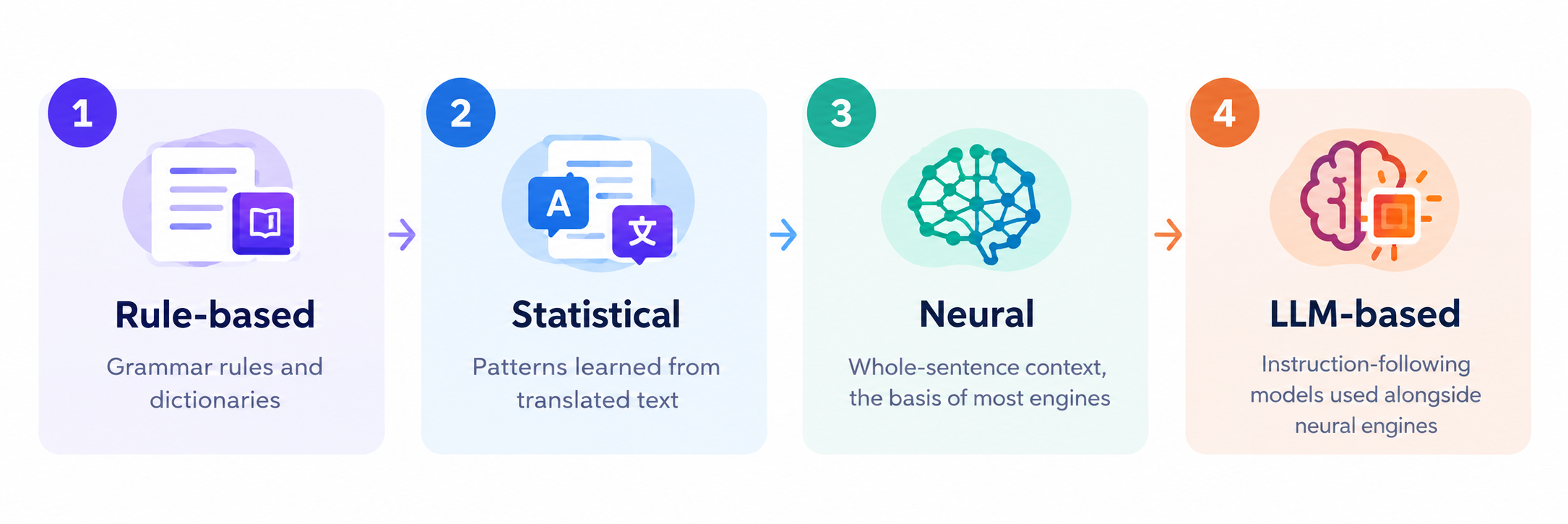
Large language models now sit alongside neural engines as a fourth approach. Every AI translation platform on this page uses at least one of the last two, and none removes the need for review where a mistake has a cost.
Is AI translation better than machine translation?
They overlap, so the label matters less than the technology behind it. Machine translation is the umbrella term for software that translates text, and AI translation usually means the neural and LLM-based systems that power most of it today.
Against older rule-based and statistical approaches, modern AI translation is clearly better because it reads whole sentences in context. Between two current AI translation systems, quality depends on language pair, content type, and model version. Raw output of either kind is fine for internal reading, and post-edited output is what belongs in front of customers.
Is DeepL an AI tool?
Yes. DeepL runs on neural machine translation, a form of AI translation technology, and in July 2024 it launched a large language model tuned for translation and editing (Source: DeepL press release, 2024). The model first reached DeepL Pro customers for English, Japanese, German, and Simplified Chinese.
DeepL's announcement includes blind-test results favoring its model over general-purpose competitors, and vendor tests make a useful starting point. Results depend on language pair and content type, so a short test on your own text comes next. A native reviewer should mark the errors that change meaning.
How do you choose machine translation software?
Choose by six criteria: customization, integrations, quality checks, data handling, pricing model, and human review.
The last criterion decides how much risk remains after the software finishes. For internal reading, raw output is usually enough. For published or regulated content, the software supplies the draft and a linguist supplies the sign-off.
What does machine translation customization look like in practice?
It looks like terminology loaded into the engine and review tiers set before the first document runs. A recent Tomedes project about a manufacturing client's German-to-English documentation program shows how. Before any document ran through the engine, Tomedes configured it with the client's approved German-English terminology pairs and classified every document type for full or light post-editing.
Twelve months in, the program covered a larger catalog at a total cost lower than the previous year's spend on a smaller one (Source: Tomedes Recent Translations, 2026). Both decisions came before the first document ran, and the work followed ISO 18587:2017.
What are the 10 best machine translation software and AI translation platforms?
The ten options below span multi-model AI translation, cloud engines, LLM APIs, and localization platforms. Language counts and prices change often, so the linked vendor pages are the final word before buying. For a broader guide that also covers AI assistants and managed services, see the buyer's guide to AI translation tools and services.
1. MachineTranslation.com
Customization: Language pair selection, with output compared across 22 AI translation models and merged into one consensus translation. Data security and layout-preserving DOCX downloads are available.
Pricing model: Free tool, with subscription plans for frequent users.
Human pairing: Human review by professional linguists is available for high-stakes material.
2. Tomedes AI Translator
Customization: Supports 270+ languages and compares multiple AI translation models, with tone, terminology, and audience set through the AI Translation Agent.
Pricing model: Free to use.
Human pairing: Tomedes' managed service adds a domain-matched post-editor under ISO 18587:2017, backed by the 1-Year Quality Guarantee. Tomedes was founded in 2007, holds three ISO certifications, and is trusted by 120,000+ businesses, including Google, Microsoft, Amazon, and IKEA.
3. Google Cloud Translation
Customization: Glossaries, custom models, and Adaptive Translation, an LLM-based mode that follows reference sentences you supply. Google's consumer Translate added 110 languages in 2024, its largest expansion (Source: Google, 2024). The Cloud API's language list differs from the consumer app, so check it for the pairs you need.
Pricing model: Pay as you go, billed per character, with rates that differ by model (standard, LLM, and custom) and a monthly free allowance.
Human pairing: Add post-editing for terminology-heavy or customer-facing content.
4. Microsoft Translator
Customization: Glossary and custom-model options through Azure.
Pricing model: Pay as you go, with prepaid commitment options. See the Azure pricing page.
Human pairing: A reviewer should check industry terminology before release.
5. DeepL
Customization: Glossary and formality controls.
Pricing model: Free plan with limits, then tiered paid plans, plus API plans.
Human pairing: Post-edit for brand voice and terminology on published content.
6. Amazon Translate
Customization: Custom terminology, formality for supported languages, and Active Custom Translation, which adapts batch jobs to the style of example data you supply (see the AWS documentation).
Pricing model: Billed per character by translation type, and Active Custom Translation jobs are priced higher than standard jobs. See the AWS pricing page.
Human pairing: Add a review stage before output flows into live systems.
7. OpenAI API
Customization: Detailed instructions, example-based prompting, and fine-tuning on some models.
Pricing model: Billed per token, and it varies by model. See the API pricing page.
Human pairing: LLM output can drift in terminology across long documents and omit content without flagging it, so a qualified reviewer should check it.
8. Smartling
Customization: Translation memory, glossaries, MT integrations, and review workflows.
Pricing model: Tiered plans scaled to usage and integrations. See the plans page.
Human pairing: Review steps are configurable, so decide which content skips human review and which never does.
9. Crowdin
Customization: Translation memory, glossaries, and connections to many MT engines, with AI translation features built in.
Pricing model: Plans based on project scale. See Crowdin pricing.
Human pairing: Common for software strings, where post-editors work inside the same platform.
10. Phrase
Customization: Translation memory, glossaries, MT integrations, and Phrase QPS, a 0 to 100 quality score based on the MQM framework that can route lower-scoring segments to human review.
Pricing model: Tiered plans scaled to operational needs.
Human pairing: Quality scores help decide which segments a human actually reads.
How much does machine translation software cost?
Cost follows four pricing models, plus a separate charge for human review. Free tiers cover occasional text with limits, subscriptions charge per user per month, usage-based APIs bill per character or per token, and platform plans scale with usage and integrations.
Human post-editing carries its own per-word price, and light and full post-editing sit at different rates. Content type and language pair move that rate more than the choice of software does, so a quote for the review step belongs in any comparison.
How should you prepare text before machine translation?
Run six checks before any engine sees the text. Tomedes' pre-translation tool covers all six.
- Detect the source language, so the setup starts correctly.
- Find the content's subject, such as law or medicine, to guide style and terms.
- Check for problems, including unclear text, cultural differences, and hard-to-translate phrases.
- Create a glossary of key terms with definitions, so terminology stays consistent.
- Measure text difficulty and suggest a method: machine translation, post-editing, or human translation.
- Add a style guide that sets tone and register.
These steps matter most when a linguist will post-edit the output, because a clean source and a glossary reduce the corrections a reviewer must make. A 2018 study of professional translators found that post-editing raised productivity by 18% for statistical machine translation and 36% for neural machine translation compared with translating from scratch (Source: Frontiers in Digital Humanities, 2018).
FAQs
Q: Can machine translation software handle confidential documents?
A: It depends on the plan and the vendor. Retention and training terms differ between free and paid tiers, so read them before uploading contracts, patient records, or financial data. Tomedes recommends full human translation under a signed NDA for the most sensitive content, such as legal proceedings, M&A, and clinical trials.
Q: Does machine translation software work equally well in every language pair?
A: No. Quality varies with language pair and available training data, and the gap is widest for languages with less data. A 2025 study in npj Digital Medicine found that ChatGPT-4o alone performed worst for Armenian and Somali when translating patient discharge instructions (Source: npj Digital Medicine, 2025). Test the pairs that matter before committing.
Q: What is the difference between machine translation software and a translation management system?
A: Machine translation software produces the translation. A translation management system, such as Smartling, Crowdin, or Phrase, wraps one or more engines in a workflow with translation memory, glossaries, and review steps. Teams that localize continuously often pair an engine with such a platform.
Q: How do you test machine translation software before buying?
A: Take about 500 words of real content and run it through two or three options. Have a native-speaking reviewer mark each error by severity: meaning errors, wrong terminology, tone problems, and omissions. Compare the number of serious errors across tools, and repeat the test on the highest-risk language pairs.
Q: Do I still need post-editing after machine translation?
A: For anything published, filed, or sent to a customer, yes. Light post-editing suits lower-risk content, and full post-editing suits content where an error has a cost, the two levels that ISO 18587:2017 defines (Source: ISO, 2017). A qualified linguist decides which level a document needs.

Written by Clarriza Heruela
Clarriza Mae Heruela graduated from the University of the Philippines Mindanao with a Bachelor of Arts degree in English, majoring in Creative Writing. Her experience from growing up in a multilingually diverse household has influenced her career and writing style. She is still exploring her writing path and is always on the lookout for interesting topics that pique her interest.
Share:

Post your Comment