 Add text to get the translation that 22 AI models agree on

Available Online 24/7
1-Year Guarantee
120,000 Business Customers
Tomedes Gives a U.S. Beauty Brand a Voice Korean Shoppers Recognize
See how Tomedes localized a U.S. beauty brand's product catalog and marketing content from English into Korean — adapting brand voice, ingredient terminology, and regulatory claims for Korean consumers and e-commerce platforms.

Trusted by
Satisfied clients worldwide


Translating a beauty brand into Korean is not about converting words. The Korean beauty market has its own language, and brands that do not speak it do not sell.
March 25, 2026The Client
Company name: Lumière Skin Co. (pseudonym)
What does the company do? A U.S.-based direct-to-consumer skincare brand with an established presence in North America and Western Europe, entering South Korea as its first Asian market.
Deadline: 14 business days
What do they need? Lumière required Korean-language versions of their full product catalog (38 SKUs covering cleansers, serums, moisturizers, and SPF products) including product names, ingredient callouts, benefit claims, usage instructions, and short-form brand copy for platform storefronts on Naver Smart Store and Coupang. The listings had to be ready for simultaneous launch on both platforms, with copy formatted to each platform's character and field specifications.
The Challenges
Entering the Korean beauty market with translated product listings is not the same as entering it with localized ones. South Korea has one of the most sophisticated and demanding skincare consumer bases in the world, and copy that reads as generic, over-claimed, or culturally misaligned will underperform regardless of the product quality behind it. Lumière faced three challenges that made direct translation insufficient.
First, K-beauty consumer expectations around ingredient and efficacy language
Korean skincare consumers read ingredient lists and efficacy claims closely. The language conventions around how a product's benefits are described in Korea differ meaningfully from U.S. norms – where American copy tends toward bold, aspirational claims ("transforms skin overnight," "visibly erases fine lines"), Korean product copy favors precise, ingredient-anchored descriptions that signal formulation credibility to an informed buyer. A serum described in English as "our most powerful anti-aging formula" needs to become something more specific and substantiated in Korean (referencing the active ingredient, its concentration or mechanism, and the skin concern it addresses) or it risks reading as the kind of vague marketing copy that Korean consumers have learned to distrust. Lumière's existing English copy was written for a U.S. audience and needed genuine transcreation, not translation.
Second, platform-specific field constraints on Naver and Coupang
Naver Smart Store and Coupang have different product listing structures, character limits, and field hierarchies. Product titles on Coupang follow a specific keyword-loaded format optimized for the platform's search algorithm, while Naver Smart Store titles follow different conventions. Bullet point fields, benefit summary fields, and usage instruction fields vary in character limits between the two platforms. Copy that was correctly formatted for one platform would overflow or truncate on the other. The project required two separately formatted versions of every listing – not just a language switch, but a structural adaptation to each platform's requirements.
Lastly, regulatory boundaries on cosmetic claims in South Korea
South Korea's Ministry of Food and Drug Safety (MFDS) governs what cosmetic products can and cannot claim in marketing copy. Certain efficacy statements that are routine in U.S. beauty marketing (particularly claims that imply medical or pharmaceutical effects) are restricted in Korean cosmetic advertising. Lumière's English copy included several claim types that required review and adjustment before the listings could be published without regulatory risk.
Why Tomedes?
Lumière selected Tomedes because the project required a team with both transcreation experience and working knowledge of Korean e-commerce platforms, not a general translation service. The copy had to feel written for a Korean buyer, not translated for one, which meant the linguistic team needed genuine familiarity with K-beauty consumer culture and platform norms.
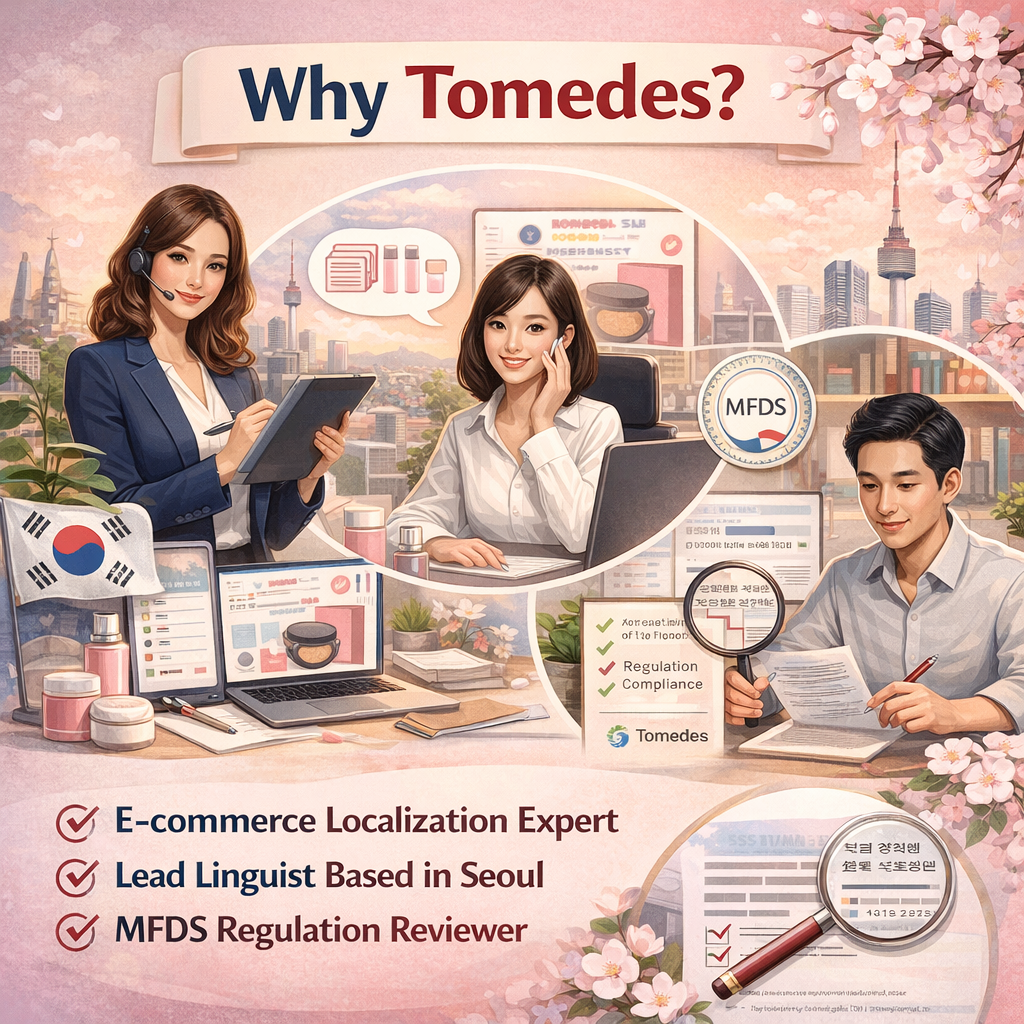
Tomedes assigned a project manager with e-commerce localization experience to oversee platform formatting and a lead linguist based in Seoul with a background in beauty and personal care brand copy. A secondary reviewer with MFDS regulatory familiarity was brought in specifically to audit the efficacy claim language before final delivery.
The Solution
First, a claim audit and transcreation brief before any copy was written
Rather than translating the English listings directly, Tomedes began by mapping every efficacy and benefit claim in the source catalog against two criteria: MFDS permissibility and K-beauty consumer register. Claims that were factually accurate but expressed in a U.S. marketing register were flagged for transcreation, rewritten to make the same underlying point in language that would resonate with a Korean buyer without overstating the product's effects. Claims that approached MFDS restricted territory were flagged for Lumière's review before localization proceeded. This pre-translation alignment step meant the copy team was working from an approved claim framework, not discovering regulatory issues after delivery.
Second, a Korean beauty consumer glossary built from platform research
The linguistic team compiled a 35-term brand glossary for Lumière's product line covering ingredient names in Korean INCI convention, approved benefit descriptors aligned with K-beauty copy norms, and the Korean-language equivalents of Lumière's brand voice markers. Ingredients like niacinamide, centella asiatica, and hyaluronic acid each have established Korean-language conventions that differ from direct transliteration, and using the correct form signals product credibility to informed consumers. The glossary was approved by Lumière's brand team before the catalog copy was written and applied consistently across all 38 SKUs.
Lastly, dual-platform formatting with per-field character compliance
Following the transcreation pass, the project team formatted every listing to the field specifications of both Naver Smart Store and Coupang (title fields, bullet benefit fields, ingredient sections, and usage instruction fields), checking character limits per field on each platform. The Consistency Checker was used to verify that ingredient names, brand terms, and product names were rendered identically across all 38 SKUs on both platforms, catching three inconsistencies in ingredient romanization before final delivery. Lumière received two complete sets of export-ready listing files, one per platform, formatted for direct upload.
Conclusion
A product listing in Korean is not a Korean translation of a product listing. It is a piece of copy written for a buyer who will evaluate it against the standards of one of the world's most competitive skincare markets. By the time Lumière's catalog went live on Naver Smart Store and Coupang, every SKU had been transcreated, claim-reviewed, and platform-formatted by a team with direct knowledge of what Korean skincare buyers expect to read. The brand launched without a single listing rejection from either platform.
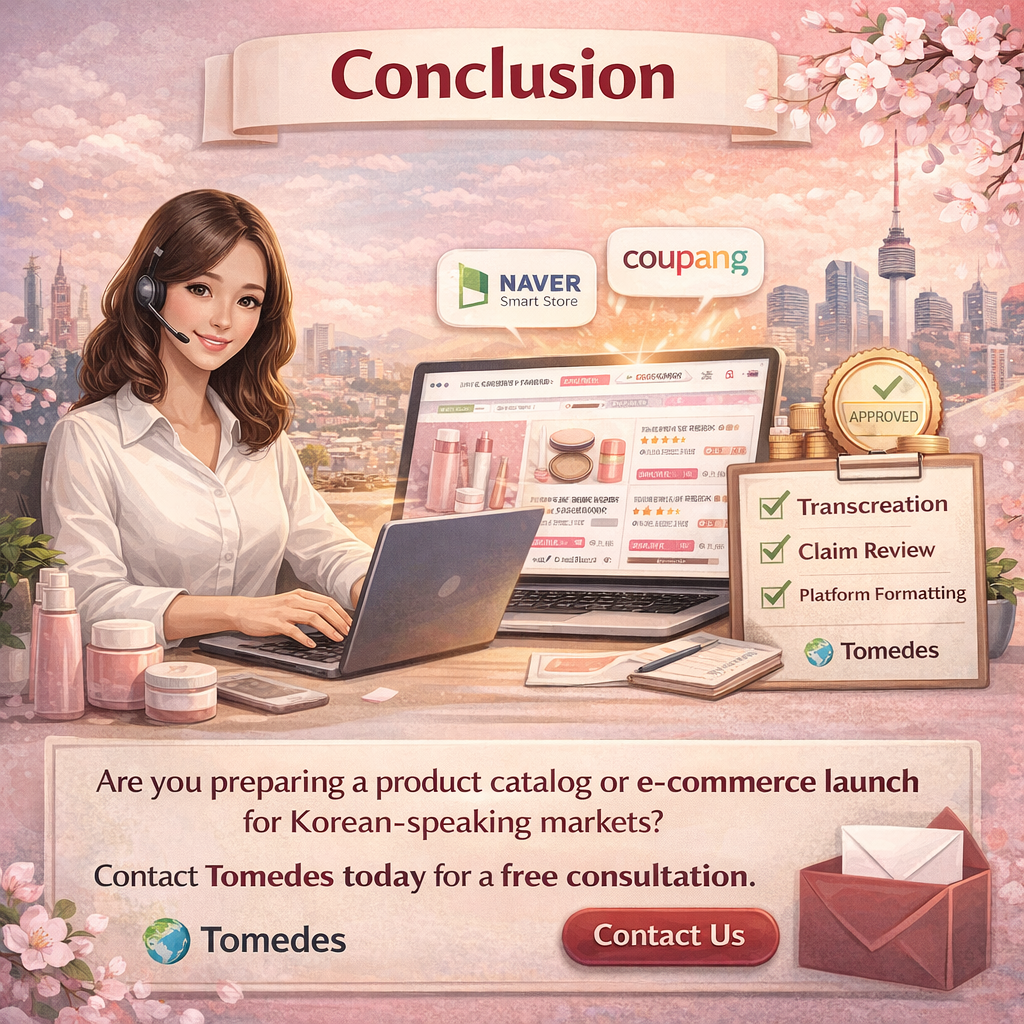
Are you preparing a product catalog or e-commerce launch for Korean-speaking markets? Contact Tomedes today for a free consultation.
Key Details
Document type | Product catalog — titles, benefit claims, ingredient callouts, usage instructions, storefront copy |
Language pair | English → Korean |
Industry | Beauty / Personal Care / E-commerce |
Service type | Transcreation + localization |
Scope | 38 SKUs, 11,000+ words, dual-platform formatting |
Turnaround | 14 business days |
Certification | ISO 17100:2015 |
Tools used | Consistency Checker, brand glossary |
Why choose us

24/7 Human Support

1 Year Guarantee

120,000 Business Customers
© Copyright 2007-2026 TOMEDES. All Rights Reserved.

