 Add text to get the translation that 22 AI models agree on

Available Online 24/7
1-Year Guarantee
120,000 Business Customers
Tomedes Ensures Japanese Patients Understand What They Are Agreeing To
See how Tomedes translated a Phase II oncology clinical trial informed consent form from English into Japanese — meeting PMDA regulatory language requirements, ICH E6(R2) standards, and patient comprehension guidelines.

Trusted by
Satisfied clients worldwide


In a clinical trial, informed consent is not a formality. It is the patient's right to understand every risk before saying yes.
March 11, 2026The Client
Company name: Verilon Therapeutics (pseudonym)
What does the company do? A mid-sized U.S. biopharmaceutical firm conducting global Phase III clinical trials for a novel oncology treatment.
Deadline: 12 business days
What do they need? Verilon Therapeutics required certified Japanese translations of their full informed consent form (ICF) package – including the main consent document, patient information leaflets, and a lay summary of clinical risks. The materials were intended for submission to Japan's Pharmaceuticals and Medical Devices Agency (PMDA) and for distribution to trial sites across three Japanese prefectures. Regulatory approval of the translation was on the critical path for the trial's Japan launch date.
The Challenges
Pharmaceutical translation for regulatory submission is one of the most demanding content categories in the language services industry. For this project, Verilon faced three challenges that ruled out any standard translation workflow.
First, dual-audience clarity in a single document
Informed consent forms must simultaneously satisfy two opposing readability standards. Regulatory bodies require precise clinical language – specific adverse event terminology, exact pharmacological descriptions, and protocol-accurate treatment descriptions. At the same time, ICFs must be written in plain language that a patient with no medical background can fully understand before signing. In Japanese, this tension is compounded by the language's register system: clinical terminology and patient-facing language draw from different vocabulary sets, and a document that reads as credible to a PMDA reviewer may be unintelligible to a trial participant in Osaka. Verilon needed translators who could hold both registers simultaneously.
Second, PMDA-specific formatting and terminology requirements
Japan's PMDA maintains strict requirements for how consent documents are structured and worded. Certain disclosures must appear in a prescribed order, specific terms carry mandated translations under Japanese pharmaceutical law (the rendering of "adverse event" versus "side effect," for instance, is not interchangeable in a regulatory context) and document formatting must match submission templates. Any deviation, even a structural inconsistency, can result in a revision request that delays trial authorization by weeks.
Lastly, the back-translation requirement for clinical validation
Verilon's clinical operations team required a certified back-translation of the Japanese ICF into English as a quality validation step – standard practice in global clinical trial management to confirm that translated consent language accurately reflects the original intent. This added a second, independent translation pass that had to be completed within the same 12-business-day window, without the two translators communicating with each other, to preserve the integrity of the back-translation process.
Why Tomedes?
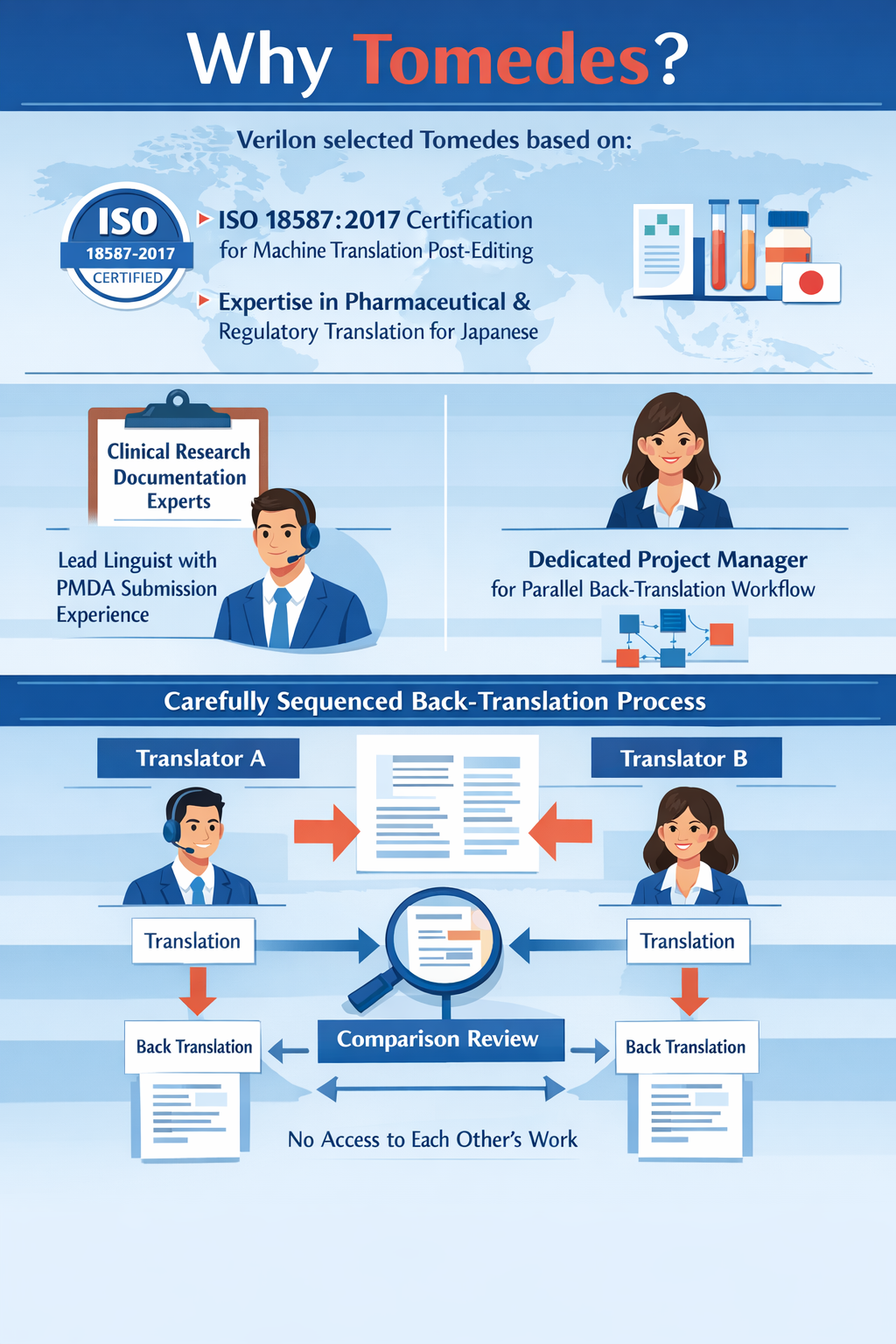
Verilon selected Tomedes based on its ISO 18587:2017 certification for machine translation post-editing and its demonstrated experience in pharmaceutical and regulatory translation for Japanese. The project required translators with documented backgrounds in clinical research documentation (not general medical translators) and Tomedes was able to assign a lead linguist with prior PMDA submission experience.
Tomedes also offered a dedicated project manager to coordinate the parallel back-translation workflow, which required careful sequencing to ensure neither translator had access to the other's work prior to the comparison review.
The Solution
First, a two-translator assignment with back-translation protocol
Tomedes assigned two independent Japanese linguists to the project: a primary translator with a background in pharmaceutical regulatory affairs, and a second translator for the back-translation pass. The primary translator worked from a Key Terms Glossary pre-approved by Verilon's clinical team that standardized translations for 47 critical terms – including adverse event classifications, protocol-specific treatment names, and regulatory disclosure language. The back-translator received only the Japanese output, with no access to the English source, and produced an independent English rendering that was then reviewed side-by-side against the original.
Second, a pre-translation source text review
Before translation began, the project team ran the source documents through Tomedes' Source Text Checker to identify ambiguous segments, inconsistent terminology, and sentences that would be difficult to render in plain Japanese without clarification. Seven segments were flagged and returned to Verilon's clinical team for clarification before translation started – a step that prevented mid-project revision cycles that would have jeopardized the deadline.
Lastly, a PMDA-aligned formatting and compliance review
Following the translation and back-translation comparison, a bilingual compliance reviewer confirmed that the Japanese document structure matched PMDA submission requirements: section order, mandatory disclosure language, and terminology alignment with current Japanese pharmaceutical regulatory guidance. The final package delivered to Verilon included the certified Japanese ICF, the back-translation report, a terminology concordance table, and a signed ISO 17100:2015 certificate of translation accuracy.
Conclusion
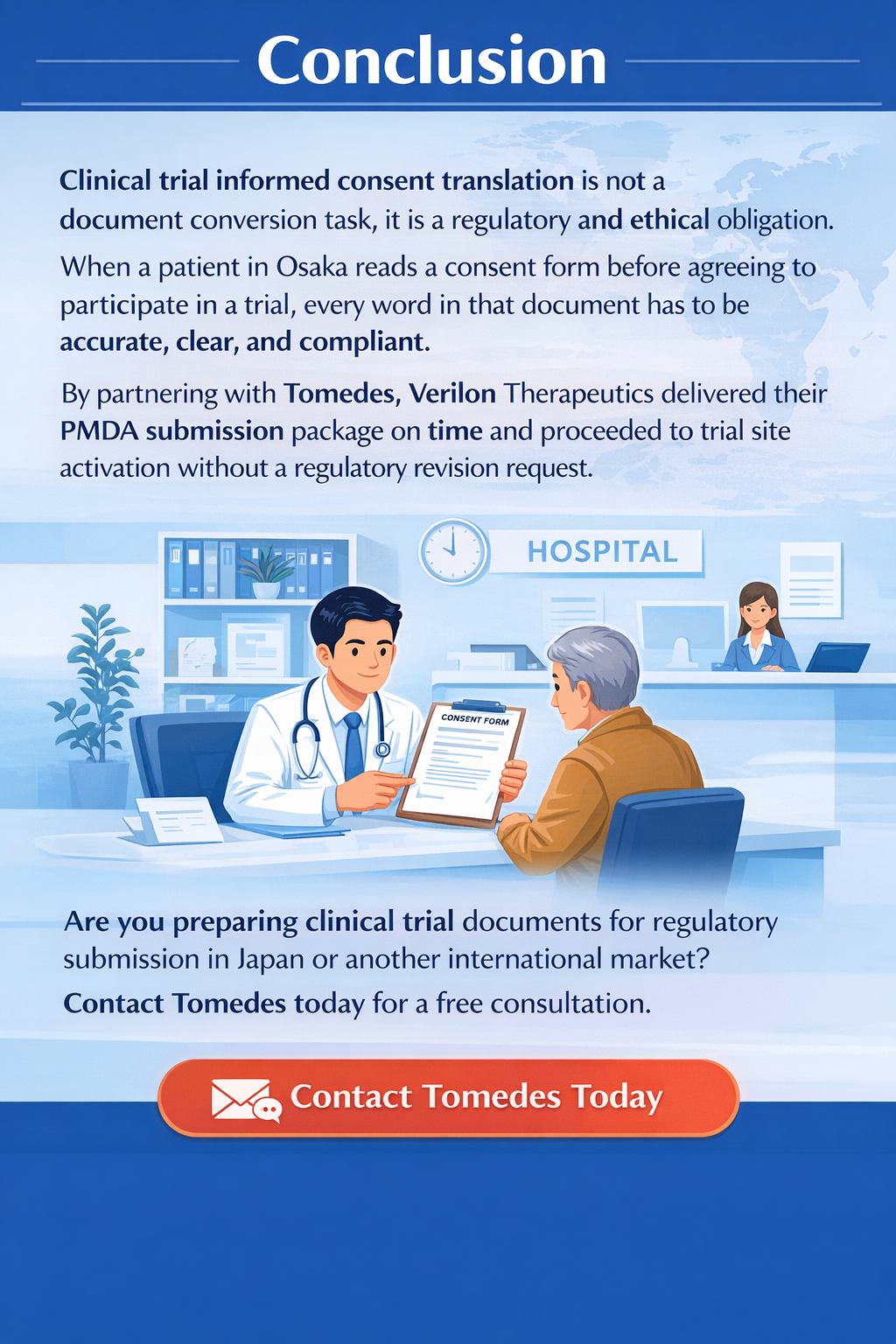
Clinical trial informed consent translation is not a document conversion task, it is a regulatory and ethical obligation. When a patient in Osaka reads a consent form before agreeing to participate in a trial, every word in that document has to be accurate, clear, and compliant. By partnering with Tomedes, Verilon Therapeutics delivered their PMDA submission package on time and proceeded to trial site activation without a regulatory revision request.
Are you preparing clinical trial documents for regulatory submission in Japan or another international market? Contact Tomedes today for a free consultation.
Key Details
Document type | Informed Consent Form (ICF) package — main consent, patient information leaflets, lay summary |
Language pair | English → Japanese |
Industry | Pharmaceutical / Clinical Research |
Service type | Certified human translation + back-translation |
Word count | 18,000 words (source) |
Turnaround | 12 business days |
Certification | ISO 17100:2015, ISO 18587:2017 |
Tools used | Source Text Checker, Key Terms Glossary |
Why choose us

24/7 Human Support

1 Year Guarantee

120,000 Business Customers
© Copyright 2007-2026 TOMEDES. All Rights Reserved.

