 Add text to get the translation that 22 AI models agree on


When does AI interpreting still need a human in the room?
A multilingual event used to mean booths, consoles, receivers, and a pair of interpreters per language. AI interpreting vendors now sell the same event with none of that. Attendees scan a code and listen on their own phones, and nobody books a booth.
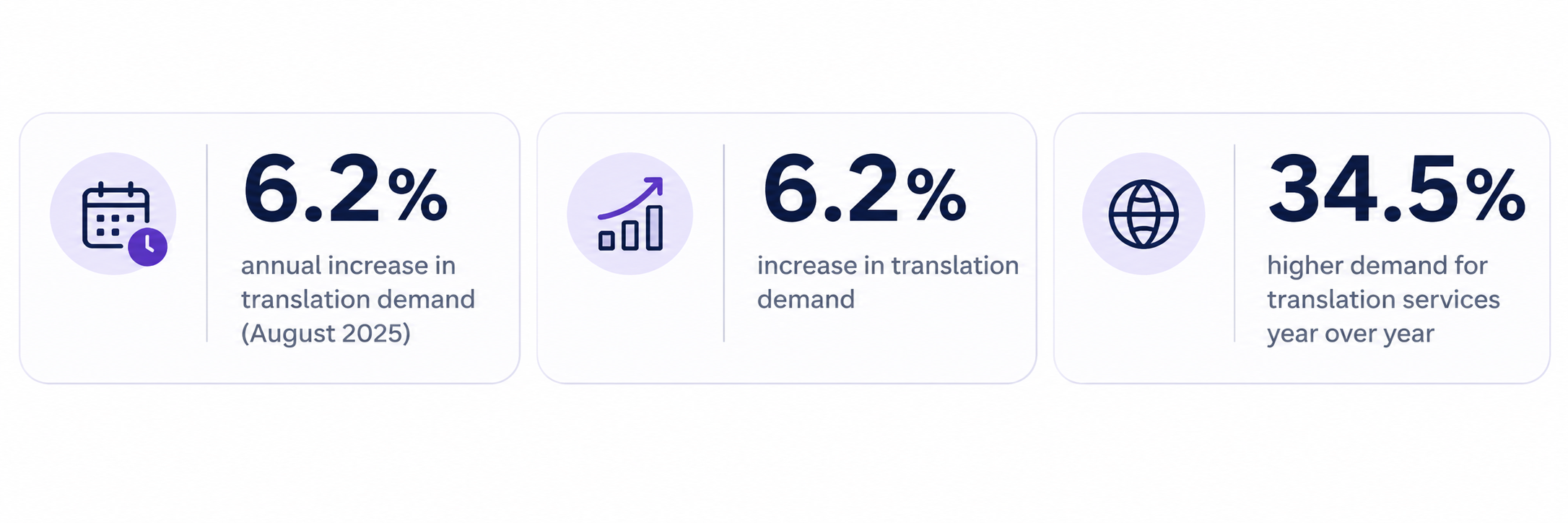
My stance is that the logistics pitch is true and incomplete. In a survey of 113 language access, operations, and clinical professionals released in November 2026, only 6.2% of organizations were using AI-assisted interpretation, and 34.5% had no formal process to evaluate multilingual communication quality.
The same logistics are available with human interpreters working remotely, so the booth is not what separates AI interpreting from a person.
This article covers what the AI interpreting pitch promises, why buyers hesitate, and how to tell when an event still needs a human in the room.
Key takeaways
- At least eight AI event-interpretation vendors use the same tagline, "no booths, no receivers," so the pitch is logistics.
- As of August 2026, 6.2% of organizations in LanguageLine's survey used AI-assisted interpretation and another 6.2% were piloting, while 34.5% had no formal process to evaluate multilingual communication quality.
- Remote simultaneous interpretation with human interpreters also removes booths and receivers, so logistics alone do not decide between AI interpreting and a person.
- An event needs a human in the room when an error costs more than the equipment saved, which covers legal, medical, financial, and regulatory sessions and unscripted plenaries.
- Before choosing AI interpreting, ask who monitors quality, what the human escalation path is, and who is accountable if it fails.
What does AI interpreting promise buyers?
It promises live interpretation on attendees' own phones, with no booths, no receivers, and no interpreter booked per language. The tagline "no booths, no receivers" appears on the websites of at least eight AI event-interpretation vendors.
I note that every one of those pages sells logistics. The pitch is that adding a language becomes a setting, with no extra interpreter team to book.
The vendors' own material names the conditions. One equipment guide lists reliable wifi as the only real requirement and warns that some older attendees are less comfortable listening on phones.
How many organizations use AI interpreting?
Few do, according to one survey. As of August 2026, 6.2% of the organizations in LanguageLine's survey of 113 professionals were using AI-assisted interpretation, and another 6.2% were piloting it, so most were still preparing for AI interpreting and had not yet adopted it.
The same survey found that 94.7% of respondents called consistent quality monitoring important, and that many organizations rely on anecdotal feedback to find problems after they occur.
I treat a vendor-run survey as a signal. The sample is 113 professionals drawn from language access, operations, customer experience, clinical, and technology roles, and LanguageLine sells both human and AI-assisted interpretation.
Why do buyers hesitate to rely on AI interpreting?
They cannot yet check it. In LanguageLine's survey, 71.7% named interpreter quality a top concern, nearly one-third were not fully confident they could ensure quality, safety, and compliance across multilingual interactions, and 34.5% had no formal evaluation process.
LanguageLine's chief executive framed the buyer's question as whether AI interpreting can be trusted in a specific environment with crosstalk, industry terminology, and emotion, and said that risk and liability rise with the complexity of the conversation.
Nimdzi's 2026 report describes the same instinct in written translation, where buyers who sent content once marked not for machine translation through raw AI output met quality failures and returned to providers for expert-in-the-loop validation.
A person in the room can ask a speaker to repeat a figure, flag a term with no equivalent, and say when a sentence did not land. Those interventions are what a buyer gives up when the pitch is only about equipment.
Where I part ways with the pitch is that it prices the booth and leaves out the check.
When does an event still need a human in the room?
An event needs a human interpreter in the room when an error costs more than the equipment saved. That covers legal, medical, financial, and regulatory sessions, plenaries with unscripted exchanges, and any meeting where someone must answer for the interpretation, whatever the delivery format.
Tomedes recommends booth-based simultaneous interpretation for plenaries and large audiences, and its simultaneous teams work in pairs that rotate at regular intervals to keep accuracy and consistency.
My rule of thumb is to ask what an error costs, how hard the setting is for a machine, and who is accountable. The setting is hard when there is crosstalk, specialist terminology, accents, or emotion.
AI interpreting can fit sessions where access matters more than precision, such as an internal all-hands or a webinar where the alternative is no interpretation at all. For those, live captions and a transcript are better than silence, and an occasional error is cheap. The mistake is to make the same choice for the board meeting.
The vendors point the same way. One comparison table lists a hybrid option with a booth for the staffed languages only, and other vendors sell AI interpreting with a human fallback.
Do you need AI interpreting to skip the booths and receivers?
No, because remote simultaneous interpretation with human interpreters also removes booths and receivers. Tomedes provides remote simultaneous interpretation that integrates with platforms such as Zoom and Microsoft Teams, and a secure cloud platform lets participants select their language channel.
The booth is a delivery choice, and the interpreter is a quality choice. Remote delivery with human interpreters keeps the second and drops the first.
To be fair to AI interpreting, it does remove lead time. Vendors advertise setup in minutes, while human interpreters are booked in advance. For an event planned weeks ahead, lead time is rarely the constraint, and for a same-day request it can be.
I add one caution. Remote delivery still needs a clean audio feed and a stable connection, and for large plenaries Tomedes recommends booth-based simultaneous interpretation.
What should a buyer ask before choosing AI interpreting?
Ask four things in writing, which are what an error costs in each session, who monitors the accuracy and how, what the human escalation path is, and who is accountable if the interpretation fails. A vendor that answers all four has a workflow.
- Rate the cost of an interpreting error for each session.
- Ask the AI interpreting vendor who monitors accuracy and how.
- Ask for a human escalation path for the sessions that matter.
- Decide who is accountable for the interpretation if it fails.
One point in the AI platforms' favor is the record. Many produce a live transcript, which makes after-the-fact review possible. A human interpreting session leaves no such record unless it is recorded.
For sessions that rate high on the first question, Tomedes' simultaneous interpreting and Zoom interpreting cover on-site and remote delivery, and the guide to simultaneous interpretation explains how the formats differ.
Mine is a simple test. If an error would cost more than the booth, book the human.
FAQs
Q: Can ChatGPT translate a live conversation?
A: Yes, for informal one-to-one conversations. ChatGPT's Voice mode translates between two languages and keeps going until you tell it to stop. A live event or meeting adds several speakers, terminology, and accountability, and most organizations in LanguageLine's survey lack formal processes to monitor that quality.
Q: What is the difference between a translator and an interpreter?
A: A translator works with written text and can revise it before delivery. An interpreter works with spoken language as it happens, so a mistake is heard once and cannot be revised. Tomedes provides both, and the two are booked, scheduled, and checked differently.
Q: What is AI interpreting's biggest weakness?
A: In interpreting, the weakness buyers name is trust, meaning whether AI interpreting holds up under crosstalk, industry terminology, and emotion in their own setting. In LanguageLine's survey, 71.7% named interpreter quality a top concern, and 34.5% had no formal process to evaluate multilingual communication quality.

Written by Ofer Tirosh
Connect on LinkedInOfer founded Tomedes in 2007 and now leads the company's push to combine two decades of human translation expertise with AI. He writes about where the language industry is actually heading and the shifts nobody's ready for, the bets that paid off, and the ones that didn't.
Share:

Post your Comment