 Add text to get the translation that 22 AI models agree on


How Tomedes supports a healthcare organization with recurring multilingual document translation
A healthcare organization that serves many communities often needs documents translated into several languages at the same time, and the need keeps coming back. Each batch has its own due date.
I lead Client Solutions at Tomedes and have worked here for ten years. My view is that a recurring multilingual need is won on ownership more than on any single delivery, meaning one team that knows the account, the languages, and the formatting rules.
One client described the work we did in Tomedes through a verified review on Trustpilot in November 2026.
Key takeaways
- The customer described itself as a large healthcare organization serving diverse populations that often needs documents translated into multiple languages.
- In a public Trustpilot review, it praised quick responses, reasonable quotes, quality work, and a quick turnaround.
- The order record shows a long-running account with multi-language orders, including one recent order that covered many languages at once.
- Formatted documents are part of the work, because desktop publishing recurs on the account and its instructions ask for original formats to be kept.
What did the healthcare organization say about Tomedes?
A customer describing itself as a large healthcare organization serving diverse populations said it often needs documents translated into multiple languages. In a verified five-star review posted in November 2026, it said the team responds quickly, gives reasonable quotes, and delivers quality work with a quick turnaround.
The review is short and makes four claims, which are fast replies, reasonable quotes, quality work, and a quick turnaround. The order record can speak to some of them, and I take them one at a time below.
What the review says and what the order record shows
| The review says | What the order record shows |
|---|---|
| Often needs documents translated into multiple languages | Multi-language orders, including one recent order covering many languages |
| Very quick to respond | Not recorded. No email history for this account is in the data. |
| Provides reasonable quotes | Not covered here. This article does not discuss pricing. |
| Completes a quality job | A standing instruction on the account asks translators to review before sending |
| Quick turnaround | Recent orders were delivered by the due dates the customer set |
What does a recurring multilingual need look like?
On this account, it looks like repeat orders over a long period, often into several languages at once, with documents that have layouts to keep. One recent order covered many languages in a single job and was delivered by the customer’s due date.
In my view, a recurring need is a different job from a one-off. The account becomes a set of habits around languages and formats.
How are multi-language orders handled?
Each language on a multi-language order is handled as its own line, so languages can be tracked and delivered separately under one due date. The account’s standing instructions apply to every line, so the customer does not have to repeat them on each order.
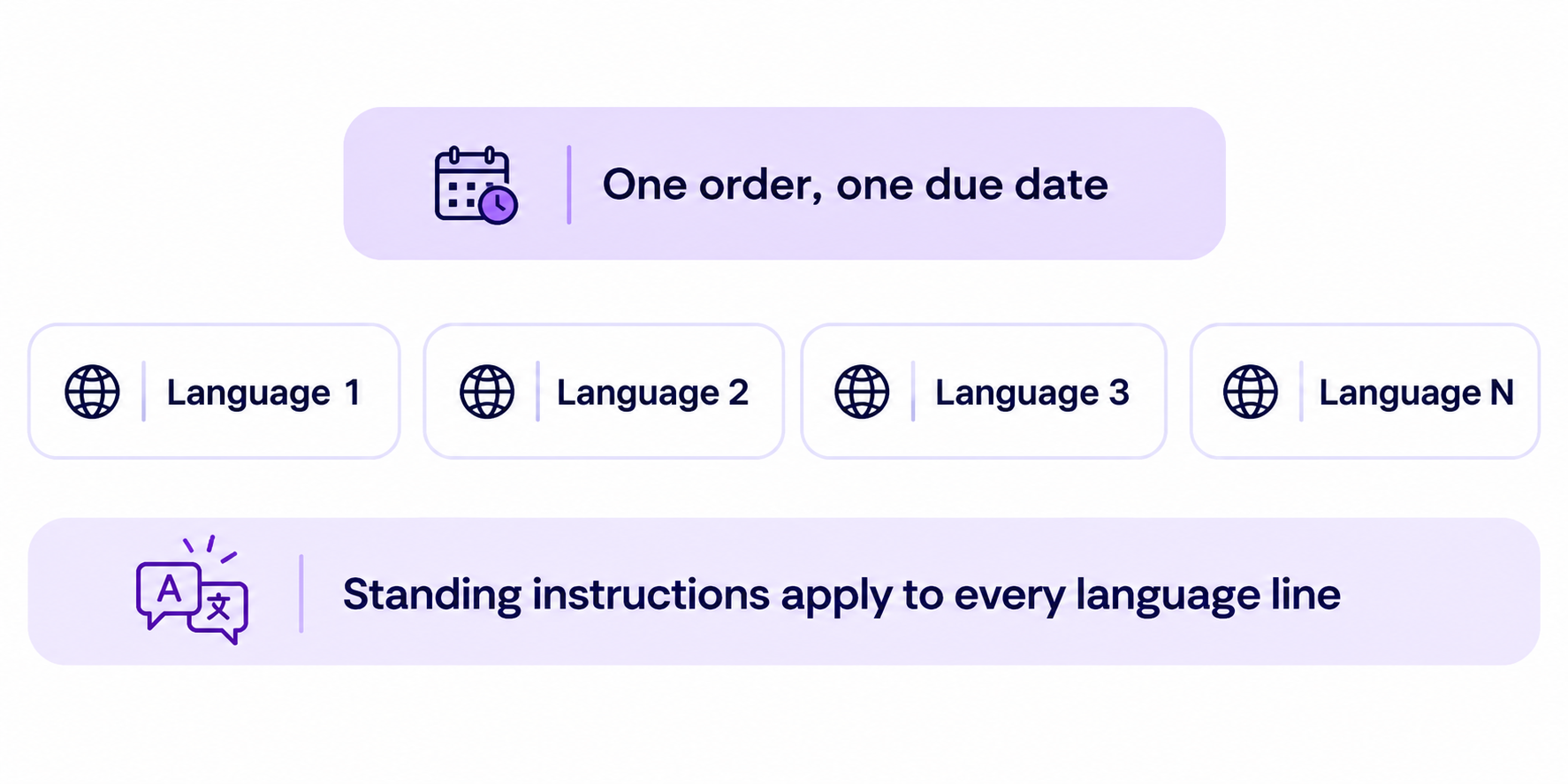
In my opinion, the standing instruction is what turns a series of orders into one account, because each new order starts from what the last one already settled. For the range of languages we cover, see our languages page.
How are formatted documents handled?
Desktop publishing recurs on this account, and its order instructions ask for the original format to be kept and for highlighted text to carry over. Formatted documents need layout work as well as translation, so the files go through both steps.
I think layout is where many first-time buyers get surprised, because a translation that no longer matches the original layout can be hard to use. Our guide to DTP translation services explains the step.
What role does human review play, and where does AI fit?
The account carries a standing instruction asking translators to review their work before sending it, and the order record labels the working method on recent orders as machine translation. It does not say what human review followed, so this article does not claim an AI and human workflow.
In my view, buyers in healthcare are right to ask where AI is used and who checks it, and the answer should name the step and the person. As of November 2026, Tomedes offers document translation, AI translation with human review, and interpretation, and our post on the hybrid translation workflow explains how the pieces fit.
What should a healthcare organization ask a translation vendor before ordering multilingual documents?
Ask how several languages are handled on one order, where your instructions and glossaries are kept, how layouts are preserved, where AI is used and who reviews it, and how sensitive documents are handled. The answers show whether the vendor can support a recurring need.
These are the six questions I would ask before the first order.
- How are several languages handled on one order, and can they be delivered separately?
- Where are my standing instructions and glossaries kept, so I do not repeat them on every order?
- How are layouts and formatting kept, and which file formats do you need from me?
- Where is AI used on my documents, and who reviews the output?
- How are confidential or sensitive documents handled, and who can access them?
- How are quotes and due dates confirmed, and who is my contact?
On my team, every customer-facing person owns the customer relationship from first contact through final delivery. For an account that keeps coming back, I think that ownership is what a repeat customer comes to rely on. For the subject itself, our medical translation guide is a good starting point.
If you have documents to translate into several languages, send the files, the languages, and the due date through the quote form.
FAQs
Q: Can one order cover several languages?
A: Yes, because a single Tomedes order can include several target languages, each handled as its own line so languages can be tracked and delivered separately. Share the full list of languages and the due date up front so the project manager can plan all lines together.
Q: Can a translated document keep the original layout?
A: Yes, because desktop publishing is available alongside translation, and customers can ask for the original format to be kept. Send editable source files where you can, and tell the project manager which parts, such as highlighted text, must carry over.
Q: What should I send to get a quote for several languages?
A: Send the documents, the full list of target languages, and the due date, and ask for one quote that covers all of them. The project manager can then plan the languages together and confirm the schedule with you before work starts.

Written by Emilyn Sinamban
Connect on LinkedInEmilyn leads Tomedes' global Client Solutions department, built around one idea: every client relationship should have a single owner from first contact to final delivery. She writes about what clients actually tell her they worry about such as data security, deadlines, and the guesswork she's spent a career trying to remove.
Share:

Post your Comment